I Make Good Money but I’m Always Broke: Where It Actually Goes
You have a decent job. Your salary sounds like enough. You’re not buying designer bags or taking big trips. And yet, a few days before payday, your checking account is down to a few hundred dollars again.
Make good money but still broke by payday? You’re not bad with money, and you’re definitely not alone. Usually there’s no single big mistake. It’s dozens of reasonable choices that quietly add up to everything you earn.
Here’s where a good paycheck actually goes, line by line, and a simple plan to keep more of it without giving up everything you enjoy.

See where your paycheck goes, and what’s safe to spend
Grab the free Budget by Paycheck Starter. Type in your numbers and it shows your “Money Left to Spend” instantly — no complicated setup.
- See your safe-to-spend number the moment you fill it in
- Built for weekly & biweekly paychecks
- Works in Google Sheets and Excel, on any device
Free forever. No spam. Unsubscribe anytime.
You’re Not Alone, Even on a Six-Figure Income
This happens at every income level. In a 2025 NerdWallet survey, 48% of Americans said they live paycheck to paycheck, including 38% of people with household incomes of $100,000 or more.
To be fair, “paycheck to paycheck” means different things to different people. Some people who say it are still saving every month. But if your money runs out before payday and nothing is growing, it’s worth a closer look. The good news is that on a good income, the fix is usually about direction, not deprivation.
Where a Good Paycheck Actually Goes
Let’s follow a real-looking example. This is an example, not anyone’s actual budget.
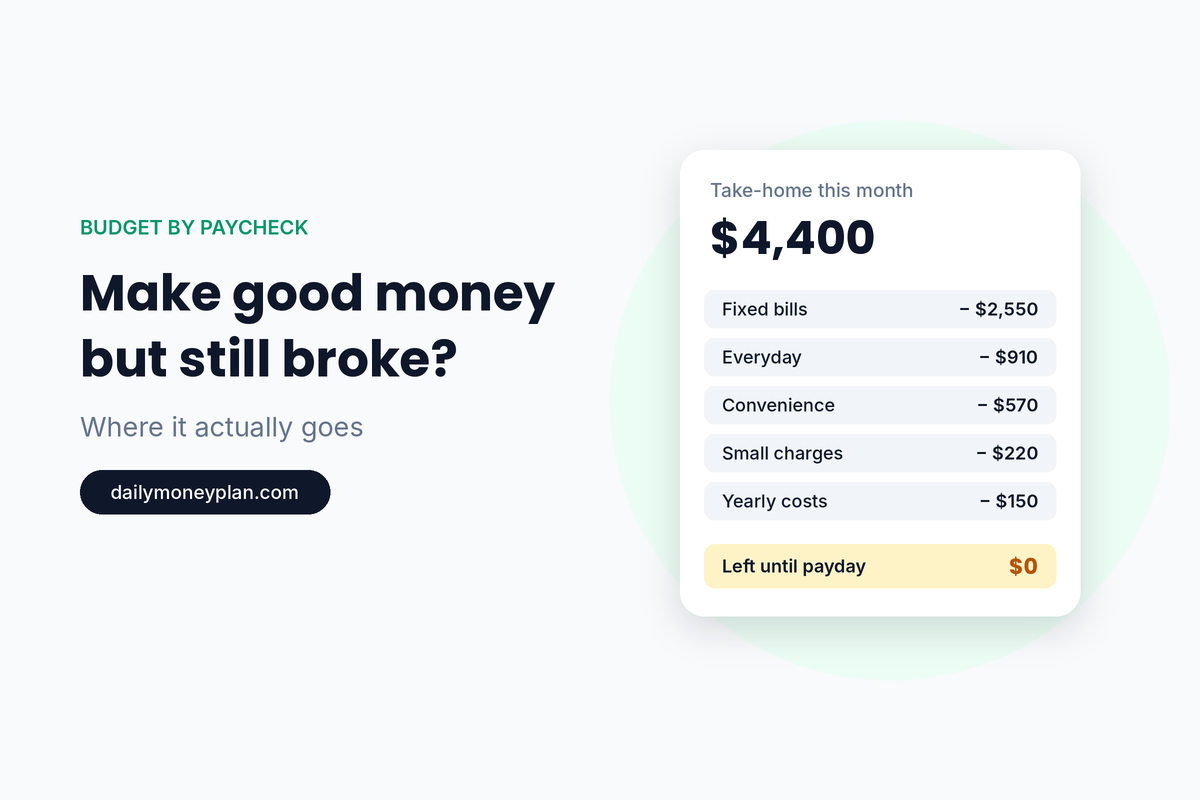
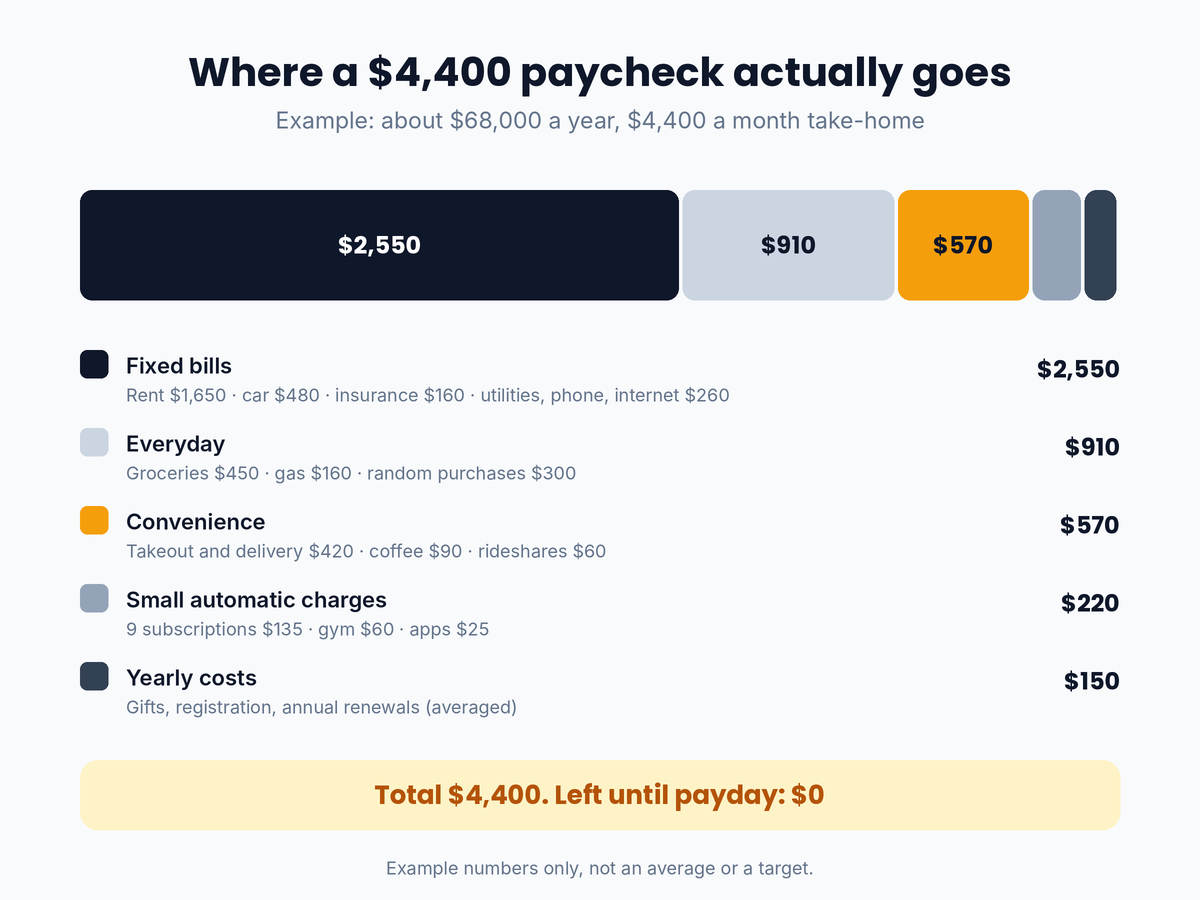
Meet Alex. Alex earns about $68,000 a year and takes home about $4,400 a month after taxes and benefits. No kids, no credit card debt, just a car payment. Here’s where it goes:
Fixed bills: $2,550
- Rent: $1,650
- Car payment: $480
- Car insurance: $160
- Utilities, phone, and internet: $260
Small automatic charges: $220
- Nine streaming and app subscriptions: $135
- Gym: $60
- Cloud storage and apps: $25
Convenience spending: $570
- Takeout and delivery: $420
- Coffee out: $90
- Rideshares: $60
Everyday spending: $910
- Groceries: $450
- Gas: $160
- “Random” online and store purchases: $300
Yearly costs that land this month: $150
- A wedding gift, car registration, and an annual subscription (about $150 a month, averaged over the year)
Total: $4,400. Left over: $0.
Nothing on that list is wild. There’s no shopping spree and no luxury car. But together, it’s every dollar Alex earns. Housing and transportation alone take more than half, which is normal. Government data shows housing and transportation made up about 50% of household spending in 2024.
Make Good Money but Still Broke? 6 Reasons Why
1. Your fixed costs grew with your income
When you get a raise, the apartment, the car, and the phone plan often get nicer too. Each upgrade feels earned. But fixed costs are hard to undo, and they lock in a bigger share of every paycheck.
2. Lifestyle creep took the raise
Lifestyle creep is when your spending rises to match your income, slowly enough that you don’t notice. A $5,000 raise can disappear into slightly nicer everything without one big decision.
3. Small automatic charges add up
Nine subscriptions at $15 each don’t feel like much. But $135 a month is over $1,600 a year, often for things you barely use.
4. You’re paying for convenience
A busy job means less time and energy. Delivery, takeout, and rideshares save time, but they cost a lot. In Alex’s example, convenience spending is $570 a month, more than the car payment.
5. Yearly costs feel like surprises
Car registration, gifts, travel, and annual renewals come up every year, but not every month. Without a plan, they hit whatever paycheck is closest.
6. Money with no plan gets spent
If money sits in checking with no job, it tends to get spent. Not because you’re careless, but because nothing told it where to go. That’s why a good income alone doesn’t build savings. A plan does.
How to Keep More of What You Earn
You don’t need to cut everything. On a good income, small changes in the right places free up real money.
Step 1: Find your real monthly take-home
Use what actually lands in your bank account, not your salary. If you’re paid every two weeks, multiply one paycheck by 26 and divide by 12.
Step 2: Look at the last 30 days
Open your bank and card statements and sort every purchase into five groups: fixed bills, small automatic charges, convenience, everyday spending, and yearly costs. It takes about 30 minutes, and it’s usually eye-opening.
Step 3: Pick your three biggest leaks
Don’t try to fix everything. Find the three categories where cutting back would hurt the least. For most people, it’s subscriptions, takeout, and “random” purchases.
Step 4: Pay yourself first
On payday, move a set amount to savings automatically before you spend anything. Even $100 a paycheck counts. Money you never see in checking is money you don’t miss.
Step 5: Set a safe-to-spend number
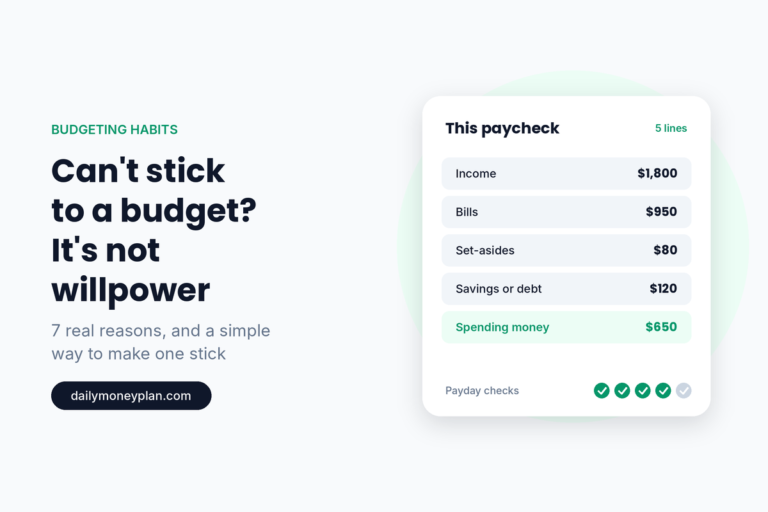
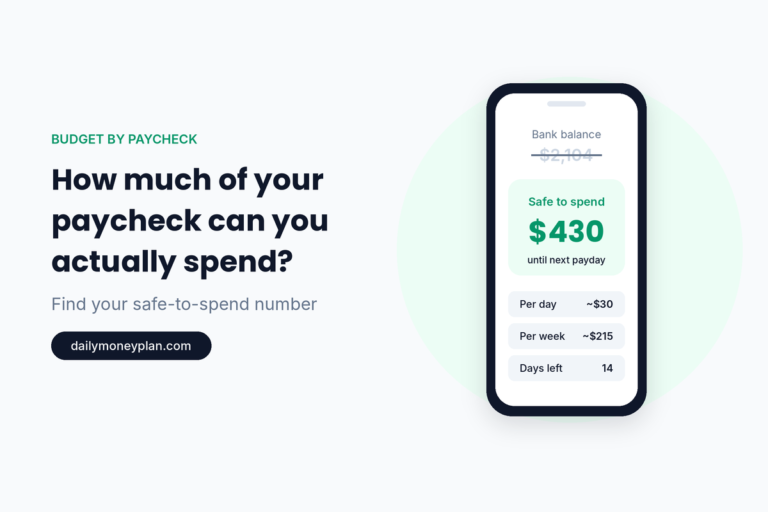
After bills and savings, how much can you spend until the next paycheck? Knowing that one number ends the guessing. Here’s how much of your paycheck you can actually spend, step by step.
Step 6: Plan for the yearly costs
Add up the costs that come once or twice a year and set aside a little from each paycheck. Then a wedding gift or car registration is already paid for when it shows up.
Find your safe-to-spend number for your next paycheck
Grab the free Budget by Paycheck Starter — type in your numbers and it shows your “money left to spend” automatically.
Free forever. No spam. Unsubscribe anytime.
What Alex’s Month Looks Like After
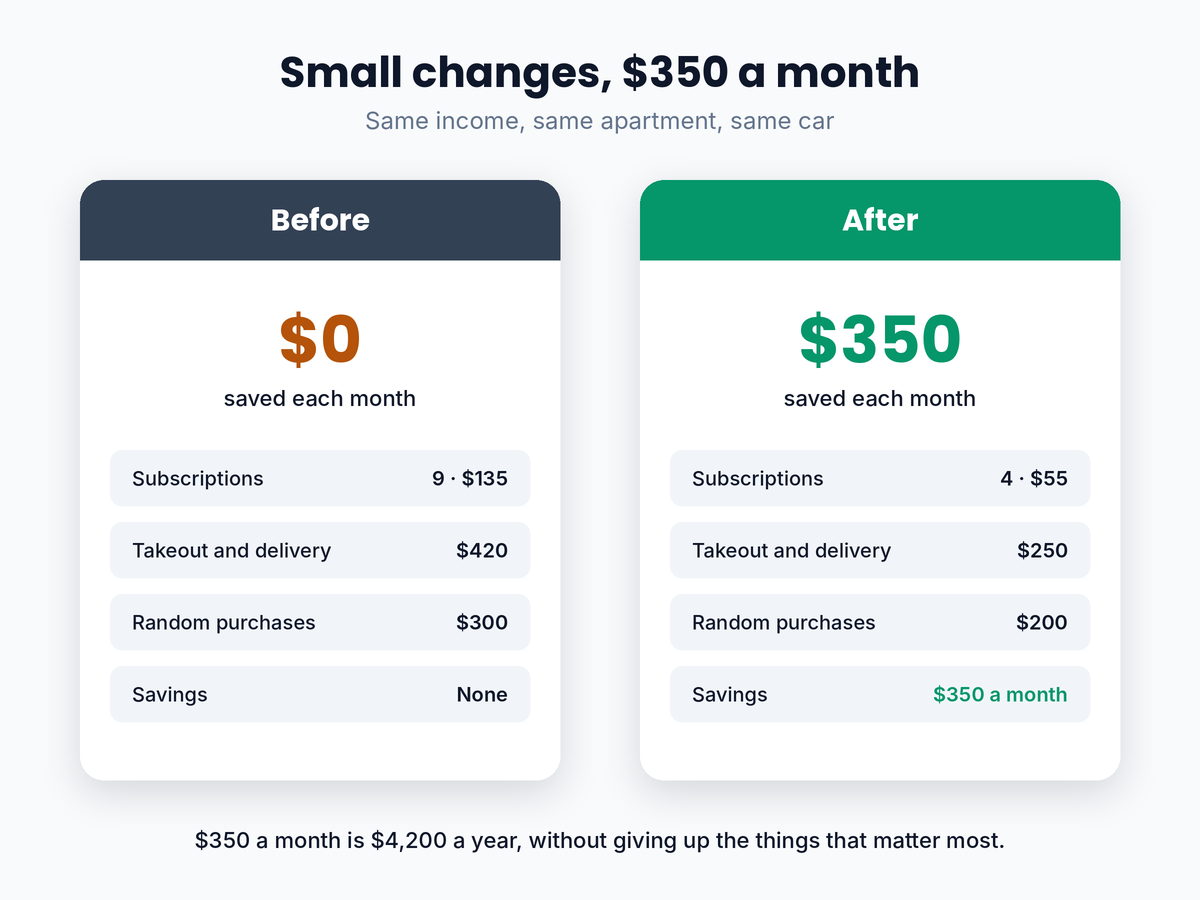
Alex keeps the apartment, the car, and the gym. The changes are small:
- Subscriptions: cancels five of nine and keeps four favorites. Saves $80.
- Takeout and delivery: from about four times a week to about two. Saves $170.
- Random purchases: a 24-hour pause before buying anything over $50. Saves $100.
That’s $350 a month, or $4,200 a year, without giving up anything Alex really cares about. Alex sets up an automatic $175 transfer to savings on each payday (two paychecks a month) and still has a clear safe-to-spend number.
FAQ
Why do I make good money but still feel broke?
Usually it’s lots of reasonable choices adding up, not one big mistake. Higher fixed costs, small automatic charges, convenience spending, and money without a plan can use up a good income completely.
Is it normal to live paycheck to paycheck on $100,000?
It’s common. In a 2025 NerdWallet survey, 38% of people with household incomes of $100,000 or more said they live paycheck to paycheck. Common doesn’t mean you’re stuck, though. A higher income gives you more room to change things.
What is lifestyle creep?
It’s when your spending rises as your income rises, slowly enough that you don’t notice. It’s why many people feel no richer after a raise.
How do I find out where my money goes?
Look at your last 30 days of bank and card statements and sort every purchase into a few simple groups. Seeing the totals side by side shows your biggest leaks quickly.
How much should I have left after bills?
There’s no single right number. A common starting point is the 50/30/20 idea: about half for needs, 30% for wants, and 20% for savings and extra debt payments. Treat it as a loose guide, not a rule.
A Good Income Needs a Plan Too
Making good money and still feeling broke is frustrating, but it’s one of the most fixable money problems there is. You don’t need to earn more. You need to see where it goes and give it a plan.
Start with the last 30 days. Find three leaks, move a little to savings on payday, and set your safe-to-spend number. If you’re always broke before payday no matter what you earn, here’s more on why you’re always broke before payday. And for the complete system, here’s how to budget by paycheck.
Give your next paycheck a plan, free
Grab the free Budget by Paycheck Starter. Type in your numbers and it shows your “Money Left to Spend” instantly — no complicated setup.
- See your safe-to-spend number the moment you fill it in
- Built for weekly & biweekly paychecks
- Works in Google Sheets and Excel, on any device
Free forever. No spam. Unsubscribe anytime.
This article is for general education only and isn’t personalized financial advice. Everyone’s situation is different, so adjust these ideas to fit yours.