How Much of Your Paycheck Can You Actually Spend?
You’re standing in line with something in your hand, and you open your banking app. There’s money in there. But is it really yours to spend, or does half of it belong to rent next week?
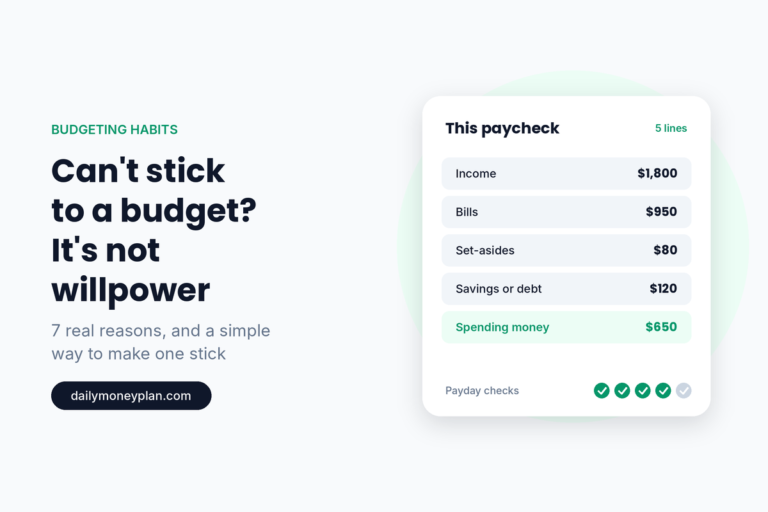
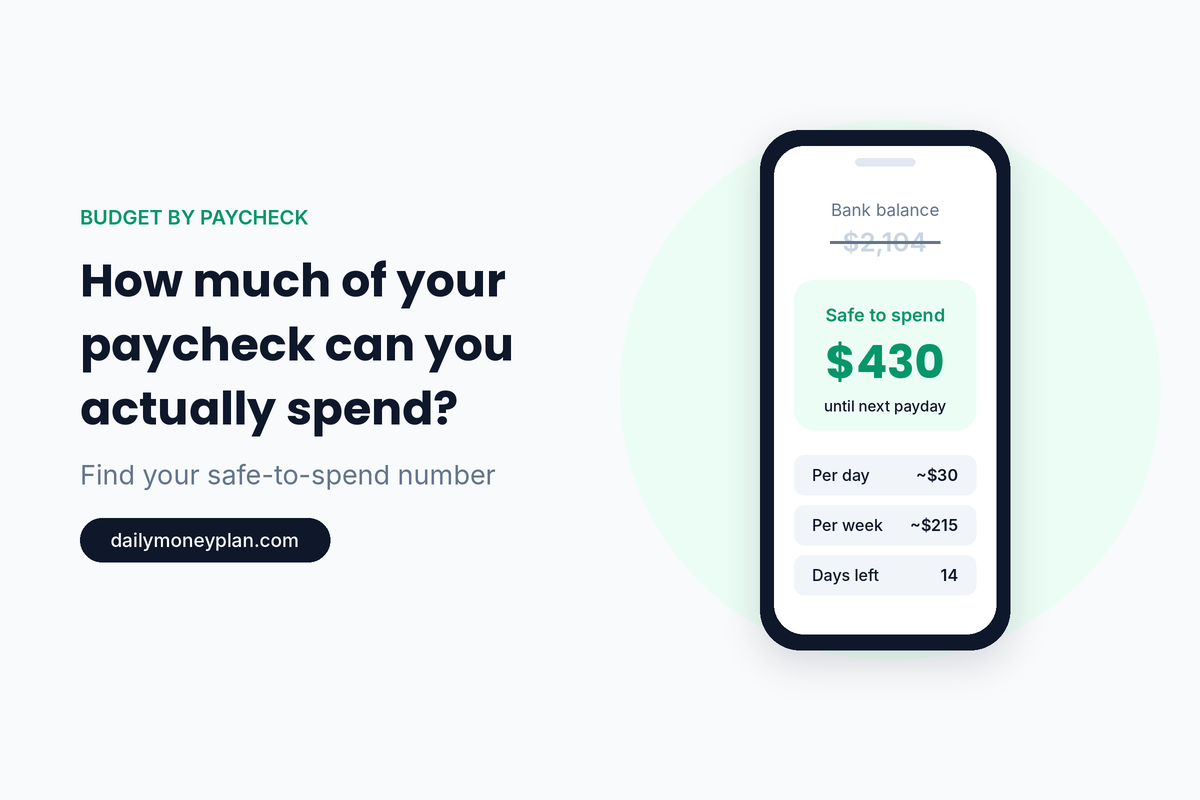
The answer isn’t your bank balance. Your safe-to-spend number is what’s left from your paycheck after the bills due before your next payday, a small set-aside for yearly costs, your savings, and essentials like groceries and gas. For example, a $2,100 paycheck might leave $430 to spend over two weeks, or about $30 a day.
Here’s how to find your number for every paycheck, turn it into a daily amount, and use it without second-guessing every purchase.

Get your safe-to-spend number without the math
Grab the free Budget by Paycheck Starter. Type in your numbers and it shows your “Money Left to Spend” instantly — no complicated setup.
- See your safe-to-spend number the moment you fill it in
- Built for weekly & biweekly paychecks
- Works in Google Sheets and Excel, on any device
Free forever. No spam. Unsubscribe anytime.
How Much Can I Spend After Bills? The Short Answer
Your safe-to-spend number is what’s left from a paycheck after everything that has to be covered before your next one:
Safe to spend = paycheck − bills − yearly-cost set-aside − savings − essentials
Essentials are the everyday must-haves for the pay period, like groceries and gas. Whatever is left is yours to spend on anything, guilt-free, until the next payday.
Why Your Bank Balance Isn’t Your Spending Money
Your bank balance shows what’s in the account right now. It doesn’t show what’s already promised.
- Bills that haven’t hit yet. Rent, the car payment, and autopays due before your next paycheck are still sitting in your balance.
- Pending charges. Some purchases take a day or two to show up fully.
- Yearly costs. Car registration, gifts, and annual renewals aren’t due today, but they’re coming.
- Your own savings goal. If you planned to save but haven’t moved the money yet, it looks spendable.
That’s why a “healthy” balance can still leave you broke a week later. The safe-to-spend number takes all of that out first.
How to Find Your Safe-to-Spend Number
Do this once per paycheck. It takes about 10 minutes, and less once you’ve done it a few times.
Step 1: Start with this paycheck
Use your take-home pay, the amount that actually landed in your bank account. Not your salary, and not next paycheck’s money.
Step 2: Subtract the bills this paycheck covers
Either take out every bill due before your next payday, or, if you split bills evenly, take out this paycheck’s share (half your monthly bills if you’re paid every two weeks). If you’re not sure which approach fits you, here’s how to budget when you get paid every two weeks.
Step 3: Set aside a little for yearly costs
Add up the costs that come once or twice a year: car registration, gifts, annual subscriptions, back to school. Divide by the number of paychecks in a year (26 for every two weeks, 24 for twice a month). Set that amount aside every time.
Step 4: Pay your savings first
Decide on a savings amount, even a small one, and treat it like a bill. Move it on payday so it’s out of sight.
Step 5: Plan your essentials for this pay period
Groceries, gas, and other everyday must-haves for the days until your next paycheck. Look at what you usually spend in a two-week stretch, and round up a little.
Step 6: What’s left is your safe-to-spend number
That’s it. This is the money for takeout, a new shirt, a night out, or anything else. If it’s spent, it’s spent, and your bills are still covered.
A Real Example: Maya’s Paycheck
Here’s what that looks like with real-looking numbers. This is an example, not a target.
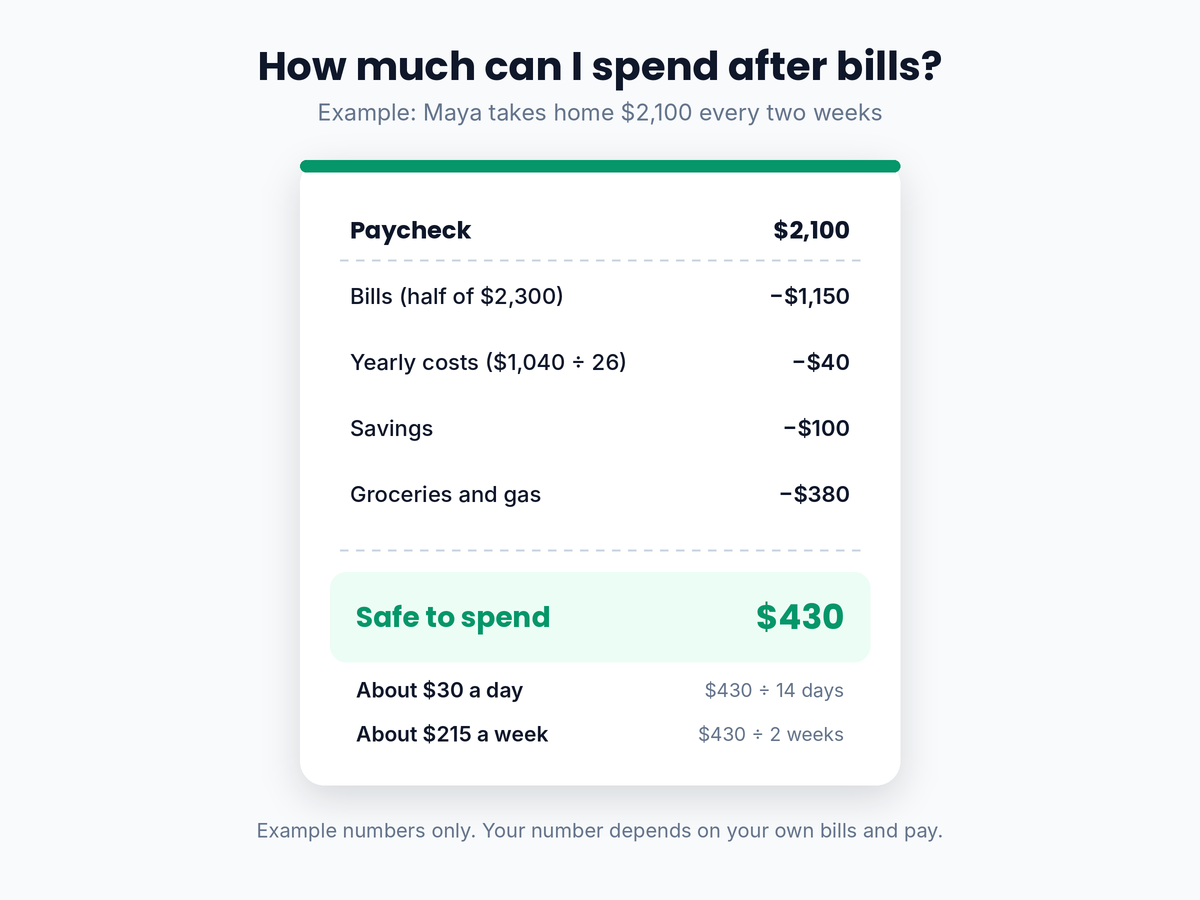
Maya takes home $2,100 every two weeks. Her monthly bills add up to $2,300, so each paycheck covers half: $1,150. Her yearly costs come to about $1,040, which is $40 per paycheck.
- Paycheck: $2,100
- Bill share (half of $2,300): −$1,150
- Yearly-cost set-aside ($1,040 ÷ 26): −$40
- Savings: −$100
- Groceries and gas for two weeks: −$380
- Safe to spend: $430
Maya’s bank account might show over $2,000 right after payday. But the real number she can spend on anything is $430 for the next two weeks.
Turn It Into a Daily or Weekly Number
A two-week number is useful. A daily number is easier to use in the moment.
Daily number = safe to spend ÷ days until your next payday
For Maya, that’s $430 ÷ 14 days = about $30 a day, or about $215 a week.
Here’s how to use it:
- It’s an average, not a limit. Spend $10 today and you have more room tomorrow. Spend $60 on a dinner out and plan a few quieter days.
- Check it once a week. Look at what you’ve spent so far and what’s left. Divide what’s left by the days remaining. That’s your new daily number.
- Paid on the 1st and 15th? Your pay periods aren’t all 14 days. The stretch from the 15th to the 1st can be 16 or 17 days, so divide by the real number of days.
The free Budget by Paycheck Starter does this math for you. It shows your money left to spend and the days left in your pay period, so you can see your number at a glance.
See your money left to spend and days left, free
Grab the free Budget by Paycheck Starter — type in your numbers and it shows your “money left to spend” automatically.
Free forever. No spam. Unsubscribe anytime.
What If Your Number Is Negative?
A negative number isn’t a failure. It’s information. It means this paycheck can’t cover everything on the list, and it’s better to know now than in the middle of the pay period.
Try these, in this order:
- Trim your essentials a little. A meal plan or one less grocery run can free up more than you’d think.
- Pause savings for one paycheck. It’s okay to skip it briefly when bills are tight. Restart next time.
- Cut or pause a bill. Subscriptions are the easiest to pause.
- Move a due date. Many companies will move a bill’s due date to after payday if you ask.
- Look at the bigger picture. If the number is negative most paychecks, the fix is usually lowering a big bill or adding income, not trying harder.
Try to avoid filling the gap with high-cost borrowing like payday loans. If you keep coming up short, here’s more on why you’re always broke before payday and how to break the cycle.
Is Your Number “Good”? A Quick Sense-Check
There’s no perfect number. But a common rule of thumb is the 50/30/20 idea: about 50% of take-home pay for needs, 30% for wants, and 20% for savings and extra debt payments.
Your safe-to-spend number is roughly your “wants.” For Maya, $430 out of $2,100 is about 20%. That’s under 30%, which is fine, because she’s also covering her savings and yearly costs.
Use it as a loose guide, not a rule. If you live somewhere expensive, your needs may be much more than 50%, and that’s normal.
Common Mistakes
- Using your bank balance as spending money. It includes money already promised to bills.
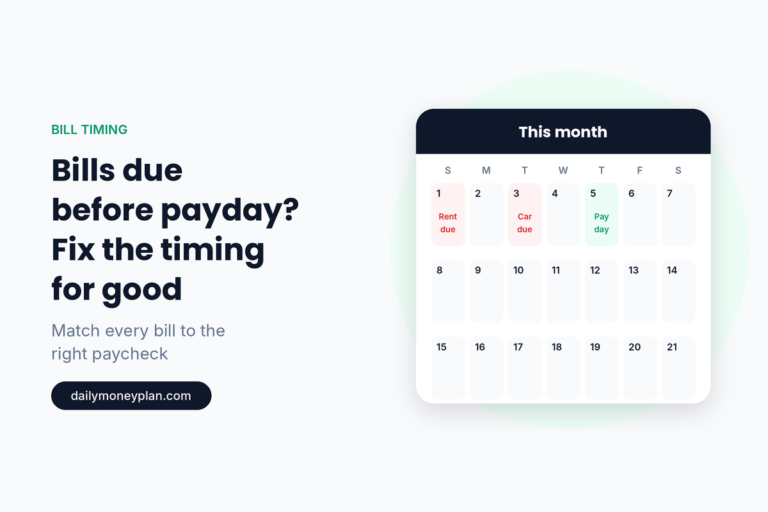
- Forgetting bills due before your next payday. Check the calendar, not just the bill list.
- Leaving out yearly costs. They’re not surprises. They’re just not monthly.
- Counting next paycheck’s money. Spend from this paycheck only.
- Treating the number as a target. It’s the most you can spend, not what you have to spend. Anything left can go to savings.
FAQ
How much can I spend after bills?
Take your paycheck, then subtract your bills, a small amount for yearly costs, your savings, and your essentials like groceries and gas. What’s left is what you can spend on anything until your next payday.
How much money should I have left after paying bills?
It depends on your income and costs. A common rule of thumb is that about 30% of take-home pay goes to wants, but many people have less, especially in expensive areas. Start with your real number and improve it over time.
How much should I spend per day until payday?
Divide your safe-to-spend number by the number of days until your next paycheck. For example, $430 over 14 days is about $30 a day.
What if my income changes every paycheck?
Use your lowest normal paycheck to work out your number. When a bigger paycheck comes in, give the extra a job, like savings or a bill you want to get ahead on.
Do I need an app to track my safe-to-spend number?
No. Pen and paper works. A simple spreadsheet just does the math for you and updates the number as you go.
Know Your Number Before You Spend
Your bank balance tells you what’s in the account. Your safe-to-spend number tells you what’s actually yours. Once you know it, you can say yes to things without worrying, because your bills are already covered.
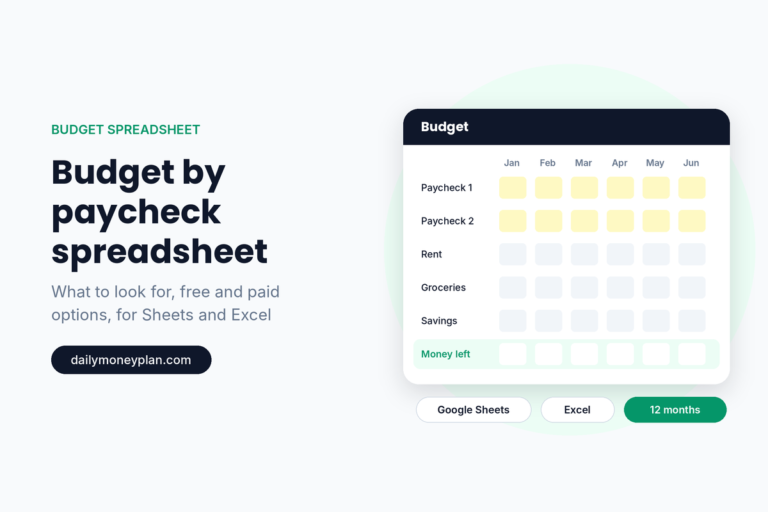
Work it out for your next paycheck: paycheck, minus bills, yearly costs, savings, and essentials. Then divide by the days until payday. For the full system behind it, here’s how to budget by paycheck. And if you’d like the whole year planned in one place, the budget by paycheck spreadsheet shows your money left for every month.
Know your safe-to-spend number every payday
Grab the free Budget by Paycheck Starter. Type in your numbers and it shows your “Money Left to Spend” instantly — no complicated setup.
- See your safe-to-spend number the moment you fill it in
- Built for weekly & biweekly paychecks
- Works in Google Sheets and Excel, on any device
Free forever. No spam. Unsubscribe anytime.
This article is for general education only and isn’t personalized financial advice. Everyone’s situation is different, so adjust these ideas to fit yours.