How to Budget When You Get Paid Every Two Weeks
You get paid every other Friday. Your rent, car payment, and phone bill come once a month. Some months it all works out fine. Other months, a bill lands in the week before payday and your account is almost empty.
That isn’t bad luck, and it isn’t you being bad with money. A monthly budget just doesn’t match how biweekly pay actually arrives. The fix is to budget each paycheck instead of each month.
This guide walks you through it step by step, with real numbers. You’ll see three simple ways to split your monthly bills between paychecks, how to handle the months with a third paycheck, and how to find what’s safe to spend every two weeks.

Know what’s safe to spend from every biweekly paycheck
Grab the free Budget by Paycheck Starter. Type in your numbers and it shows your “Money Left to Spend” instantly — no complicated setup.
- See your safe-to-spend number the moment you fill it in
- Built for weekly & biweekly paychecks
- Works in Google Sheets and Excel, on any device
Free forever. No spam. Unsubscribe anytime.
Why Biweekly Pay Makes Budgeting Confusing
Biweekly pay is the most common pay schedule in the US. The Bureau of Labor Statistics estimates that 43% of private businesses pay their employees every two weeks. So if this feels confusing, you’re in very big company.
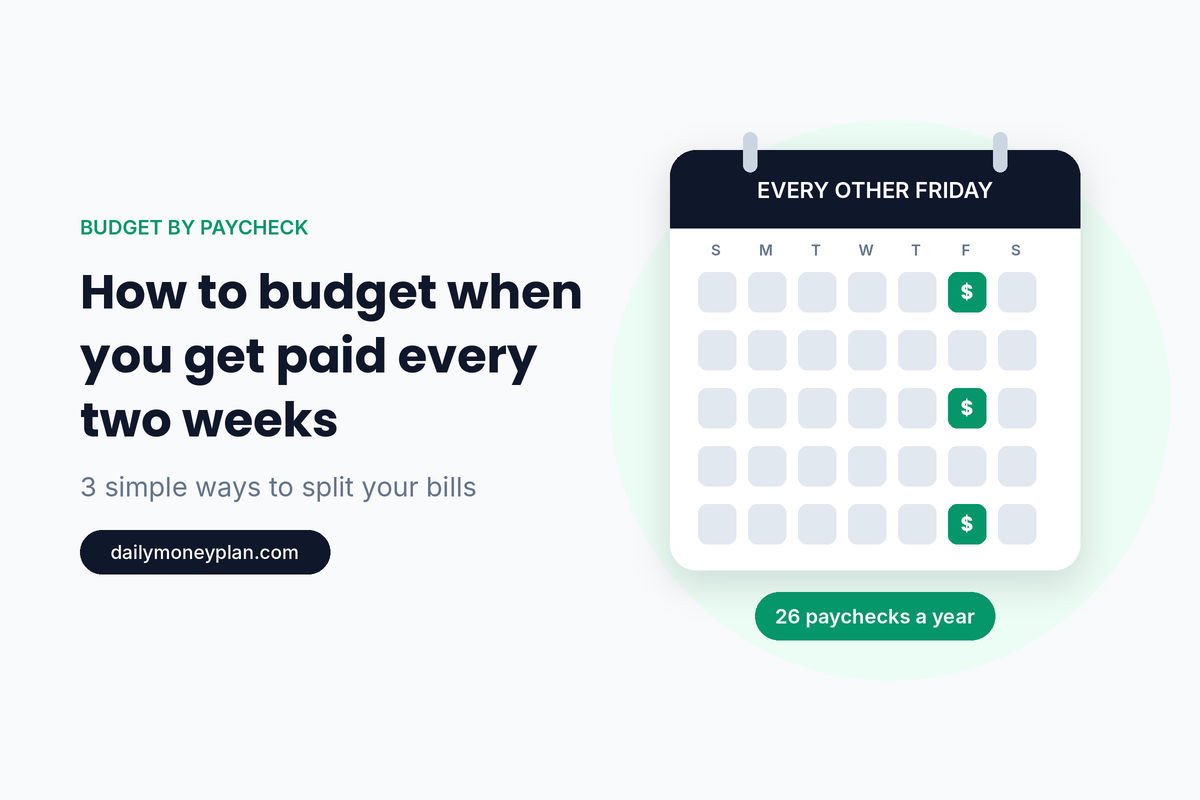
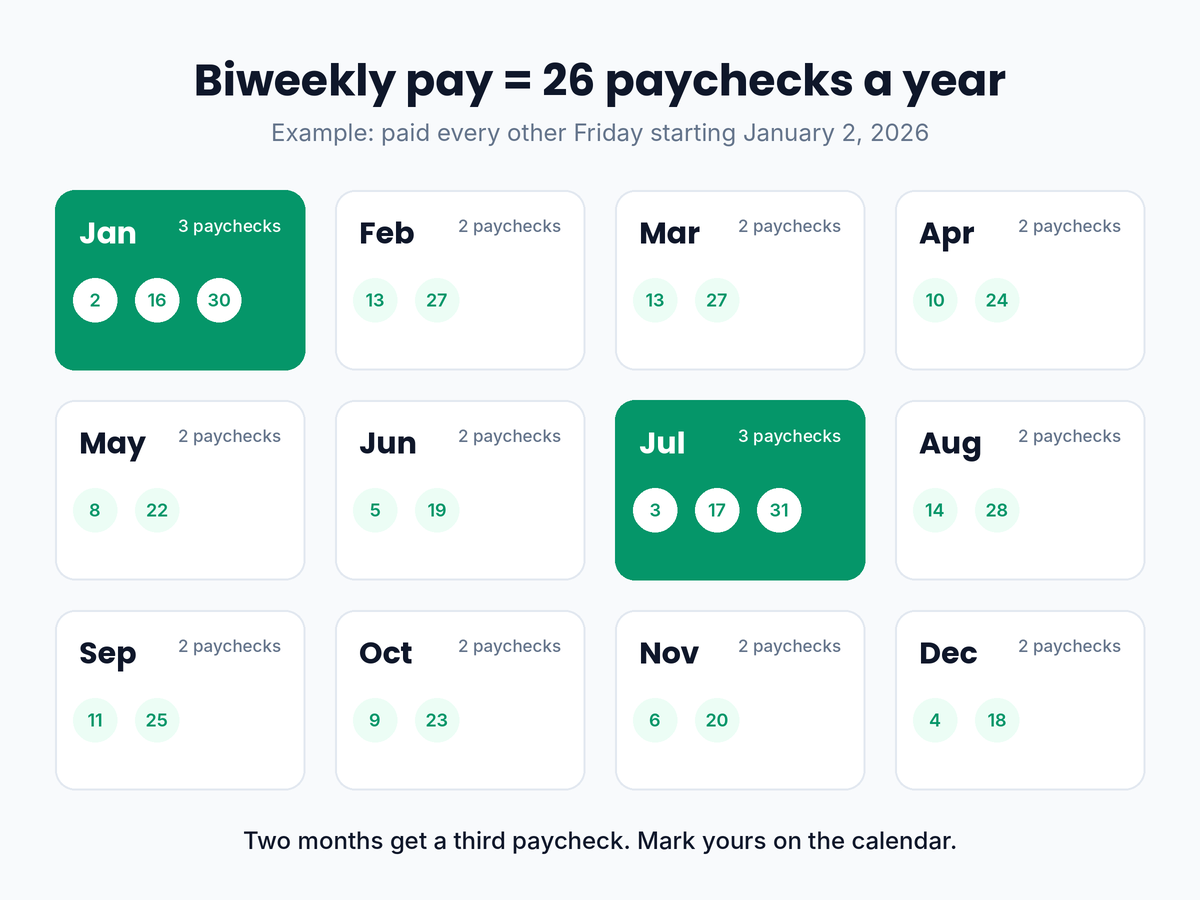
Here’s why it’s tricky. A year has 52 weeks, so biweekly pay gives you 26 paychecks a year. That’s about 2.17 paychecks a month, not a clean two.
In practice, that means three things:
- Most months you get two paychecks. Two months a year, you get three.
- Your paydays move. If you’re paid on the 5th and 19th this month, next month it might be the 2nd and 16th.
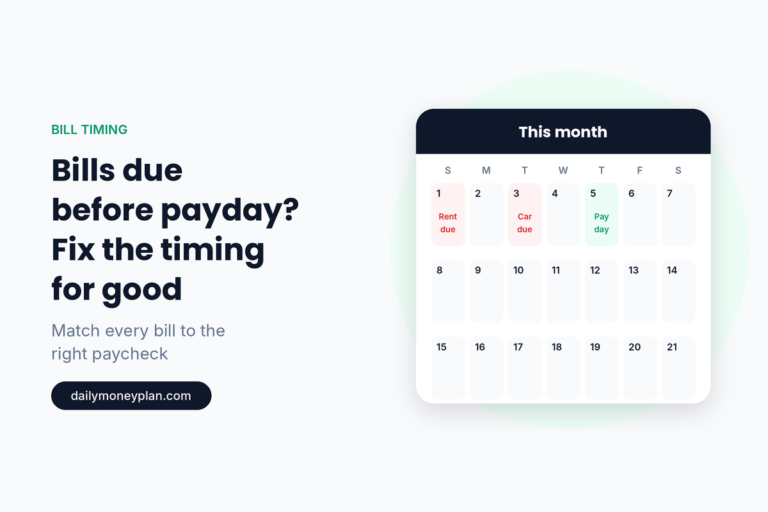
- Your bills don’t move. Rent is due on the 1st every month, no matter when you get paid.
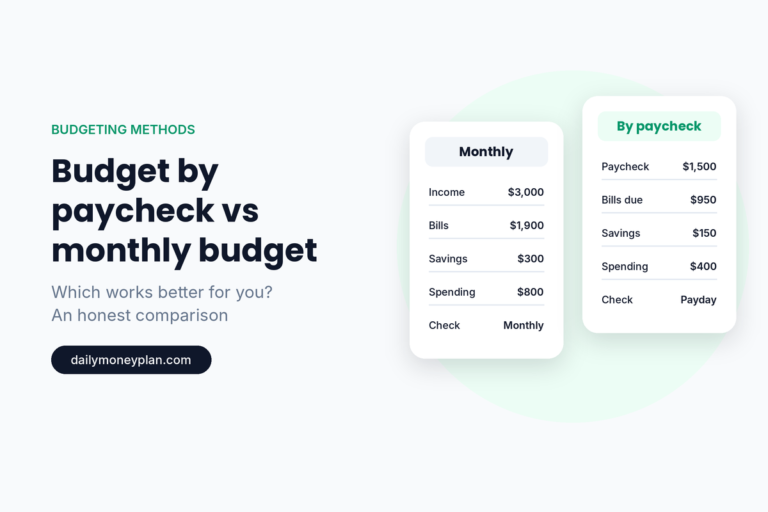
A monthly budget assumes one fixed pile of money. Biweekly pay is a moving target. That’s why budgeting by paycheck works so much better.
Step 1: Know Your Real Paycheck
Start with your take-home pay, the amount that actually lands in your bank account after taxes and deductions. Not your salary, and not your hourly rate times 80 hours.
Look at your last two or three pay stubs. If the amount changes a little (overtime, tips, shift differentials), use the lowest normal amount. Anything above that is a bonus you can give a job later.
Step 2: List Your Bills and Add Them Up
Write down every bill that comes once a month, with its due date:
- Rent or mortgage
- Car payment and car insurance
- Utilities, phone, and internet
- Subscriptions
- Minimum debt payments
Add them up to get your total monthly bills. You’ll use this number in the next step.
Here’s the example we’ll use for the rest of this guide. Meet Jordan, who takes home $1,600 every other Friday:
- Rent: $1,250 (due the 1st)
- Car payment: $320 (due the 10th)
- Utilities: $160 (due the 18th)
- Phone: $75 (due the 20th)
- Car insurance: $140 (due the 24th)
- Subscriptions: $45 (due the 28th)
That’s $1,990 in monthly bills. These are example numbers to show the math, not a target for anyone.
Step 3: Pick How You’ll Split Your Bills
Short version: if you’re just starting, use Method 2, the half-and-half split. It’s the simplest, and it works for almost everyone.
If you want to see your options, there are three good ways to split monthly bills between biweekly paychecks. They all work. The difference is how much each paycheck has to carry, and when you get breathing room.
Method 1: The payday calendar
Mark your paydays on a calendar for the month. Then give each bill to the paycheck that lands before its due date.
For Jordan, the paycheck around the 1st covers rent. The paycheck mid-month covers the car payment, utilities, phone, insurance, and subscriptions.
- Best for: bills that are already spread fairly evenly across the month.
- Watch out for: big bills like rent. If one paycheck carries rent alone, it can leave you with almost nothing for two weeks. (That lopsided paycheck is one of the main reasons people end up always broke before payday.)
This is the method in our main guide on how to budget by paycheck, if you want the full walkthrough.
Method 2: The half-and-half split
Each paycheck sets aside half of your total monthly bills, no matter which bills are due when. The money sits in checking (or a separate bills account) until each bill is due.
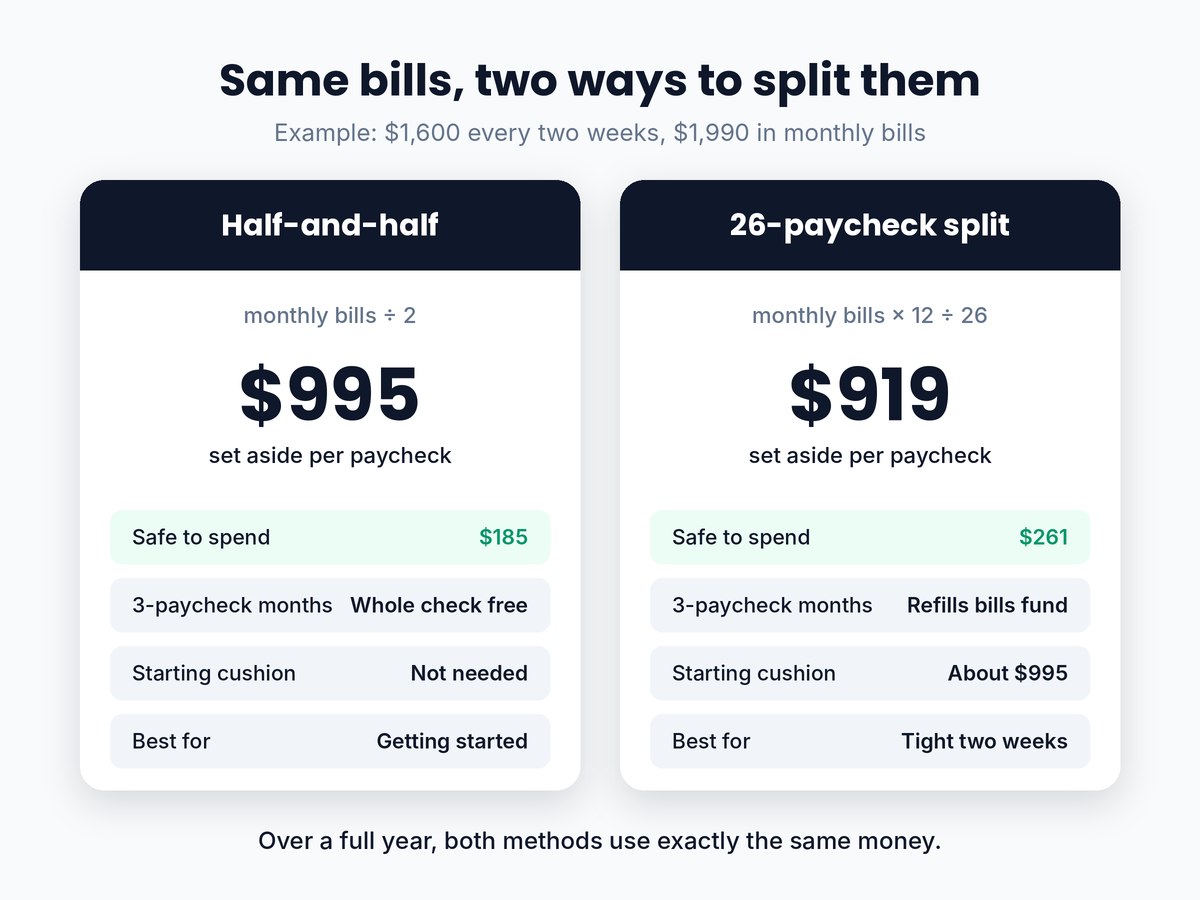
For Jordan: $1,990 ÷ 2 = $995 from every paycheck.
- Best for: anyone with one big bill, like rent, that throws a single paycheck off.
- The bonus: in the two months with a third paycheck, your bills are already covered. That whole third paycheck is free to give a job.
Method 3 (optional): The 26-paycheck split
Skip this one if you’re just getting started. It’s useful later, once you have a small cushion.
Instead of planning around two paychecks a month, spread a full year of bills across all 26 paychecks:
Per paycheck = monthly bills × 12 ÷ 26
For Jordan: $1,990 × 12 = $23,880 for the year. Divided by 26 paychecks, that’s about $919 per paycheck. (Round up so you’re never short.)
- Best for: people who want a little more breathing room every single paycheck.
- The catch: in two-paycheck months, you set aside about $150 less than your bills. The three-paycheck months make up the difference. So you need a starting cushion in your bills account. Half a month of bills is a safe amount (about $995 for Jordan), or you can start this method right after a three-paycheck month.
Which method should you pick?
Here’s the part that surprises people. Over a full year, all three methods use exactly the same money. They just time it differently.
With half-and-half, you get your “extra” money in two big chunks. With the 26-paycheck split, you get it as about $76 more every two weeks. Both add up to roughly $1,990 a year.
If you’re just starting, half-and-half is the easiest. There’s no cushion to build first, and the three-paycheck months feel like a real reward. If two weeks always feel tight, the 26-paycheck split can help once you have a small cushion.
Step 4: Budget Essentials by the Pay Period, Not the Month
Groceries, gas, and everyday costs don’t care about due dates. They happen every week. So plan them for the two weeks each paycheck has to cover, not for a whole month.
For Jordan, that’s about $300 for groceries and $60 for gas every two weeks, so $360 per paycheck.
If you don’t know your numbers yet, look at the last month of bank statements and divide by two. It doesn’t have to be perfect. You’ll adjust as you go.
Step 5: Find Your Safe-to-Spend Number for Each Paycheck
Now put it together. Your safe-to-spend number is what’s left from a paycheck after everything that has to be covered before the next one:
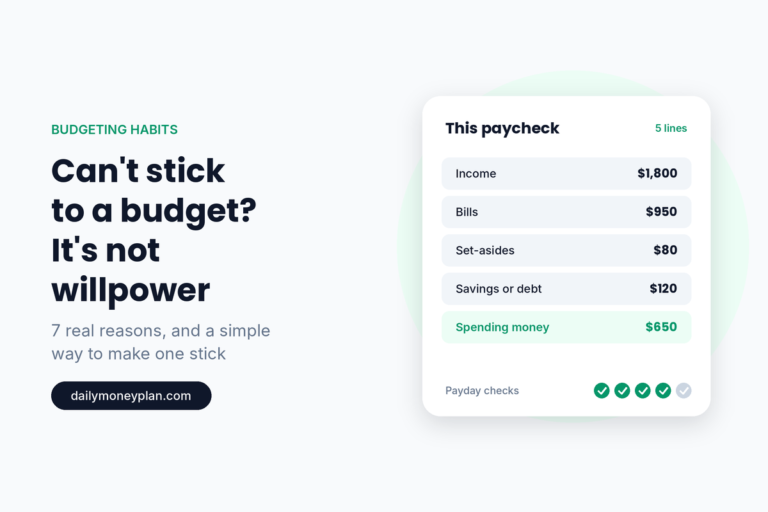
Safe to spend = paycheck − bill set-aside − essentials − savings
Here’s Jordan’s number using the half-and-half split:
- Paycheck: $1,600
- Bill set-aside: −$995
- Groceries and gas: −$360
- Savings: −$60
- Safe to spend: $185 per paycheck
(With the 26-paycheck split, the same math leaves $261, because the bill set-aside is $919 instead of $995.)
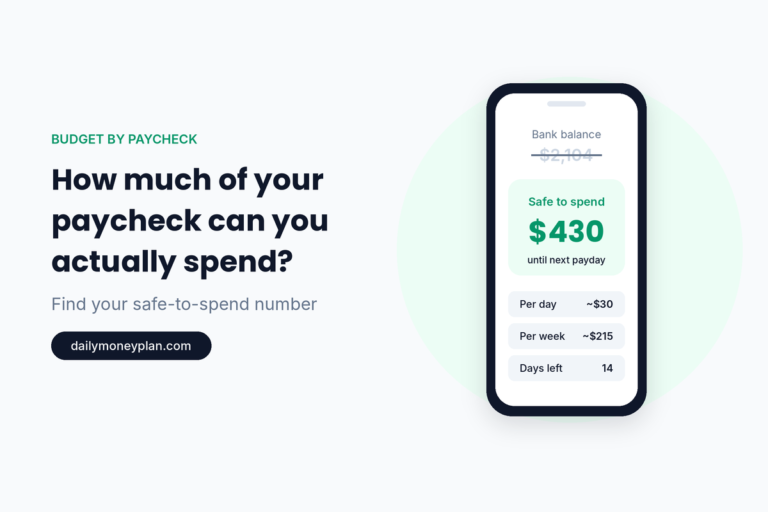
That’s the number Jordan can spend on anything over the next two weeks, guilt-free, with every bill still covered. No guessing, and no “can I afford this?” in the checkout line. For more on this number, see how much of your paycheck you can actually spend.
If your number comes out negative, that’s useful too. It tells you the gap is real, and the fix is lowering a bill or adding income, not trying harder.
Get your safe-to-spend number for your next paycheck
Grab the free Budget by Paycheck Starter — type in your numbers and it shows your “money left to spend” automatically.
Free forever. No spam. Unsubscribe anytime.
Step 6: Plan Your Three-Paycheck Months
Twice a year, you’ll get a third paycheck in the same month. Which months depends on your pay dates, so check your calendar and mark them now.
If you use the half-and-half method, that third paycheck has no bills to pay. It’s the closest thing to free money in a budget. Decide ahead of time what it’s for, before it disappears into everyday spending:
- Build or top up your emergency fund
- Make an extra debt payment
- Fill a sinking fund (car repairs, holidays, back to school)
- Get a month ahead on bills
If you use the 26-paycheck split, part of that check refills your bills account, and the rest is yours to plan.
One more thing to know: every 11 years or so, depending on your pay dates, a year has 27 paychecks instead of 26. When that happens, you’ll have one more bonus check to plan. For ideas, here’s more on what to do with your extra paychecks.
Step 7: Check In Once a Week
Pick one day a week and take ten minutes. Look at what you’ve spent, what’s due before your next payday, and how much of your safe-to-spend number is left.
That’s it. You’re not logging every coffee. You’re just making sure the plan still matches real life, and adjusting early if it doesn’t.
Biweekly vs. Paid on the 1st and 15th
Quick note, because these get mixed up a lot. Biweekly means every two weeks, so 26 paychecks a year. Semi-monthly means twice a month on set dates, like the 1st and 15th, so 24 paychecks a year.
If you’re paid on the 1st and 15th, your paydays don’t move and you never get a third paycheck. The half-and-half method works great for you, and you can skip Step 6. For the full breakdown, see the difference between being paid every two weeks vs. the 1st and 15th.
Common Mistakes to Avoid
- Budgeting four paychecks into a month. Some months only get two. Plan for two, and treat the third as a bonus.
- Letting one paycheck carry rent alone. It makes that two-week stretch brutal. Split it across both paychecks instead.
- Spending the bill money because it’s sitting there. If seeing it in checking is too tempting, move it to a separate bills account on payday.
- Planning essentials by the month. Groceries and gas happen every week. Budget them for each two-week stretch.
- Forgetting the three-paycheck months. Without a plan, that extra check tends to disappear. Mark the months now.
FAQ
How much of each biweekly paycheck should go to bills?
With the half-and-half method, it’s half of your total monthly bills. With the 26-paycheck split, it’s your monthly bills × 12 ÷ 26. For $1,990 in monthly bills, that’s $995 or about $919 per paycheck.
Should I budget off two paychecks a month?
Yes, for most people that’s the simplest way to start. Budget every month as if it has two paychecks, and treat the third paycheck in those two months as a bonus to give a specific job.
Which months will I get three paychecks?
It depends on your exact pay dates, and it changes from year to year. Take your next payday, count forward every 14 days on a calendar, and look for the two months that end up with three.
How do I split rent between two biweekly paychecks?
Set aside half of your rent from each paycheck and hold it until the due date. If rent is $1,250, that’s $625 from each check. The half-and-half method does this for all your bills automatically.
Do I need a separate bank account for bills?
You don’t need one, but it helps a lot of people. Moving your bill set-aside to a separate account on payday keeps you from accidentally spending it. Check that the account has no monthly fees first.
Start With Your Next Paycheck
Budgeting with biweekly pay gets a lot easier once you stop forcing it into a monthly shape. List your bills, pick a way to split them, plan your essentials for two weeks at a time, and find your safe-to-spend number for each paycheck. Then mark your two three-paycheck months and decide what they’re for.
Start with your very next paycheck. You don’t have to plan the whole year today.
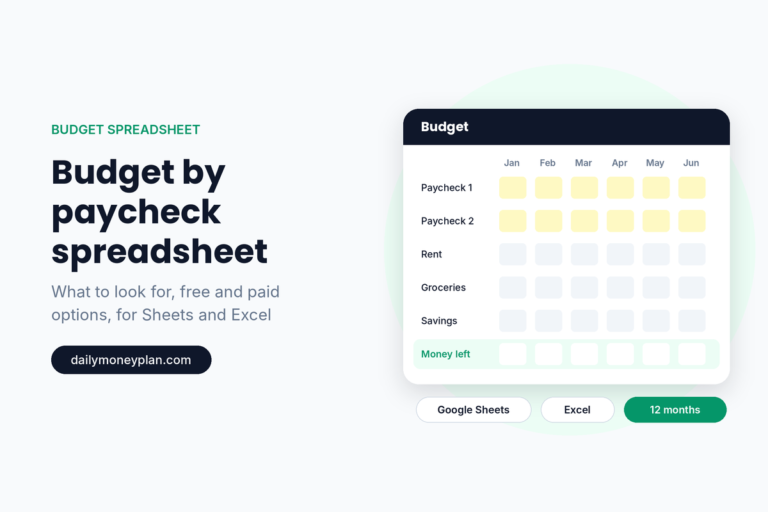
If you’d rather see the whole year in one place, including the months with a third paycheck, the full budget by paycheck spreadsheet handles every month in one workbook. But you can start today with the free version below.
Give your next paycheck a plan
Grab the free Budget by Paycheck Starter. Type in your numbers and it shows your “Money Left to Spend” instantly — no complicated setup.
- See your safe-to-spend number the moment you fill it in
- Built for weekly & biweekly paychecks
- Works in Google Sheets and Excel, on any device
Free forever. No spam. Unsubscribe anytime.
This article is for general education only and isn’t personalized financial advice. Everyone’s situation is different, so adjust these ideas to fit yours.