The 2 Extra Paychecks a Year: What to Actually Do With Them
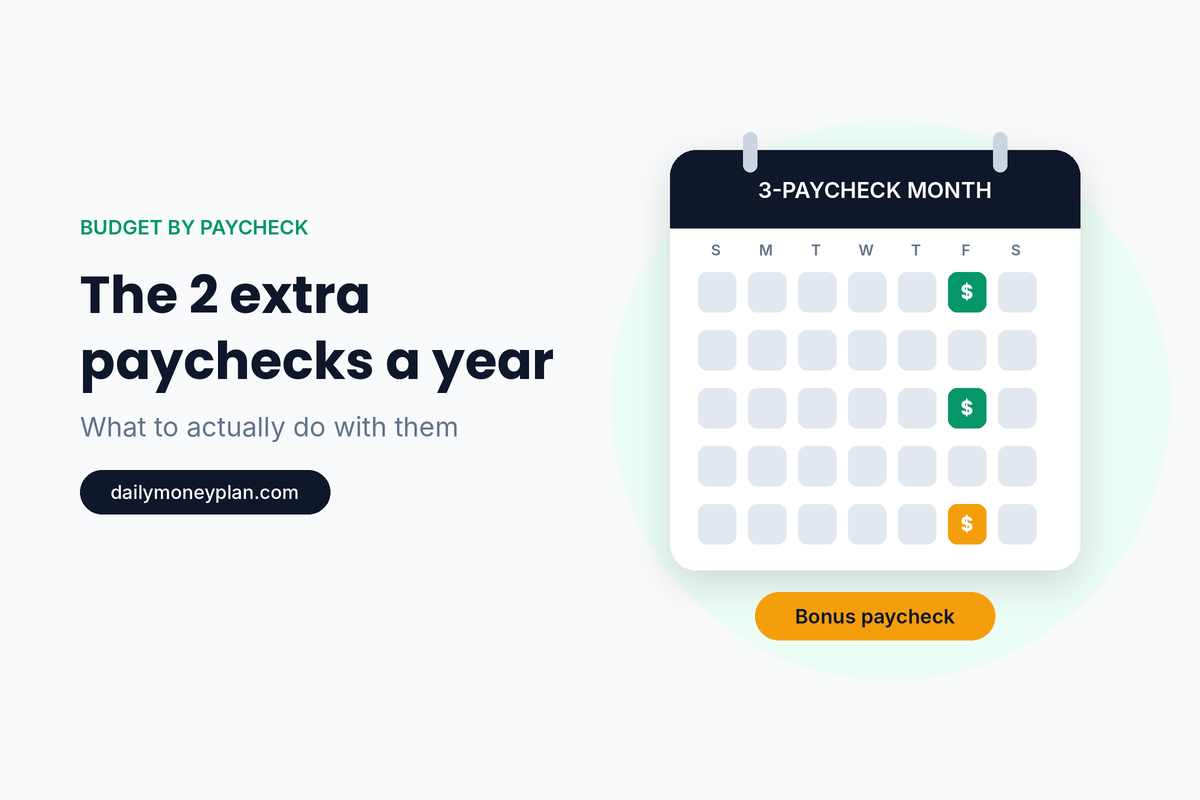
If you get paid every two weeks, you have two 3 paycheck months a year, when a third paycheck shows up. Your rent doesn’t go up. Your car payment doesn’t double. That paycheck has no bills waiting for it.
Most people don’t notice it until it’s already spent. A few extra takeout orders, a sale, a weekend trip, and it’s gone. It doesn’t have to go that way.
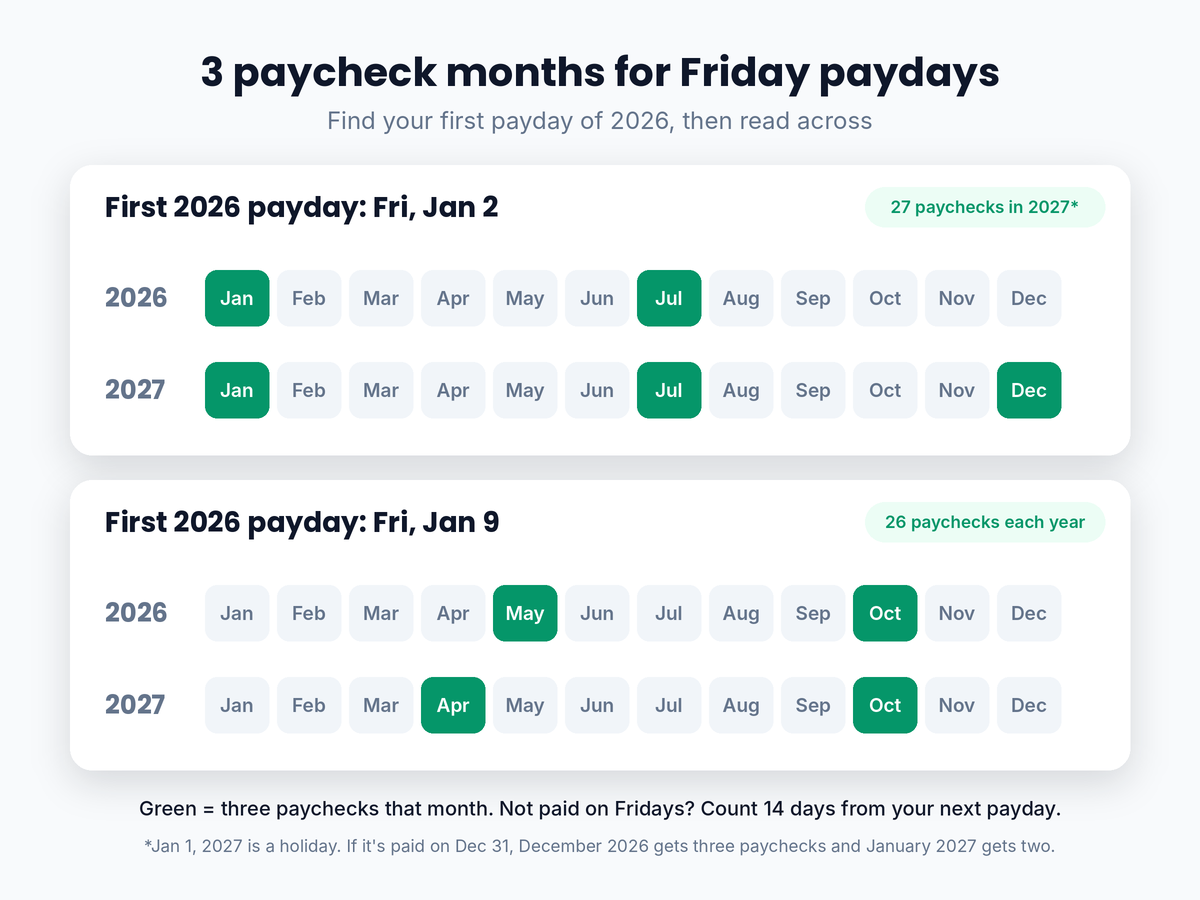
Short answer: if you’re paid every other Friday, your 3 paycheck months in 2026 are either January and July, or May and October. In 2027, they’re either January, July, and December, or April and October. Paid on a different day? The table below covers every payday.
In this guide, you’ll see exactly which months bring a third paycheck in 2026 and 2027, how to make sure the money is really extra, and a simple plan for what to do with it.
Know what’s safe to spend, even in a three-paycheck month
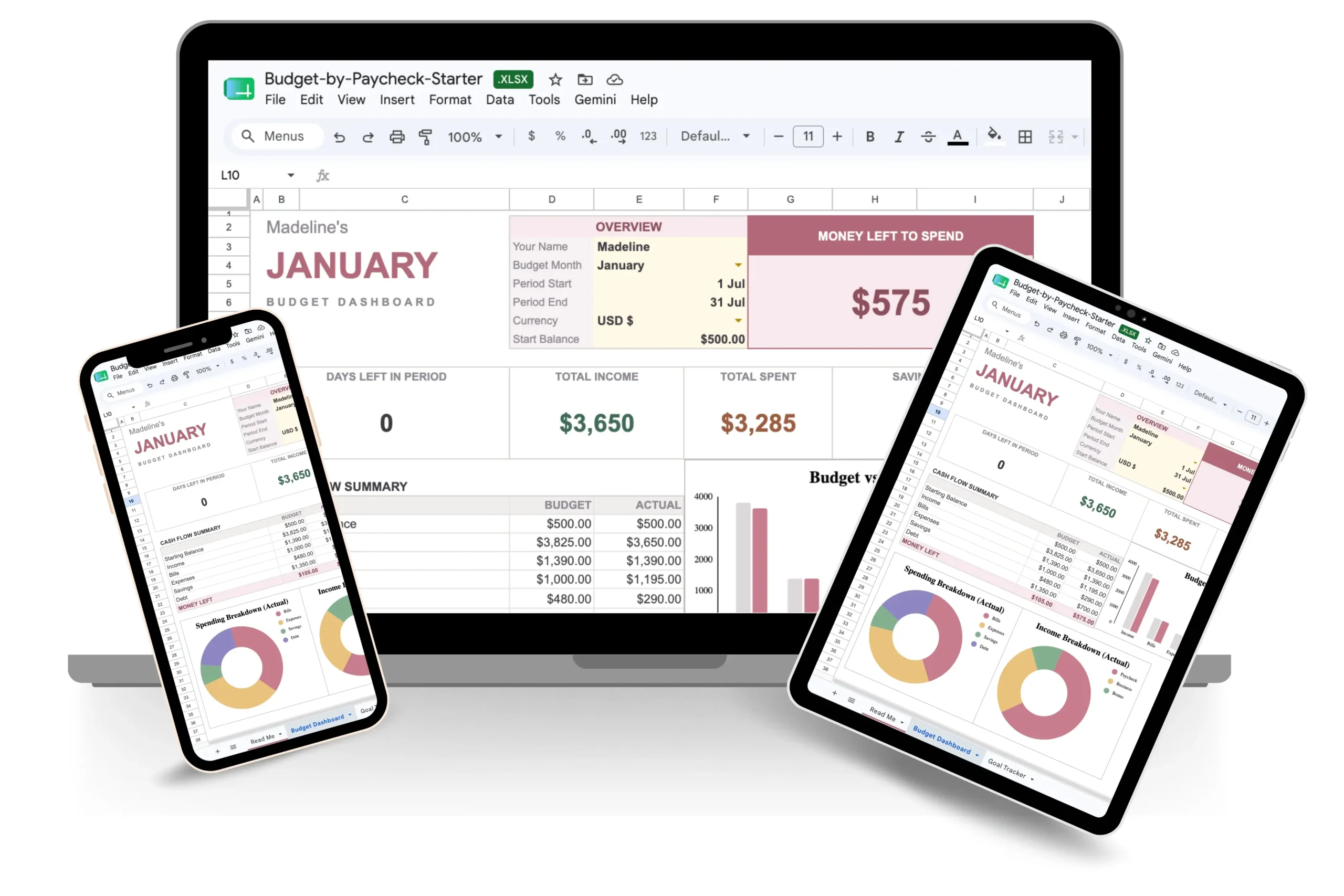
Grab the free Budget by Paycheck Starter. Type in your numbers and it shows your “Money Left to Spend” instantly — no complicated setup.
- See your safe-to-spend number the moment you fill it in
- Built for weekly & biweekly paychecks
- Works in Google Sheets and Excel, on any device
Free forever. No spam. Unsubscribe anytime.
Why You Get Extra Paychecks
A year has 52 weeks. If you’re paid every two weeks, that’s 26 paychecks a year, not 24.
Most months have room for two paydays. But because the paydays drift a little earlier each month, twice a year a month fits three. Those are your three-paycheck months.
If you set up your budget to run on two paychecks a month, those two extra paychecks aren’t needed for bills at all. If you’re still figuring out that setup, start with how to budget when you get paid every two weeks.
When Are Your 3 Paycheck Months?
It depends on the date of your first payday of the year. If you’re paid on Fridays, every biweekly schedule follows one of two patterns. Find your first payday of 2026 below:
| Your first 2026 payday | 2026 three-paycheck months | 2027 three-paycheck months |
|---|---|---|
| Friday, January 2 | January and July | January, July, and December |
| Friday, January 9 | May and October | April and October |
If your first payday was January 9, your three October 2026 paychecks land on the 2nd, 16th, and 30th.
If your first payday was January 2, 2027 is a rare year with 27 paychecks, running from January 1 to December 31. That means three extra paychecks instead of two.
One catch: January 1 is New Year’s Day. When payday lands on a holiday, many employers pay a day early. That would move the check into December 2026. Your employer’s payroll calendar will tell you for sure.
Paid on a Different Day? Find Your Months
Not paid on Fridays? Find your first payday in January 2026 below, then read across.
| Your first payday in January 2026 | 3 paycheck months in 2026 | 3 paycheck months in 2027 |
|---|---|---|
| Thursday, Jan 1 | January, July, December* | July, December |
| Friday, Jan 2 | January, July | January, July, December* |
| Saturday, Jan 3 | January, August | January, July |
| Sunday, Jan 4 | March, August | January, August |
| Monday, Jan 5 | March, August | March, August |
| Tuesday, Jan 6 | March, September | March, August |
| Wednesday, Jan 7 | April, September | March, September |
| Thursday, Jan 8 | April, October | April, September |
| Friday, Jan 9 | May, October | April, October |
| Saturday, Jan 10 | May, October | May, October |
| Sunday, Jan 11 | May, November | May, October |
| Monday, Jan 12 | June, November | May, November |
| Tuesday, Jan 13 | June, December | June, November |
| Wednesday, Jan 14 | July, December | June, December |
*A 27-paycheck year. If a payday lands on a holiday like New Year’s Day, many employers pay a day early, which can move that check into the previous year. Your payroll calendar will confirm it.
Can’t find your schedule? Take your next payday, count forward 14 days at a time on a calendar, and circle any month that ends up with three.
First, Make Sure It’s Actually Extra
Before you plan the money, check two things.
1. Does your budget run on two paychecks a month? If you plan every month around two paychecks, the third one is truly free. But if your budget spreads a full year of bills across all 26 paychecks, part of the third check is needed to refill your bills money. Spend the “extra” without checking, and you’ll be short later.
2. Look at the pay stub. The third paycheck is regular pay, not a bonus, so taxes come out the same way they do on your other paychecks. But some employers skip certain deductions on the third check, like health insurance premiums, because they only take them 24 times a year. If that’s you, your third paycheck may be a little bigger. Plan with the real amount, not a guess.
What to Do With It: A Simple Priority Ladder
There’s no single right answer. But when money is tight, order matters. Work down this list and stop at the first step that isn’t done yet. Most people only need the first two or three.
1. Catch up on anything past due
Late rent, a utility bill, or a payment you missed comes first. Getting current stops late fees and protects your credit. It also takes away a lot of stress.
2. Build a small starter cushion
If you don’t have any savings, put the extra paycheck toward a small emergency cushion. Even $500 to $1,000 means a flat tire or a vet bill doesn’t go on a credit card.
3. Pay down high-interest debt
If you carry a credit card balance, an extra payment here saves you real money in interest. Put the extra toward the card with the highest interest rate, or the smallest balance if quick wins keep you going.
4. Fill your sinking funds
A sinking fund is money you set aside, a little at a time, for a cost you know is coming. Think holidays, car registration, back-to-school, or an annual subscription. A three-paycheck month is a great time to fill one in a single step.
5. Get a month ahead on bills
This is the quiet game changer. If you use extra paychecks to build up one month of bills in your account, you can start paying this month’s bills with last month’s money. Payday stops being a countdown. If you’re always broke before payday, this step changes how every month feels.
6. Save for bigger goals
Once the basics are covered, the extra paycheck can go toward longer-term goals, like a bigger emergency fund, a down payment, or retirement savings.
Keep a small slice for yourself
It’s okay to enjoy part of it. A small, planned treat (say 10% to 20%) makes the rest of the plan easier to stick with. The key word is planned.
Example: Jordan’s Two Extra Paychecks
Here’s how this might look in real life. These are example numbers, not a target.
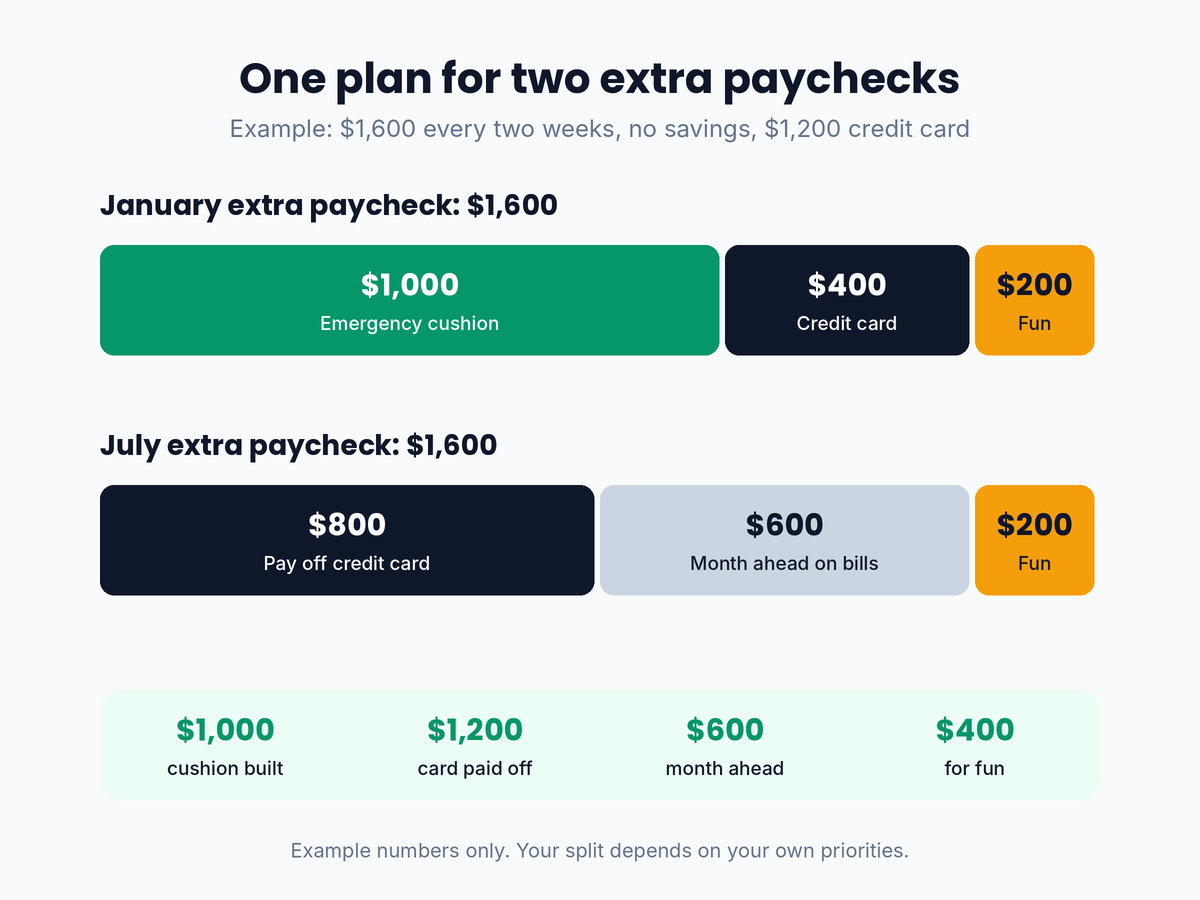
Jordan takes home $1,600 every two weeks and budgets on two paychecks a month. That means two extra paychecks a year, $3,200 in total. Jordan has no savings and a $1,200 credit card balance.
First extra paycheck (January): $1,600
- $1,000 to a starter emergency cushion
- $400 extra toward the credit card
- $200 for something fun
Second extra paycheck (July): $1,600
- $800 to pay off the rest of the credit card
- $600 toward getting a month ahead on bills
- $200 for something fun
By the end of the year, Jordan has a $1,000 cushion, a paid-off credit card, and a head start on being a month ahead, from paychecks that would otherwise have disappeared.
Give every paycheck a plan, including the extra ones
Grab the free Budget by Paycheck Starter — type in your numbers and it shows your “money left to spend” automatically.
Free forever. No spam. Unsubscribe anytime.
How to Keep It From Disappearing
A plan only works if the money gets there before you spend it. A few simple habits help:
- Decide now, not on payday. Write down where the next extra paycheck is going while it’s still weeks away.
- Set a reminder a week before. Put a note on your phone calendar: “Extra paycheck Friday. It goes to the cushion.”
- Move it the same day it lands. Set up a transfer to savings, or make the extra debt payment that morning.
- Use a separate savings account. Money you can’t see in checking is much easier to leave alone.
Paid Weekly or on the 1st and 15th?
Paid weekly? You get 52 paychecks a year, so four months usually bring a fifth paycheck. If you’re paid on Fridays, that’s January, May, July, and October in 2026, and January, April, July, October, and December in 2027. The same plan works. Budget on four paychecks a month and give the fifth one a job.
Paid on the 1st and 15th? That’s semi-monthly pay, with exactly 24 paychecks a year, so you don’t get extra paychecks. Here’s more on the difference between biweekly and semi-monthly pay.
Common Mistakes to Avoid
- Not knowing it’s coming. If you only notice on payday, it’s usually already spent. Mark the months now.
- Counting it in your regular budget. Plan every month on two paychecks so the third stays free.
- Spending it all, or saving all of it. All-spend leaves you where you started. All-save can feel like punishment. A planned split works better.
- Assuming the amount. Check your pay stub, since deductions can differ on the third check.
FAQ
Is a third paycheck taxed more?
No. It’s a regular paycheck, not a bonus, so taxes are withheld the same way as on your other paychecks. If it looks different, it’s usually because some deductions, like health premiums, aren’t taken from it.
Which months are my 3 paycheck months?
It depends on your first payday of the year. For Friday paydays, 2026’s three-paycheck months are January and July, or May and October. In 2027 they’re January, July, and December, or April and October. Use the table above or count forward 14 days from your next payday.
Should I save my extra paycheck or pay off debt?
If you have no savings at all, start with a small cushion so the next surprise doesn’t become new debt. After that, extra payments on high-interest debt usually make a big difference. Many people split it between the two.
Do I get an extra paycheck if I’m paid twice a month?
No. If you’re paid on set dates like the 1st and 15th, you get exactly 24 paychecks a year. Only biweekly and weekly pay create extra paychecks.
What if my budget already counts on the third paycheck?
Then it isn’t extra, and that’s okay. Once your bills are covered with two paychecks a month, the third one frees up. Getting there can take a few months of small changes.
Give Your Next Extra Paycheck a Job Today
Two times a year, you get a paycheck that your bills don’t need. That’s a real chance to get ahead, but only if you decide what it’s for before it arrives.
Find your months in the table, check your pay stub, pick your step on the ladder, and set a reminder for the week before. That’s the whole plan.
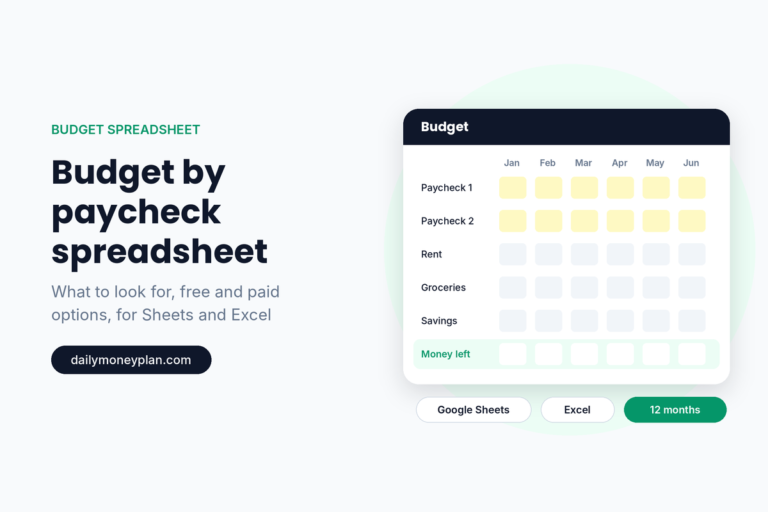
If you want the full picture first, here’s how to budget by paycheck so every regular paycheck has a job too. And if you’d like all 12 months in one place, the budget by paycheck spreadsheet lets you plan the whole year in one workbook, including the months with an extra paycheck.
Plan your next paycheck before it lands
Grab the free Budget by Paycheck Starter. Type in your numbers and it shows your “Money Left to Spend” instantly — no complicated setup.
- See your safe-to-spend number the moment you fill it in
- Built for weekly & biweekly paychecks
- Works in Google Sheets and Excel, on any device
Free forever. No spam. Unsubscribe anytime.
This article is for general education only and isn’t personalized financial advice. Everyone’s situation is different, so adjust these ideas to fit yours.