Paid Every Two Weeks vs. the 1st & 15th: Why Your Budget Feels Off
You did the math. Your salary divided by 12 should cover your bills with room to spare. But most months, it doesn’t quite work, and you’re a couple hundred dollars short without knowing why.
The answer might be your pay schedule. Biweekly vs semi-monthly pay sounds like the same thing (two paychecks a month, right?), but they work differently. If your budget is built for one and you’re paid on the other, it will feel off every month.
Here’s the difference in plain English, why it throws your budget off, and the right way to budget for your schedule.
Know what’s safe to spend, whatever your pay schedule
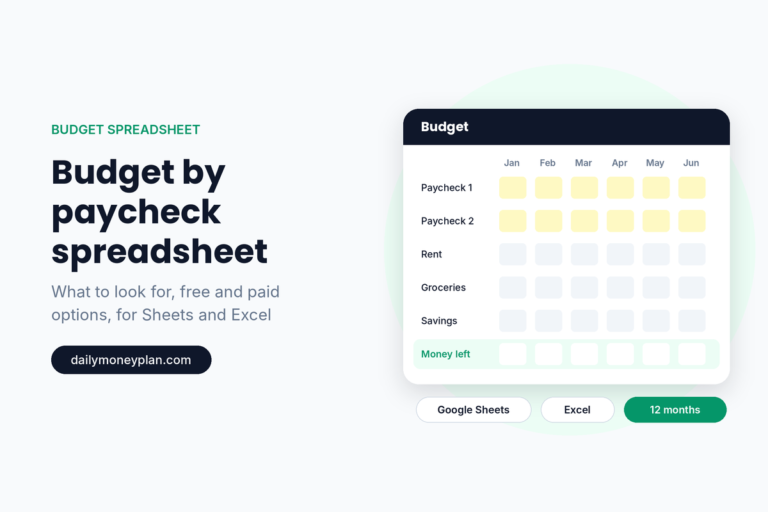
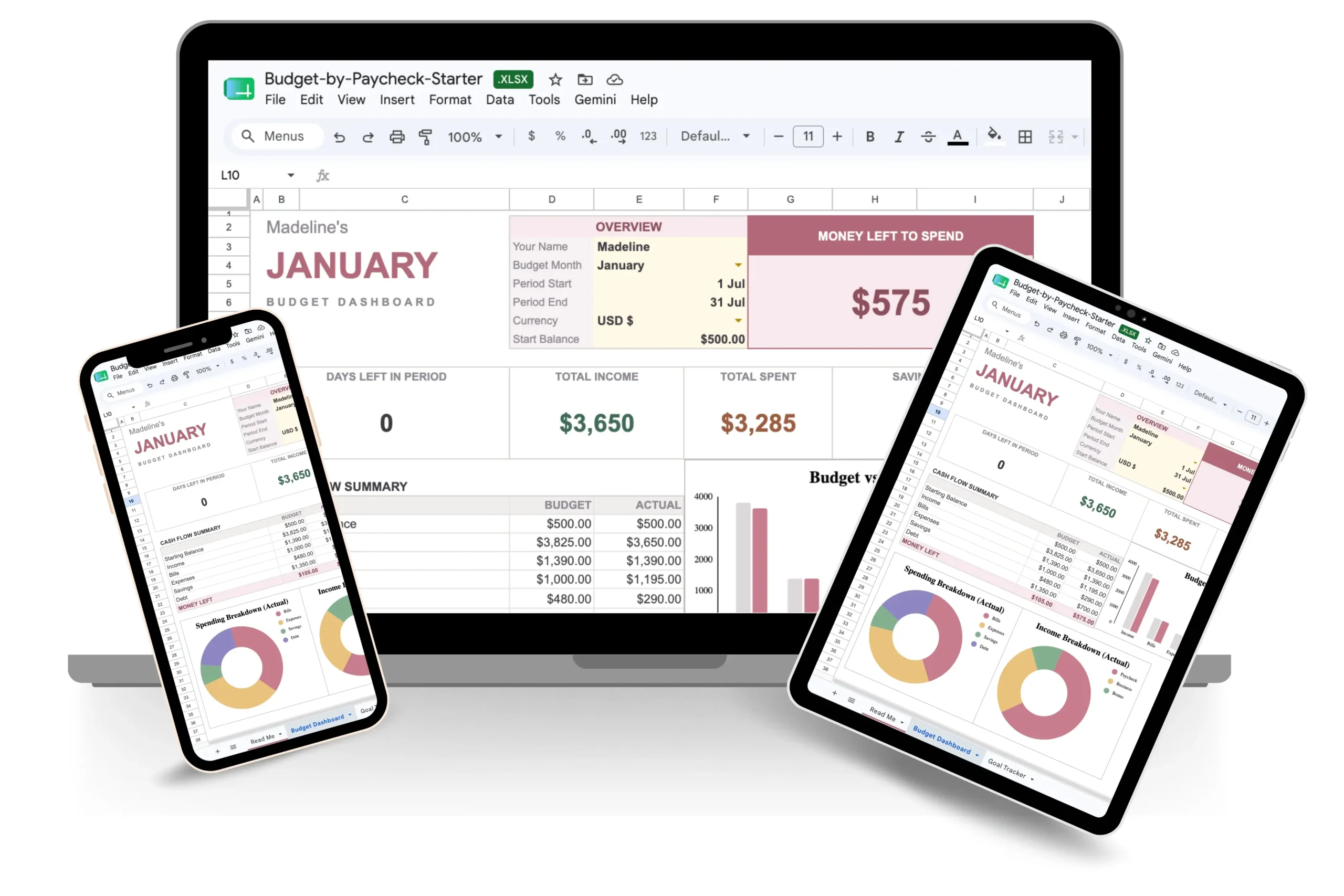
Grab the free Budget by Paycheck Starter. Type in your numbers and it shows your “Money Left to Spend” instantly — no complicated setup.
- See your safe-to-spend number the moment you fill it in
- Built for weekly & biweekly paychecks
- Works in Google Sheets and Excel, on any device
Free forever. No spam. Unsubscribe anytime.
Biweekly vs Semi-Monthly: The Quick Difference
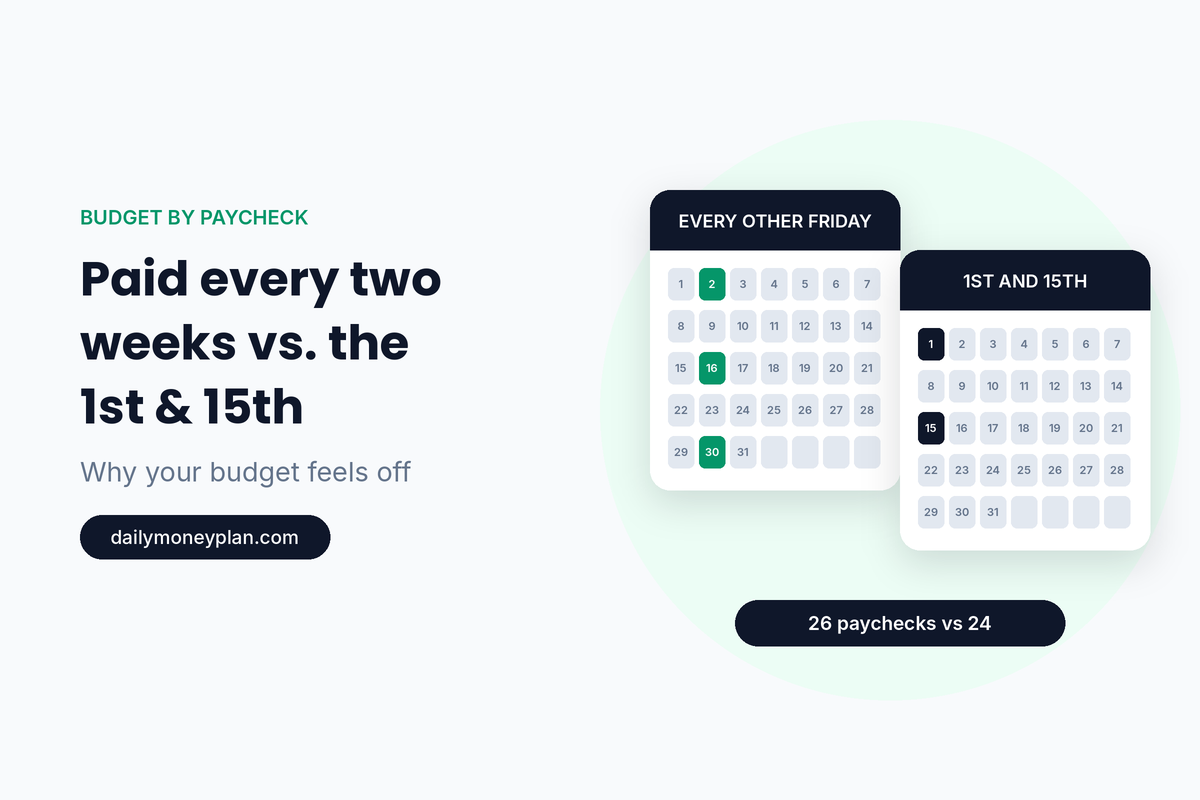
Biweekly means you’re paid every two weeks, always on the same day of the week, like every other Friday. Semi-monthly means you’re paid twice a month on set dates, like the 1st and the 15th.
| Biweekly | Semi-monthly | |
|---|---|---|
| How often | Every two weeks | Twice a month |
| Paychecks a year | 26 | 24 |
| Payday | Same weekday, dates move | Same dates, weekday moves |
| Paychecks per month | Usually 2, sometimes 3 | Always 2 |
| Each paycheck | A little smaller | A little bigger |
Biweekly is the most common schedule in the US. The Bureau of Labor Statistics found that 43% of private businesses pay every two weeks, compared with about 20% that pay semi-monthly, 27% weekly, and 10% monthly.
Same Salary, Different Monthly Paycheck
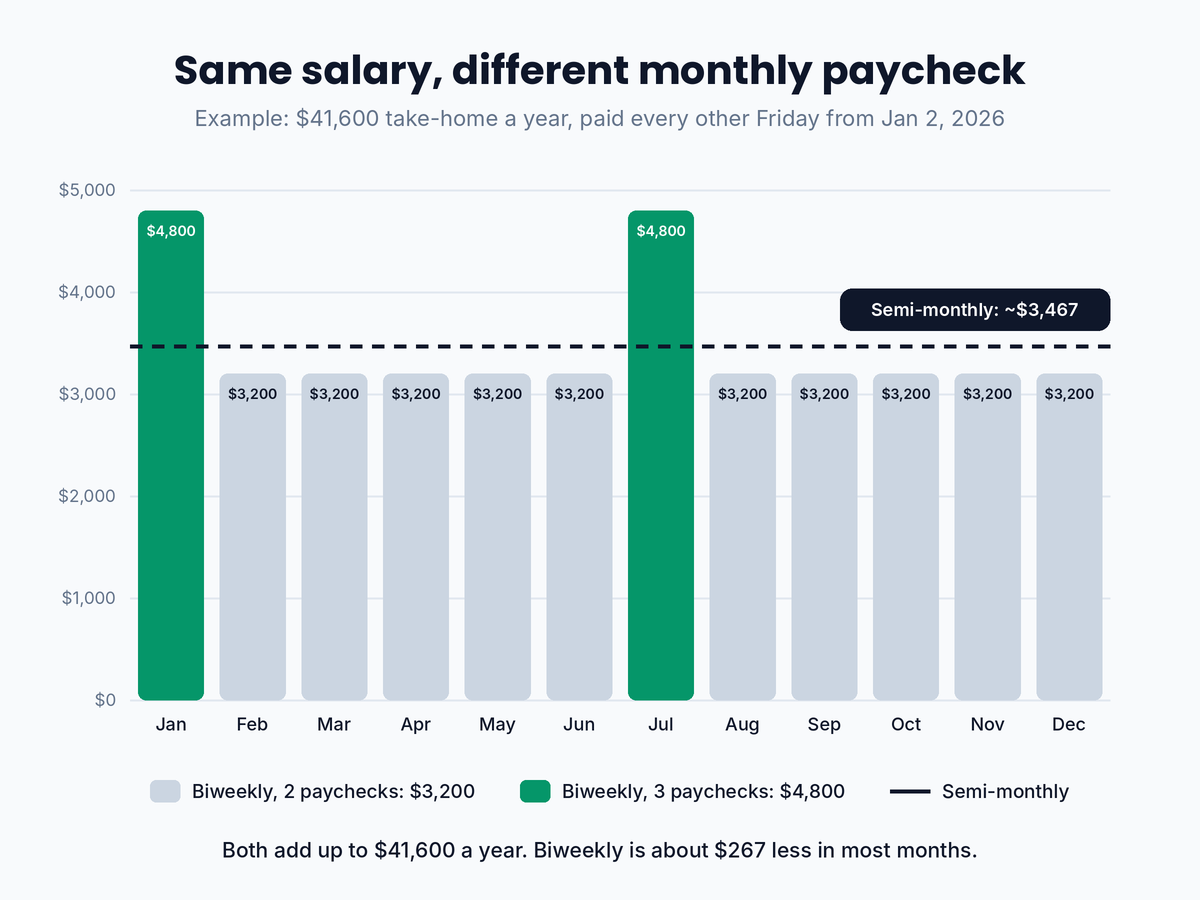
This is the part most people miss. Let’s say you take home $41,600 a year after taxes. Here’s how that arrives:
- Biweekly: $41,600 ÷ 26 = $1,600 per paycheck. In most months you get two, so $3,200 a month.
- Semi-monthly: $41,600 ÷ 24 = about $1,733 per paycheck. You always get two, so about $3,467 a month.
Same salary. But on biweekly pay, a normal month brings in about $267 less than on semi-monthly pay.
You don’t lose that money. It comes back as the two months a year with a third paycheck. But if you build your budget on $3,467 while you’re paid biweekly, you’ll be about $267 short in ten months of the year. That’s exactly the “something’s off” feeling.
Try it with your numbers
Grab your yearly take-home pay (what lands in your bank account after taxes) and do this quick math:
- Your biweekly month: yearly take-home ÷ 26 × 2
- Your semi-monthly month: yearly take-home ÷ 12
- Your gap: subtract the first number from the second
For example, with $52,000 a year: $52,000 ÷ 26 × 2 = $4,000, and $52,000 ÷ 12 = about $4,333. The gap is about $333 a month.
If you’re paid biweekly, build your budget on the first number. That’s the amount you can actually count on in a normal month.
5 Reasons Your Budget Feels Off
1. You’re budgeting from your salary divided by 12
It’s the most common setup, and it fits semi-monthly pay perfectly. But if you’re paid biweekly, it counts your two extra paychecks as if a little of them arrived every month. They don’t. Your budget expects money that only shows up twice a year.
2. You changed jobs (and pay schedules)
Moving from a 1st-and-15th job to a biweekly one, or the other way around, quietly breaks a budget that used to work. Same salary, different timing.
3. Your biweekly paydays keep moving
On biweekly pay, your payday drifts a little earlier each month. If your bills are tied to “the paycheck around the 15th,” that paycheck eventually lands after the bill instead of before it.
4. The gaps between semi-monthly paychecks aren’t equal
From the 15th to the 1st can be 16 or 17 days. From the 1st to the 15th is 14. That longer stretch at the end of the month needs more grocery and gas money, and it’s often when people run short.
5. Your semi-monthly payday moves when it lands on a weekend
If the 15th falls on a Saturday, many employers pay the business day before. That’s nice once, but it makes the next stretch longer. Check your employer’s rule so it doesn’t catch you by surprise.
How to Budget if You’re Paid Biweekly
- Budget on two paychecks a month. In our example, that’s $3,200, not $3,467. Plan every month as a two-paycheck month.
- Split your bills between the two paychecks. The simplest way is to set aside half of your monthly bills from each one. Here’s a full walkthrough of how to budget when you get paid every two weeks.
- Plan your 3 paycheck months. Twice a year, a third paycheck arrives with no bills waiting for it. Decide ahead of time what it’s for. Here’s how to plan your 3 paycheck months.
Plan your next paycheck in minutes, free
Grab the free Budget by Paycheck Starter — type in your numbers and it shows your “money left to spend” automatically.
Free forever. No spam. Unsubscribe anytime.
How to Budget if You’re Paid on the 1st and 15th
Good news: semi-monthly pay works well with a regular monthly budget, because your income is the same every month.
- Budget on your true monthly income. In our example, about $3,467. No extra paychecks to plan for.
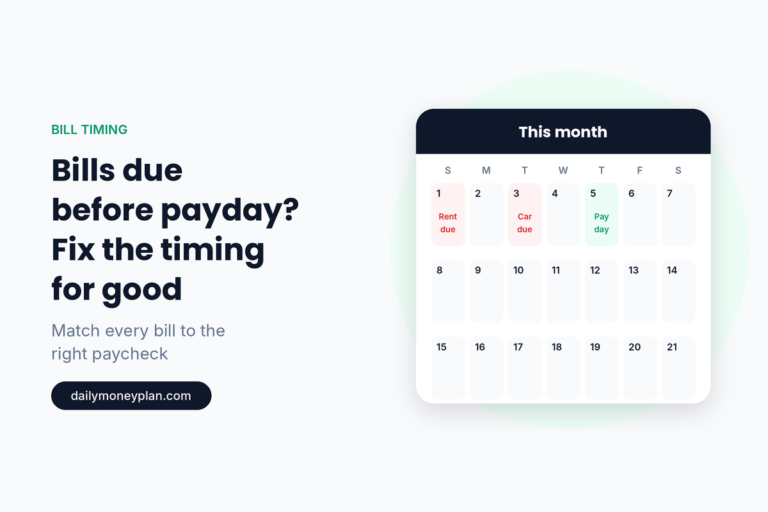
- Match bills to paychecks by date. The paycheck on the 1st covers bills due from the 1st to the 14th. The paycheck on the 15th covers bills due from the 15th to the end of the month.
- Give the longer stretch more spending money. The 15th to the 1st is usually two or three days longer, so plan a little more for groceries and gas from that paycheck.
- Watch rent on the 1st. If rent is due the same day you’re paid, a weekend or bank delay can make it tight. Setting aside part of next month’s rent from the 15th paycheck takes the pressure off.
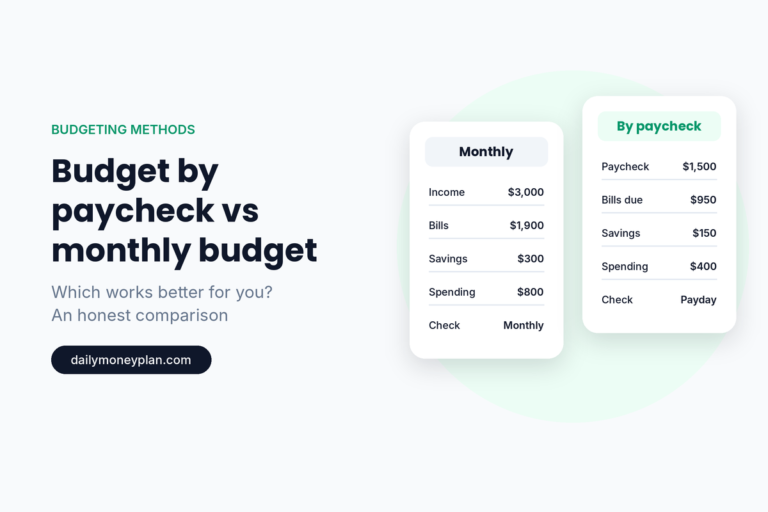
If you’d like the full picture of how the two approaches compare, here’s budget by paycheck vs. a monthly budget.
Not Sure Which One You Are?
Check your last few pay stubs. If the pay dates are exactly 14 days apart and always the same weekday, you’re biweekly. If they’re on (or near) the same two dates every month, like the 1st and 15th or the 15th and last day, you’re semi-monthly.
You can also count. If you get 26 paychecks a year, it’s biweekly. If you get 24, it’s semi-monthly.
FAQ
Is biweekly the same as twice a month?
No. Biweekly means every two weeks, so 26 paychecks a year and sometimes three in a month. Twice a month (semi-monthly) means 24 paychecks a year, always two per month.
Which is better for budgeting, biweekly or semi-monthly?
Neither is better. They just need different methods. Semi-monthly is easier to match with a monthly budget. Biweekly gives you two months a year with an extra paycheck, which is great for savings or debt if you plan for it.
Why is my biweekly paycheck smaller than I expected?
Because your yearly pay is split into 26 paychecks instead of 24. Each check is a bit smaller, but you get two more of them a year.
How do I compare biweekly vs semi-monthly pay for the same salary?
Divide your yearly take-home by 26 for a biweekly paycheck, or by 24 for a semi-monthly one. Then multiply by two to see a normal month. That shows how much you can count on each month.
What if my payday falls on a weekend or holiday?
It depends on your employer. Many pay the business day before. Check your pay calendar or ask HR so you know when to expect it.
Match Your Budget to Your Payday
If your budget always feels a little off, check your pay schedule before you blame yourself. Biweekly vs semi-monthly pay can bring in the same money over a year, but it arrives differently month to month.
Paid biweekly? Budget on two paychecks and give your extra paychecks a job. Paid on the 1st and 15th? A monthly budget with bills matched to each paycheck works great.
For the full step-by-step system, here’s how to budget by paycheck.
Find your safe-to-spend number for your next paycheck
Grab the free Budget by Paycheck Starter. Type in your numbers and it shows your “Money Left to Spend” instantly — no complicated setup.
- See your safe-to-spend number the moment you fill it in
- Built for weekly & biweekly paychecks
- Works in Google Sheets and Excel, on any device
Free forever. No spam. Unsubscribe anytime.
This article is for general education only and isn’t personalized financial advice. Everyone’s situation is different, so adjust these ideas to fit yours.