How to Budget on an Irregular or Variable Income
One month you’re fine. The next, a client pays late, your tips drop, or commissions dry up, and suddenly rent feels scary. Then a big month comes, and somehow that money disappears too.
If your income changes every month, a normal budget will feel broken, because it was built for a paycheck that never changes. Here’s how to budget with irregular income instead: start from your lowest month, use a simple priority list every time money comes in, and work toward paying yourself a steady paycheck.
You’ll see it all with a real-looking example, plus what to do in slow months and good months.

Plan every paycheck, even when your income changes
Grab the free Budget by Paycheck Starter. Type in your numbers and it shows your “Money Left to Spend” instantly — no complicated setup.
- See your safe-to-spend number the moment you fill it in
- Built for weekly & biweekly paychecks
- Works in Google Sheets and Excel, on any device
Free forever. No spam. Unsubscribe anytime.
You’re Not the Only One
Irregular income is more common than most people think. In the Federal Reserve’s latest household survey, about 3 in 10 adults had income that changed at least some of the time during the year. And about 1 in 9 adults struggled to pay their bills in the past year because their income changed.
So if budgeting feels harder for you than for people with a steady paycheck, that’s not your imagination. It is harder. You just need a different method.
Why Normal Budgets Break
A normal monthly budget starts with one number: what you earn each month. If that number moves, everything built on it moves too.
Budget on a good month, and you’ll come up short in a slow one. Budget on your average, and you’ll still be short in about half of your months, because an average is just the middle. The fix is to plan around the income you can count on, not the income you hope for.
How to Budget With Irregular Income: 5 Steps
Step 1: Find your baseline
Look back at the last 6 to 12 months of income. Use what you actually took home. If you’re self-employed, use what’s left after setting aside taxes. Write down each month.
Your baseline is your lowest normal month. Skip a true one-off, like a month you were sick, but be honest. If slow months happen every year, they count.
Step 2: Build a bare-bones budget that fits the baseline
List only what you truly need each month: housing, utilities, phone, transportation, insurance, groceries, and minimum debt payments. This is your bare-bones budget.
If it fits inside your baseline, great. Your must-haves are covered even in your worst month. If it doesn’t fit, that’s the most important thing to fix, by lowering a bill or adding a steadier income source.
Step 3: Set aside taxes first (if you’re self-employed)
If no one takes taxes out of your pay, set some aside from every payment before you spend any of it. Many freelancers set aside 25% to 30%, but the right amount depends on your income and state, so check with a tax professional.
The IRS says you generally need to make estimated tax payments if you expect to owe $1,000 or more, paid in four periods during the year. Keeping the tax money in a separate savings account makes those payments much easier.
Step 4: Use a priority list every time money comes in
When a payment lands, give it a job in this order:
- Taxes (if self-employed)
- Bare-bones bills for the month
- Your buffer (more on this next)
- Debt and savings goals
- Wants and fun money
You only move down the list once the step above is covered. In a slow month, you might stop at step 2. In a great month, you’ll reach step 5.
Step 5: Build a buffer, then pay yourself a steady paycheck
This is the step that makes irregular income feel regular.
- Open a separate holding account (a basic savings account works).
- Send all your income there instead of to checking.
- Once it holds about one month of what you want to live on, start paying yourself a fixed amount into checking each month, like a salary.
- Pick a paycheck amount that’s below your average income. Good months refill the holding account. Slow months draw from it.
Now you budget off one steady number, just like someone with a regular job.
Riley’s Six Months: A Worked Example
Here’s how it looks with real-looking numbers. This is an example, not anyone’s actual budget.
Riley is a freelance designer. Here’s Riley’s take-home income for six months, after setting aside taxes:
| Month | Income |
|---|---|
| January | $2,800 |
| February | $4,600 |
| March | $3,200 |
| April | $5,400 |
| May | $2,600 |
| June | $3,900 |
That’s $22,500 over six months. The average is $3,750, and the lowest month is $2,600.
Riley’s bare-bones budget is $2,500: rent $1,200, utilities and phone $220, car payment and insurance $380, groceries $450, gas $150, and minimum debt payment $100. It fits inside the $2,600 baseline, so the must-haves are covered even in the slowest month.
Riley’s steady paycheck is $3,200 a month, below the $3,750 average. Riley started with $3,200 in the holding account (one month’s paycheck). Here’s the holding account at the end of each month:
- January: $2,800
- February: $4,200
- March: $4,200
- April: $6,400
- May: $5,800
- June: $6,500
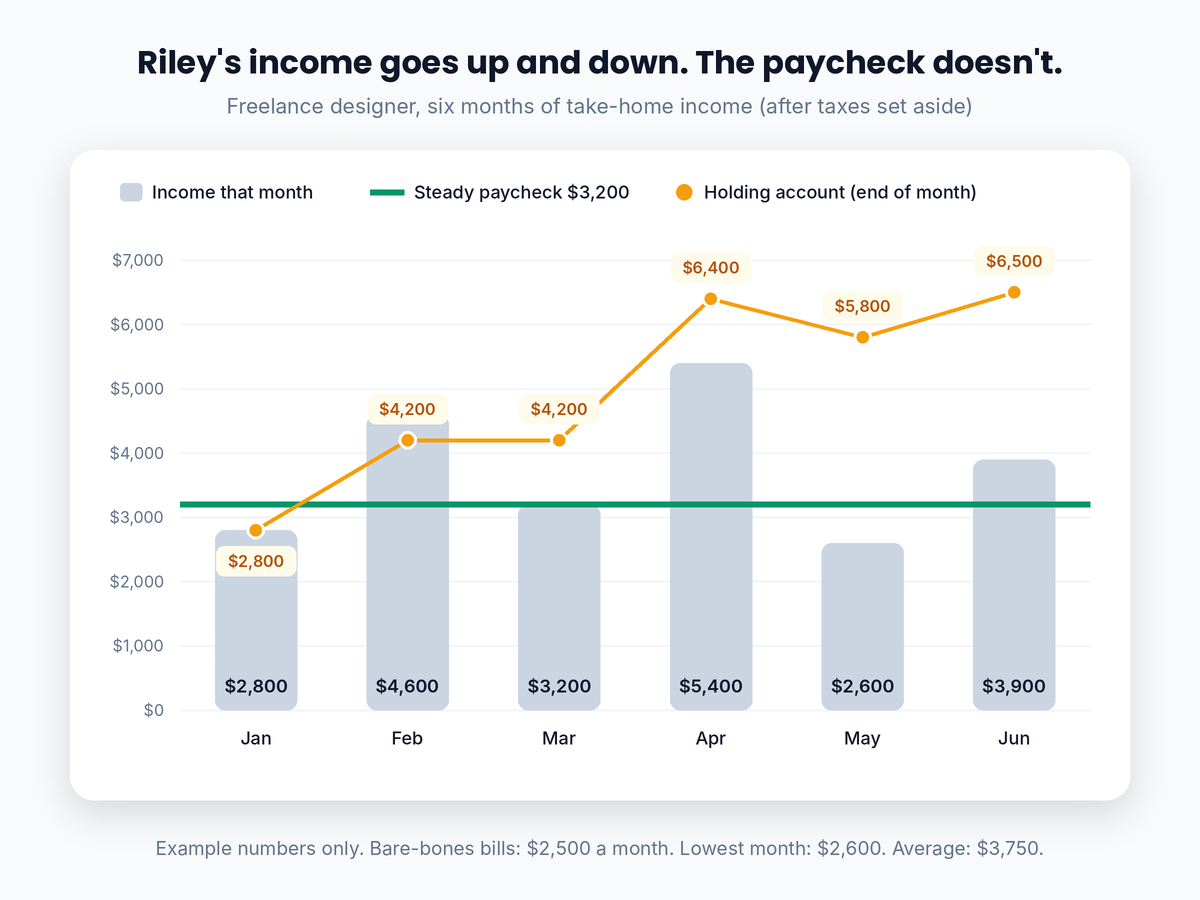
Riley’s income swung by $2,800 between the best and worst months. But Riley’s paycheck never changed, and the holding account never dropped below $2,800. That’s the whole point.
Riley’s $3,200 paycheck covers the $2,500 bare-bones budget with $700 to spare for other spending and savings goals. And because the holding account grew from $3,200 to $6,500, Riley can raise the paycheck a little later, or move the extra to savings.
Turn an up-and-down income into a steady plan, free
Grab the free Budget by Paycheck Starter — type in your numbers and it shows your “money left to spend” automatically.
Free forever. No spam. Unsubscribe anytime.
What to Do in a Slow Month
- Stick to the bare-bones budget. Pause wants and extra savings until income picks up.
- Pay the essentials first: housing, utilities, food, and getting to work.
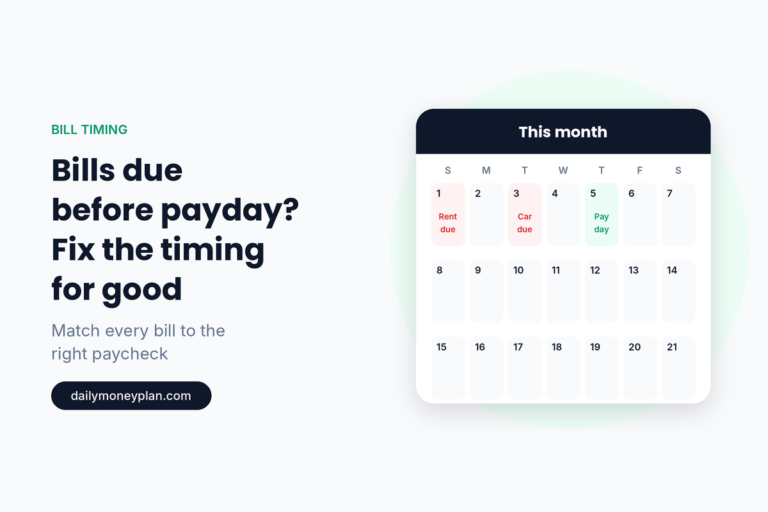
- Call before a bill is late. Many companies may offer a short extension or a new due date if you ask early. Here’s what to do when bills are due before payday.
- Use the buffer. That’s exactly what it’s for. Refill it in the next good month.
- Avoid high-cost borrowing like payday loans, which can make the next slow month worse.
What to Do in a Good Month
A good month is your chance to get ahead, not to upgrade your lifestyle.
- Top up the tax account first, if you’re self-employed.
- Refill the buffer to at least one month, then aim for two.
- Fill sinking funds for yearly costs like car registration and holidays.
- Pay extra on high-interest debt or add to savings.
- Then enjoy a planned portion. A little fun keeps the plan going.
It’s the same idea as planning what to do with your extra paychecks on a regular schedule: decide before the money arrives.
Common Mistakes
- Budgeting on your best month. It sets you up to come up short most of the year.
- Budgeting on your average. You’ll still be short in about half your months unless you have a buffer.
- Spending the tax money. If you’re self-employed, set it aside first, every time.
- Upgrading in good months. New fixed costs are hard to cut when a slow month comes.
- Paying yourself more than your average. The holding account will slowly drain.
A Tool That Shows the Whole Year
With irregular income, the most useful thing you can see is the whole year at once: which months were slow, what your average really is, and whether your buffer is growing.
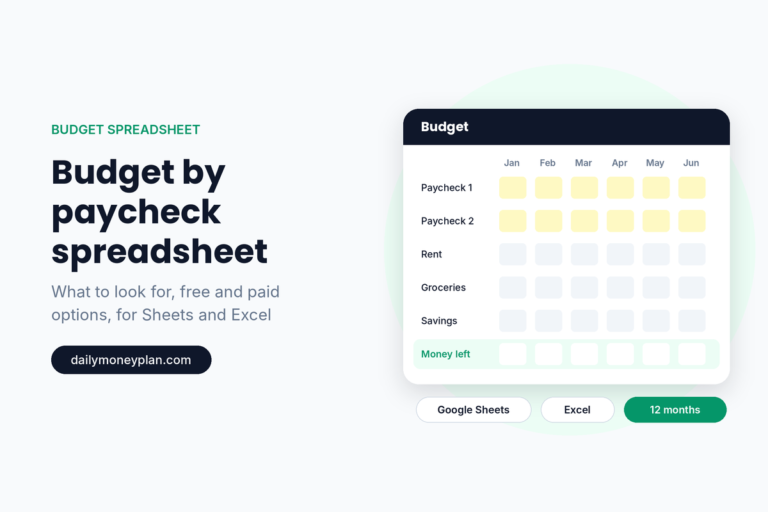
The Budget by Paycheck System was built with that in mind. It has eight separate income lines (paycheck, business, bonus, freelance, side hustle, and more), so every source has its own row. All 12 months sit in one workbook, and each month’s ending balance carries into the next. The dashboard shows your average monthly income and your best month for the year so far. It works in Google Sheets and Excel.
If you’d like to compare options, here’s more on the budget by paycheck spreadsheet. Or start with the free version below.
FAQ
How do I budget with irregular income?
Here’s how to budget with irregular income in short: start from your lowest normal month and build a bare-bones budget that fits inside it. Every time money comes in, cover taxes, bills, and your buffer first. Once your buffer holds about one month’s paycheck, pay yourself a steady amount each month from a holding account.
Should I budget based on my lowest month or my average?
Start with your lowest normal month. It’s the safest number. Once you have a buffer, you can pay yourself a steady amount a little below your average, and let good months refill the buffer.
How much should a freelancer set aside for taxes?
Many set aside 25% to 30% of every payment, but your amount depends on your income, deductions, and state. A tax professional can help you find the right number. The IRS generally requires estimated payments if you expect to owe $1,000 or more.
How big should my buffer be?
Start with one month of what you want to pay yourself. If your income swings a lot or you have slow seasons, work toward two or three months.
What if my bare-bones budget is more than my lowest month?
That’s the most important thing to fix. Look for a big bill you can lower, or a steadier source of income, even a small one. Until then, keep your buffer as large as you can.
Steady Plan, Unsteady Income
You can’t control when the money comes in. But you can control the plan. Budget from your lowest month, follow the same priority list every time you’re paid, and build a buffer until you can pay yourself a steady paycheck.
Start this week: write down your last six months of income and find your baseline. For the full paycheck system behind it, here’s how to budget by paycheck. And to see what’s safe to spend from each payment, here’s how much of your paycheck you can actually spend.
Give every payment a plan, starting today
Grab the free Budget by Paycheck Starter. Type in your numbers and it shows your “Money Left to Spend” instantly — no complicated setup.
- See your safe-to-spend number the moment you fill it in
- Built for weekly & biweekly paychecks
- Works in Google Sheets and Excel, on any device
Free forever. No spam. Unsubscribe anytime.
This article is for general education only and isn’t personalized financial or tax advice. Everyone’s situation is different, so adjust these ideas to fit yours.