What to Do When Bills Are Due Before Payday
Payday is Friday. Rent is due Wednesday. You have the money, just not yet.
If you keep running into bills due before payday, you’re not bad with money. You have a timing problem. Your bills are due on dates someone else picked, and your paychecks land on a different schedule. When the two don’t line up, one paycheck gets overloaded and the other feels like extra money.
This guide covers what to do if a bill is due before payday this week, and then how to fix the timing so it stops happening.

See which bills each paycheck needs to cover
Grab the free Budget by Paycheck Starter. Type in your numbers and it shows your “Money Left to Spend” instantly — no complicated setup.
- See your safe-to-spend number the moment you fill it in
- Built for weekly & biweekly paychecks
- Works in Google Sheets and Excel, on any device
Free forever. No spam. Unsubscribe anytime.
If a Bill Is Due Before Payday This Week
Start here if you’re short right now.
- Check for a grace period. Look at the bill or your account online. Some bills give you a few extra days before a late fee kicks in.
- Call before the due date, not after. Ask if they can move this payment to your payday, set up a short extension, or waive the late fee one time. Companies are often more flexible when you call early.
- Ask about a payment plan if you can only pay part of it. Ask whether a partial payment now avoids the late fee.
- Cover the essentials first: housing, utilities, food, and getting to work. More on this below.
- Look for local help if you’re behind on utilities or rent. Call or text 211 to find programs near you.
Also know how late payments work. A bill paid a few days late usually means a late fee, not a hit to your credit. Experian notes that late payments are reported to the credit bureaus once you’re at least 30 days past due. But once they’re reported, they can stay on your credit report for seven years. So don’t let a few days turn into a month.
What to avoid: payday loans. The CFPB gives this example: a typical two-week payday loan fee of $15 per $100 works out to an APR of almost 400%. Cash advance apps can also lead to a cycle. When the advance comes out of your next paycheck, that paycheck comes up short too.
Why This Keeps Happening
Most bills are due on the same date every month. Most paychecks don’t work that way. If you’re paid every two weeks, your paydays move around the calendar.
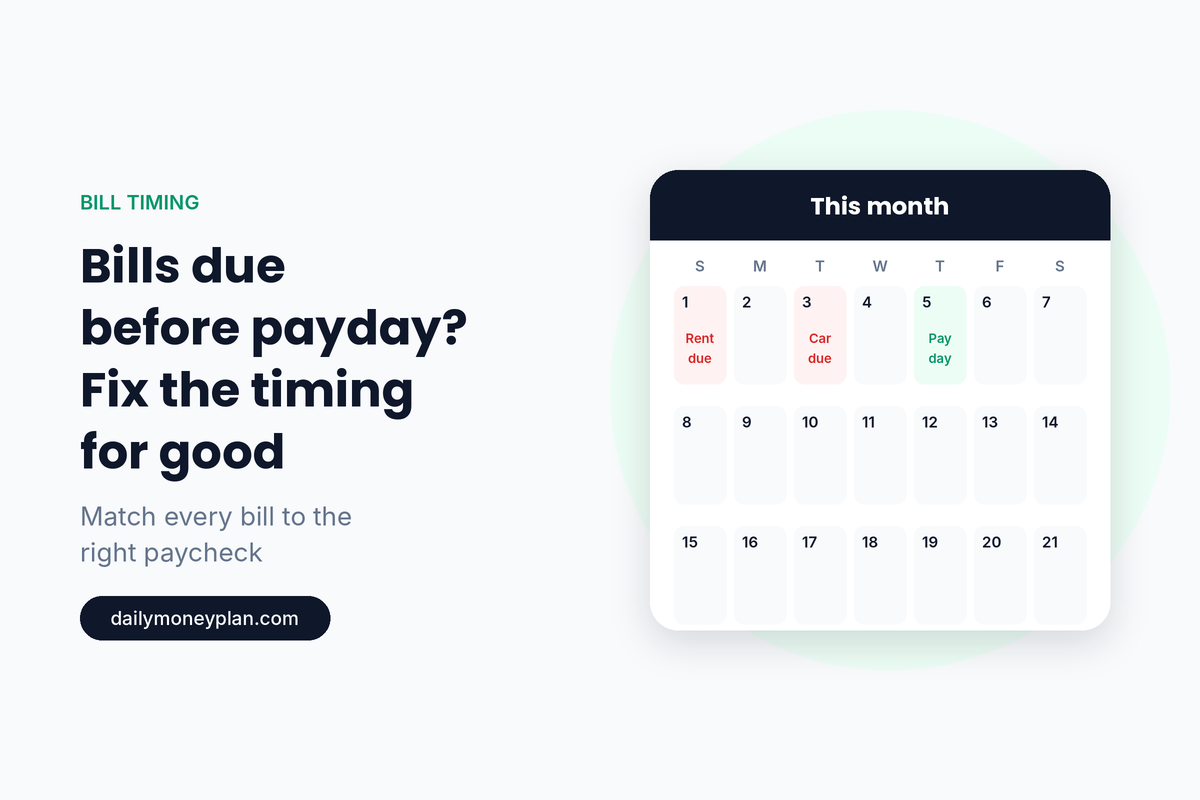
So bills often bunch up in one part of the month. Rent on the 1st and a car payment on the 3rd can both land before your first paycheck of the month. One paycheck ends up paying for almost everything. The other one feels like extra money, gets spent, and leaves you short when the big bills come back around.
It’s the same reason so many people are always broke before payday. The fix isn’t earning more or trying harder. It’s matching each bill to the right paycheck.
How to Fix Bills Due Before Payday for Good: 5 Steps
Step 1: Map your bills against your paydays
Write down every bill, its amount, and its due date. Then mark your paydays for the next two months on a calendar. You’ll see right away where bills bunch up and which paycheck is carrying too much.
Step 2: Use the “paycheck before” rule
Each bill gets paid from the last paycheck that arrives before its due date. Not the one after. If rent is due on the 1st and you’re paid on the 20th and the 4th, rent comes from the 20th paycheck.
Set that money aside the day you’re paid, even if the bill isn’t due for another week. If you get paid every other week, here’s more on how to budget when you get paid every two weeks.
Step 3: Split your biggest bill across two paychecks
This is the step that fixes most timing problems. Take your largest bill, usually rent, and set aside half from each paycheck. When the due date comes, the full amount is already waiting.
Keep the set-aside money somewhere you won’t spend it, like a separate savings account.
Step 4: Move the due dates you can
Lots of companies let you pick a new due date, especially credit card, phone, and utility companies. Card issuers aren’t required to, but many will move your due date if you ask, often right from your online account.
A few tips:
- Pick a date a few days after a payday, so the money is always there first.
- Spread your bills across both halves of the month, so each paycheck carries a fair share.
- The change can take a billing cycle or two to kick in. Keep paying on the old date until you see the new one on your statement.
- Rent and loans are often harder to move, but it never hurts to ask.
Step 5: Get one bill cycle ahead
The long-term goal is to pay every bill from money you already have, not money you’re waiting on. That means building a cushion about the size of your biggest bill, then slowly growing it.
A good time to start is a month with an extra paycheck. If you’re paid every two weeks, you get two of those a year. Here’s what to do with your extra paychecks.
Dana’s Month: A Worked Example
Here’s how it looks on a real calendar. This is an example, not anyone’s actual budget.
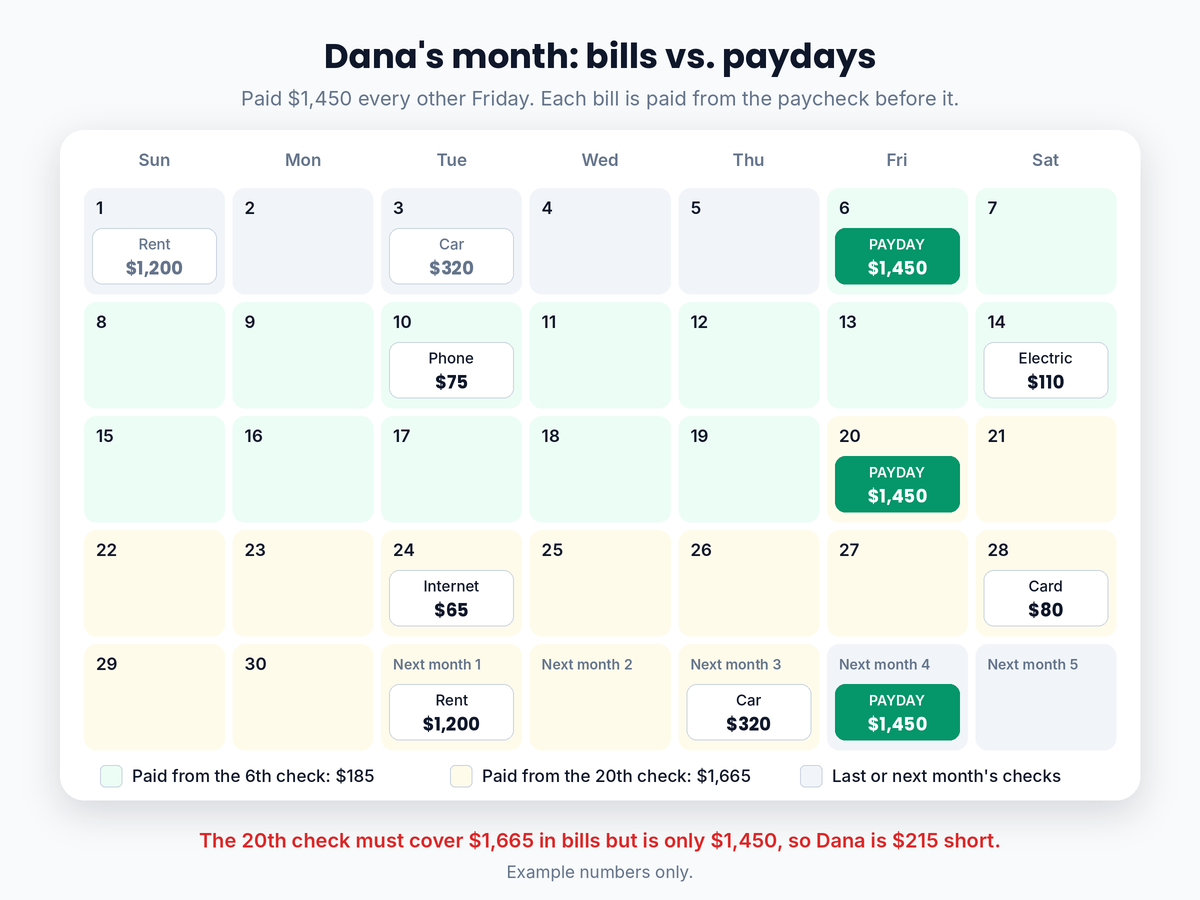
Dana takes home $1,450 every other Friday. This month, paydays fall on Friday the 6th and Friday the 20th. The next one is Friday the 4th of next month.
Dana’s monthly bills add up to $1,850:
- Rent $1,200, due the 1st
- Car payment $320, due the 3rd
- Phone $75, due the 10th
- Electric $110, due the 14th
- Internet $65, due the 24th
- Credit card minimum $80, due the 28th
[IMAGE: Dana’s monthly calendar with paydays on the 6th and the 20th, and bills marked on the 1st, 3rd, 10th, 14th, 24th and 28th, showing next month’s rent on the 1st and car payment on the 3rd falling before the next payday on the 4th]
Before: paying each bill from whatever money is there
Using the paycheck-before rule, Dana’s bills split like this:
- The 6th paycheck covers bills due the 6th to the 19th: phone and electric. That’s $185, leaving $1,265.
- The 20th paycheck covers bills due from the 20th to the 3rd of next month: internet, credit card, next month’s rent, and the car payment. That’s $1,665. But the check is only $1,450. Dana is $215 short.
That’s the trap. The first paycheck feels like plenty, so it gets spent. Then the second paycheck can’t cover the big bills.
After: splitting rent across both paychecks
Dana sets aside $600 for rent from each paycheck, instead of $1,200 from one.
- The 6th paycheck: $185 in bills + $600 for rent = $785, leaving $665.
- The 20th paycheck: $65 + $80 + $320 + $600 for rent = $1,065, leaving $385.
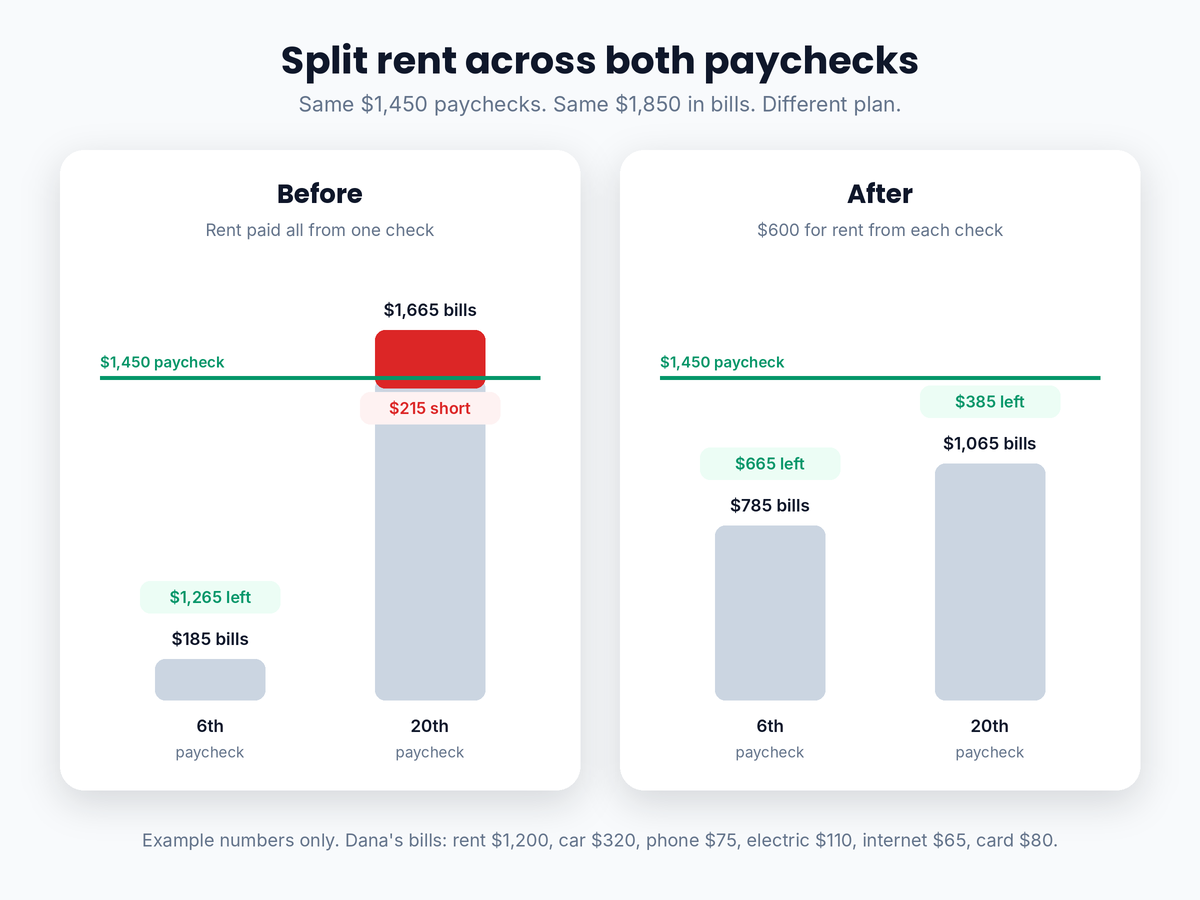
Same income. Same bills. Now both paychecks cover their bills, with money left over each time. Dana didn’t have to call anyone or borrow a dollar. It just took a plan for which paycheck pays what.
The first month is the hardest, because the 6th paycheck has to start saving for next month’s rent. If that’s too tight, start with a smaller amount and build up over two or three paychecks.
Match every bill to the right paycheck, free
Grab the free Budget by Paycheck Starter — type in your numbers and it shows your “money left to spend” automatically.
Free forever. No spam. Unsubscribe anytime.
Which Bills to Pay First When Money Is Tight
If you can’t cover everything this pay period, protect the basics first:
- Housing: rent or mortgage
- Utilities: electricity, water, heat
- Food and medicine
- Getting to work: car payment, insurance, gas, or transit
- Everything else: credit cards, other loans, subscriptions
For anything you can’t pay in full, call before the due date and ask about options. Pause subscriptions and other extras until you’re caught up.
Common Mistakes
- Paying bills from the paycheck after the due date. That’s how late fees start. Use the paycheck before.
- Spending the “light” paycheck. If one paycheck has few bills, that money is probably needed for the next big one.
- Setting autopay for the due date without checking your payday. Autopay is great once the timing works. Until then, it can cause overdrafts.
- Moving due dates without a plan. Moving every bill to the same week just creates a new pile-up.
- Using a payday loan to fix a timing problem. It turns a one-time gap into a monthly one.
A Simple Way to See What’s Due Next
Once your bills are mapped to paychecks, the hard part is remembering to look. That’s where a simple tracker helps.
The free Budget by Paycheck Starter gives you one dashboard for a single pay period. It shows your money left to spend and how many days are left until payday. Bills due within the next 7 days turn orange, and overdue bills turn red, so you can see what’s coming before it’s a problem. It works in Google Sheets and Excel.
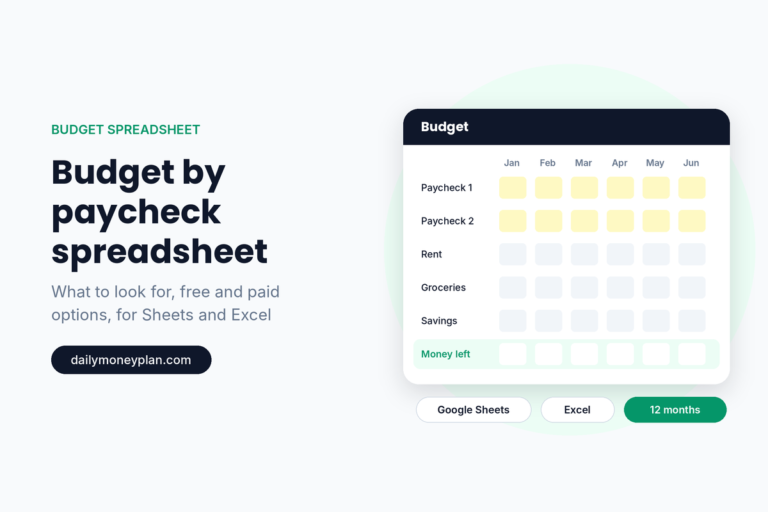
If you want the full year, the Budget by Paycheck System adds a due date column for every bill and debt, all 12 months in one workbook, and a balance that carries from month to month. Here’s more on the budget by paycheck spreadsheet.
FAQ
What should I do if I have bills due before payday?
Check for a grace period, then call the company before the due date. Ask for a short extension, a new due date, or a payment plan. Cover housing, utilities, food, and getting to work first. Avoid payday loans if you can.
Can I change my bill due dates?
Often, yes. Many credit card, phone, and utility companies let you pick a new due date, sometimes right in your online account. It can take a billing cycle or two to start. Rent and loans are harder to change, but it’s worth asking.
Will paying a bill a few days late hurt my credit?
Usually not by itself. Late payments are generally reported to the credit bureaus once you’re 30 days past due. You may still owe a late fee, so call early and ask if they can waive it.
What is the “paycheck before” rule?
Pay each bill from the last paycheck that arrives before its due date. Set that money aside the day you’re paid, even if the bill isn’t due yet. It keeps the light paycheck from getting spent on things it was needed for.
How do I get one month ahead on bills?
Build a small cushion about the size of your biggest bill. Months with an extra paycheck, tax refunds, and side income are good times to add to it. Once it’s there, you pay bills from money you already have.
Plan the Calendar Once
Bills due before payday feel like a money problem, but most of the time they’re a calendar problem. Map your bills to your paydays, pay each one from the paycheck before it, split your biggest bill, and move the due dates you can. You set it up once, and every month after gets easier.
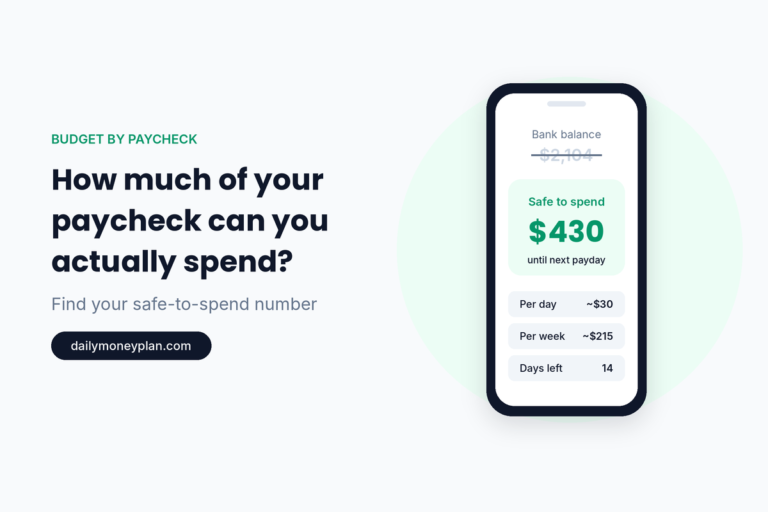
Start this week: write down every bill and its due date next to your paydays. For the full system behind it, here’s how to budget by paycheck. And to see what’s left after your bills, here’s how much of your paycheck you can actually spend.
Know which bills are due before your next paycheck
Grab the free Budget by Paycheck Starter. Type in your numbers and it shows your “Money Left to Spend” instantly — no complicated setup.
- See your safe-to-spend number the moment you fill it in
- Built for weekly & biweekly paychecks
- Works in Google Sheets and Excel, on any device
Free forever. No spam. Unsubscribe anytime.
This article is for general education only and isn’t personalized financial advice. Everyone’s situation is different, so adjust these ideas to fit yours.