How to Budget With ADHD: Why It’s Hard and What Actually Works
If you’ve started a budget, felt great about it for a week, and then quietly stopped opening it, you’re in good company. A lot of people with ADHD have a folder full of abandoned budgets and a nagging feeling that they’re just bad with money.
You’re probably not. Most budgets are built around skills that ADHD makes harder: remembering, planning ahead, tracking small details, and sticking with a boring task. When a system depends on those skills, it breaks, and you blame yourself instead of the system.
This guide to budgeting with ADHD explains why it feels so hard, what an ADHD-friendly budget actually needs, how to set one up in a single sitting, and how to keep it going after the first exciting week wears off.
Tired of budgets that don’t fit your brain?
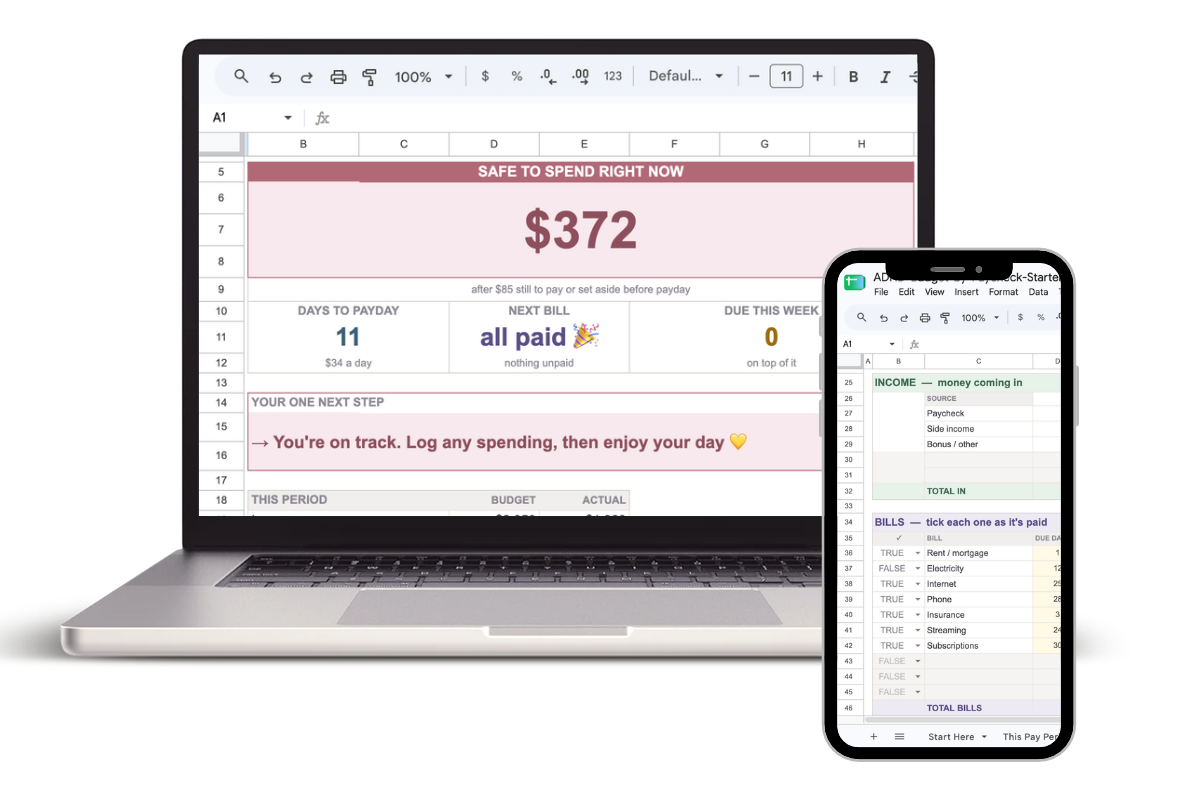
- One safe-to-spend number
- A countdown to payday
- Bills marked paid, due soon, or overdue
- A 24-hour impulse pause
Free for Google Sheets and Excel. Simple setup, no shame.
Why Budgeting With ADHD Feels So Hard
Here’s the good news first: ADHD doesn’t make you bad at math or unable to understand money. As the nonprofit Understood explains, the hard part is managing money, because that leans on executive function skills like attention, working memory, planning, impulse control, and keeping track of how you’re doing.
Think about what a typical budget asks you to do:
- Remember every bill and when it’s due
- Plan a whole month ahead
- Log every purchase, every day
- Stop and think before buying something you want right now
- Keep going long after the new-system excitement fades
Each of those is a place where ADHD tends to show up. So the budget doesn’t fail because you don’t care. It fails because it needs you to do the exact things that are hardest for your brain, over and over, with no reward.
What the research says
Research on ADHD and money is still fairly young, and most studies rely on people describing their own habits. Still, the findings match what many people with ADHD say about their own money.
In a 2017 study of 544 US adults, people who reported more ADHD symptoms also reported more late credit card payments, more carried balances, and more personal debt. That held even after the researchers accounted for things like income and education. A 2020 Dutch study of about 1,300 adults found that people with ADHD symptoms reported more impulse buying and were less likely to save on a regular basis. The authors noted that personality played a big part too.
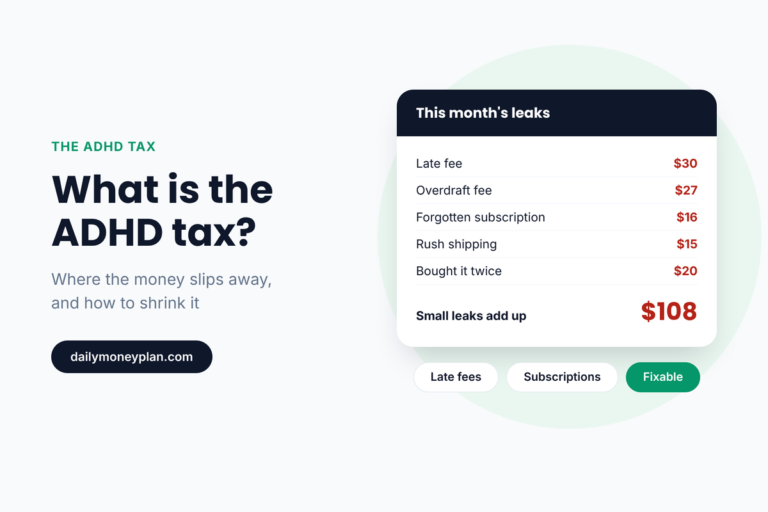
None of this means everyone with ADHD struggles with money. It means that if you do, you’re dealing with something common and real, not a personal failing. The extra costs that come from late fees, forgotten subscriptions, and impulse buys even have a name: the ADHD tax.
Why the usual budgeting advice backfires
Most budgeting advice is written for brains that find routine tasks easy to repeat. For an ADHD brain, some of the most common tips can make things worse:
- “Track every purchase.” Daily logging is the first habit to slip, and once you miss a few days, catching up feels impossible.
- “Use detailed categories.” Every category is a small decision. Twenty of them turns a five-minute task into a draining one.
- “Plan your month.” A month is a long time to hold in your head, especially if you’re paid every week or two.
- “Just have discipline.” Willpower runs out. A system that depends on it will fail on your worst day, and everyone has worst days.
The fix is a budget that’s built differently, not more effort with the same one.
What an ADHD-Friendly Budget Actually Needs
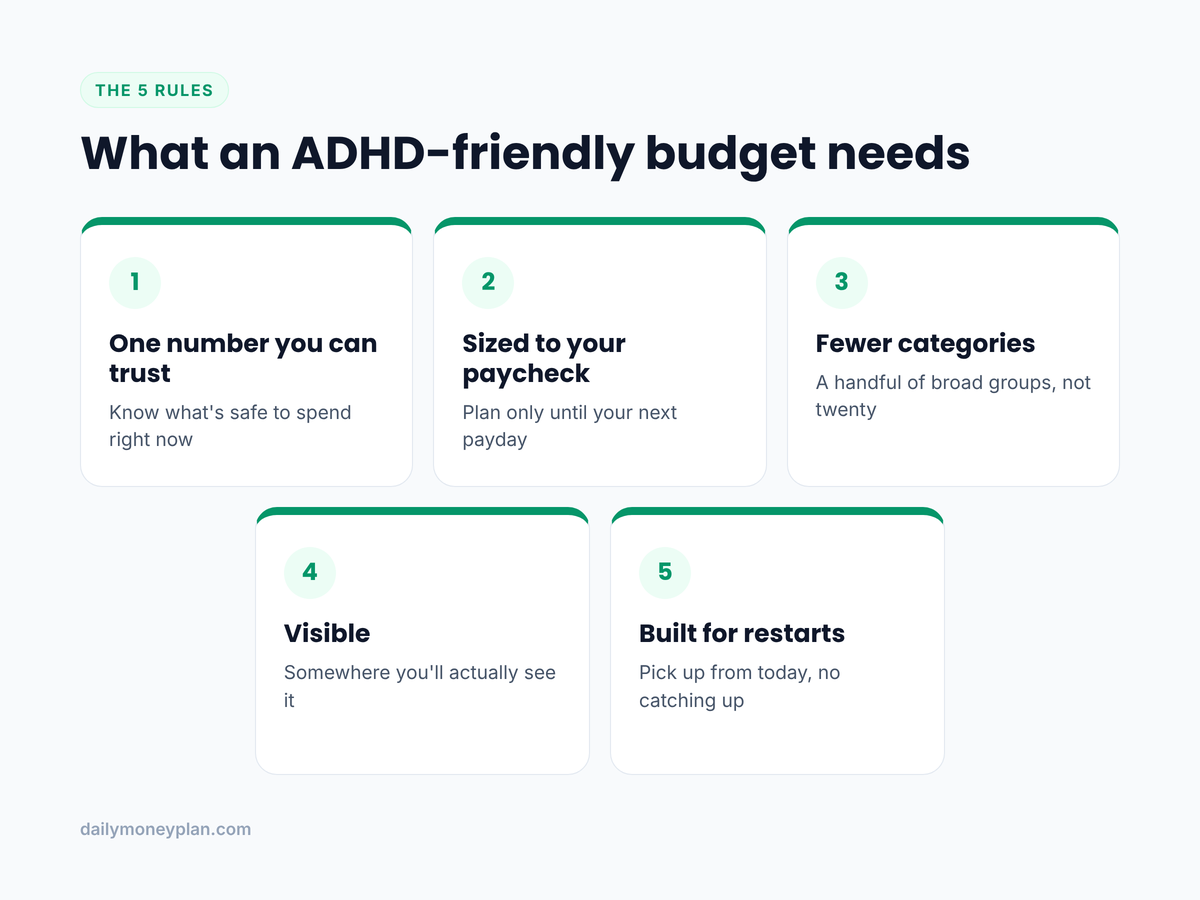
You don’t need a perfect budget. You need one you’ll still be using next month. In practice, that comes down to five things.
1. One number you can trust
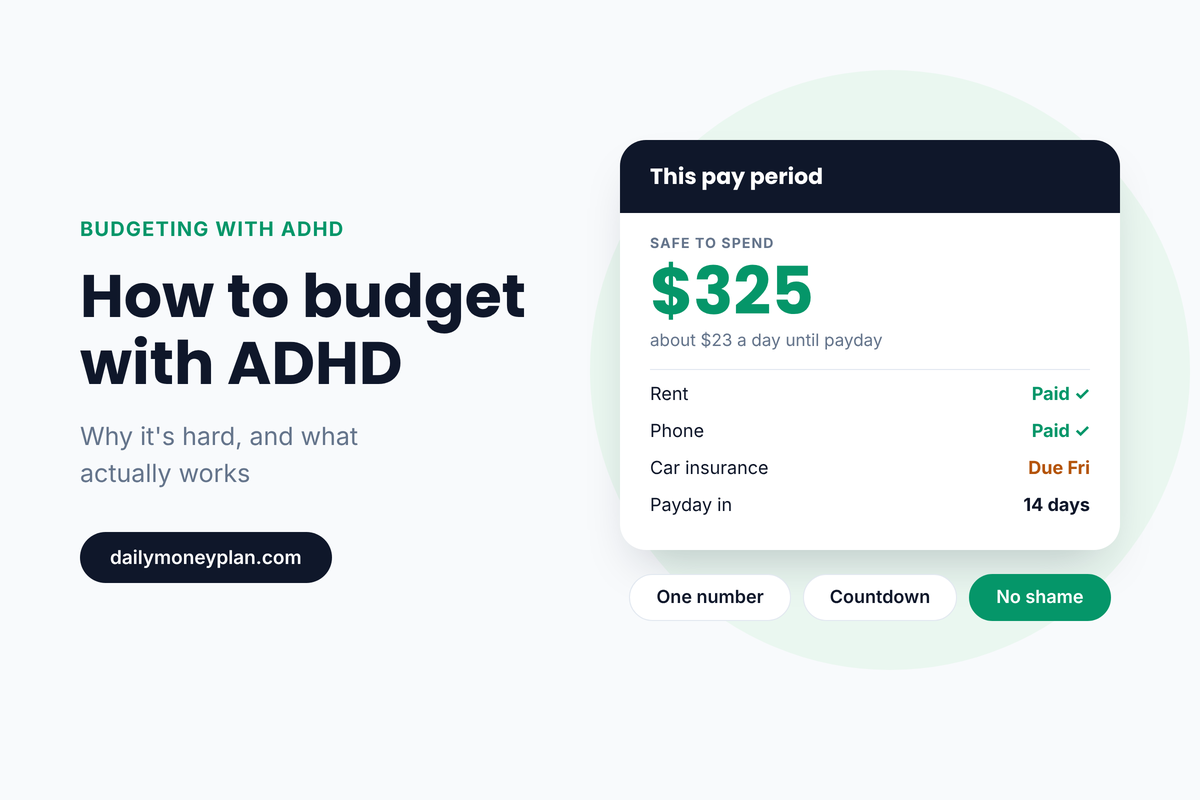
Instead of juggling categories in your head, your budget should give you one clear answer: how much you can safely spend right now. That’s your safe-to-spend number, which is the money left after the bills, debt payments, and savings you need to cover before your next payday.
When you know that number, a lot of daily decisions get easier. Can I get takeout tonight? Check the number. No spreadsheet math, no guessing.
2. Paycheck-sized, not month-sized
If you’re paid weekly or every two weeks, a monthly budget asks you to plan around money you don’t have yet. Budgeting by paycheck shrinks the job. You only plan from this payday to the next one, so there’s less to hold in your head and you get a fresh start more often.
If this is new to you, this guide to budgeting by paycheck walks through the basic method. There’s also a step-by-step guide on how to budget with ADHD when you get paid.
3. Fewer categories
Keep it to a handful of broad groups, like bills, everyday spending, debt, and savings. You can split “everyday spending” into a few categories if that helps, but stop well before it feels like homework. A simple budget you keep beats a detailed one you abandon.
4. Visible and outside your head
Out of sight really can mean out of mind. If your budget lives in a file you never open, it doesn’t exist on a busy week. Put it somewhere you’ll see it: a shortcut on your phone’s home screen, a bookmark on your laptop, or a note on the fridge with your safe-to-spend number.
The same goes for bills. Put every bill in one list with its due day, so nothing depends on memory. If bills tend to slip for you, here’s why bills slip through the cracks and how to catch them.
5. Built for restarts
Every budget gets skipped sometimes. An ADHD-friendly budget expects that. It should be easy to pick back up from today without fixing the past. If missing two weeks means hours of catch-up, the system will eventually lose.
How to Set Up a Budget With ADHD in One Sitting
Give yourself 30 to 45 minutes, a drink you like, and permission for this to be rough. You can adjust it later. The goal today is a budget that works for one pay period.
Step 1: Pick one simple tool
A spreadsheet, an app, or a notebook can all work, and a ready-made ADHD budget spreadsheet can save you the setup. The best choice is the one that asks the least of you and that you’ll actually open. If you’re not sure which to pick, this comparison of budgeting apps vs spreadsheets for ADHD can help. Don’t spend more than a few minutes deciding. Pick one and move on.
Step 2: Write down what’s coming in this pay period
Start with the money you’ll actually have: the paycheck you just got (or the next one), plus any side income you know is coming. Use your take-home pay, the amount that lands in your bank account.
Step 3: List the bills due before your next payday
Go through your bank app and email and list every bill that’s due before your next paycheck arrives. Write the amount and the day of the month it’s due. Don’t forget debt payments and subscriptions. Anything due after your next payday can wait for that paycheck.
Step 4: Set aside a little for savings
Pick an amount small enough that it won’t hurt, even $10 or $20. A small amount you actually move is better than a big goal you skip. You can raise it later. If saving has never stuck for you, this guide on how to save money with ADHD goes deeper.
Step 5: Find your safe-to-spend number
Here’s the simple math:
Money coming in, minus bills and debt payments due before payday, minus savings = safe to spend
That number covers groceries, gas, eating out, and fun until your next paycheck. Divide it by the days until payday to see roughly what you can spend per day.
Step 6: Automate what you safely can
Automation takes memory out of the picture. Set up autopay for bills that stay the same each month, like your phone or car insurance. Schedule payments a few days after payday so the money is there, and keep a small cushion in checking so a payment doesn’t overdraw your account. Start with the one bill you forget most often, and add more once that’s working.
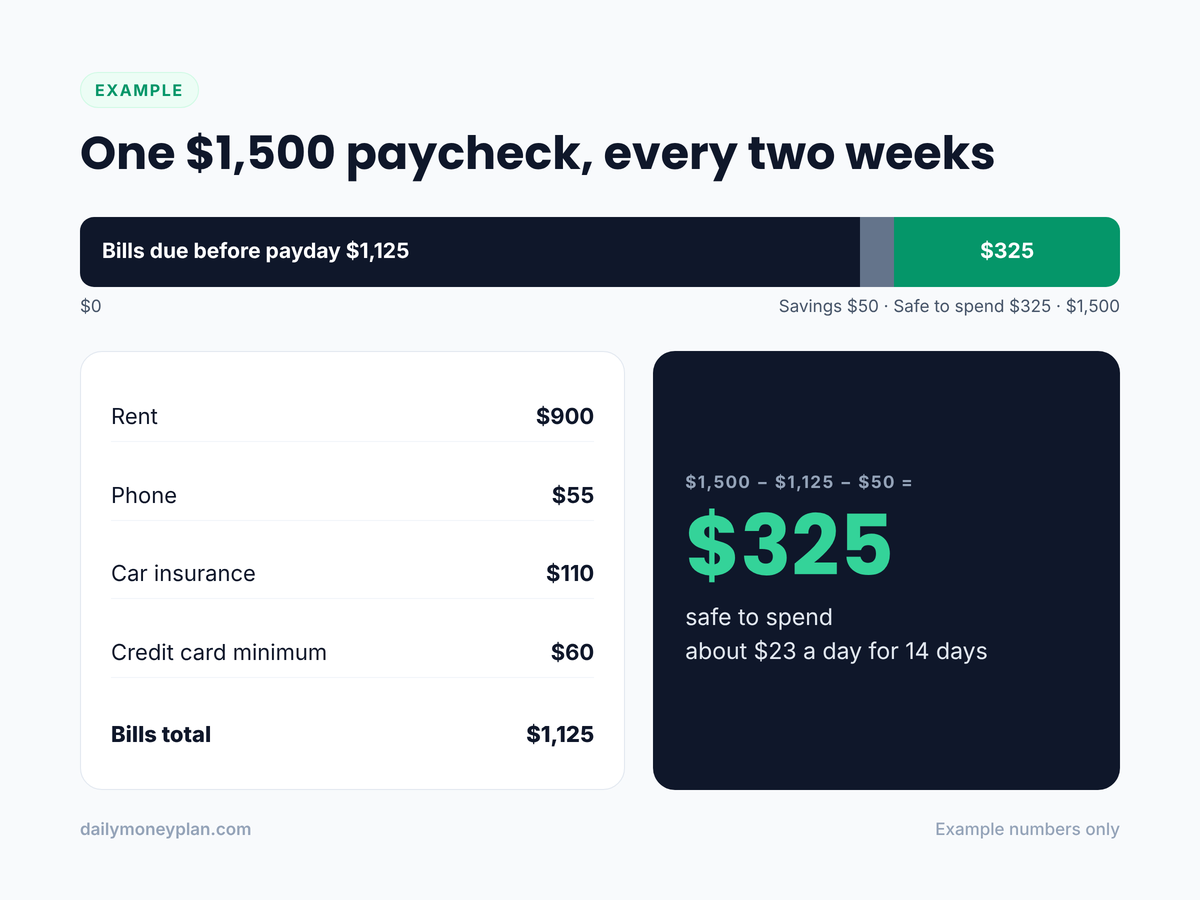
Example: a $1,500 biweekly paycheck
Here’s how it might look for someone paid $1,500 every two weeks. These numbers are just an example, not a target.
- Coming in: $1,500 paycheck
- Due before next payday: rent $900, phone $55, car insurance $110, credit card minimum $60 (total $1,125)
- Savings: $50
- Safe to spend: $1,500 − $1,125 − $50 = $325
- Per day: $325 ÷ 14 days = about $23 a day for groceries, gas, and everything else
That’s the whole budget for this pay period. One number to check, one list of bills, one small savings step.
Want your safe-to-spend number without the math?
Get the free ADHD Budget Starter for Google Sheets and Excel. It does the math for you, one paycheck at a time.
How to Keep Your Budget Going (the Part Most Guides Skip)
Setting up a budget is the easy part. Many budgets fade two or three weeks in, quietly, without any big failure. These habits help yours last.
Check in once a week, not every day
Pick one day a week, like payday or Sunday morning, and spend 10 minutes on four things: add up what you spent, look at bills coming up, check your safe-to-spend number, and notice one thing that went well. That’s it. A short weekly check-in is much easier to keep than daily tracking. Here’s how to build a 10-minute weekly money routine that sticks.
Make progress easy to see
Saving rarely feels rewarding in the moment, and spending usually does. You can balance that out by making progress visible: a savings bar that fills up, bills ticked off as paid, or a note of every week you stayed on track. Small, visible wins give you a reason to come back.
Put a pause before impulse buys
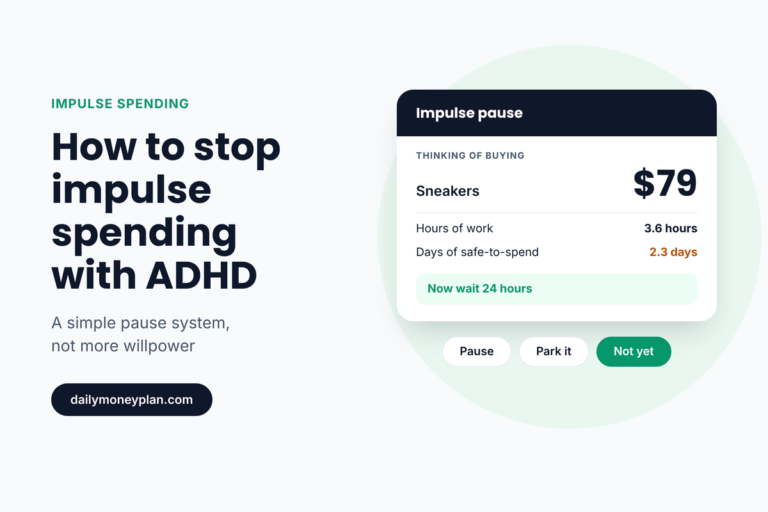
If you’re tempted by something that isn’t urgent, wait 24 hours before buying it. Write it down, check it against your safe-to-spend number, and decide tomorrow. Often the urge passes. For more ways to slow down, see how to stop impulse spending with ADHD.
Restart from today, not from where you left off
Missed a week? Missed a month? Skip the catch-up. Check your current bank balance, list the bills due before your next payday, and work out a new safe-to-spend number. You’re back on track in ten minutes. The past few weeks don’t need to be perfect for this week to work.
Common ADHD Budgeting Mistakes
Most of these come from trying too hard, not too little.
- Starting with the perfect system. Building a complex budget feels productive, but it uses up the energy you need to keep it going. Start small.
- Tracking every coffee. Category totals once a week are enough for most people. Log individual purchases only if it genuinely helps you.
- Budgeting by month when you’re paid every two weeks. Match your budget to your paychecks so the numbers make sense.
- Forgetting irregular bills. Annual renewals, car repairs, and holiday costs aren’t really surprises. They just don’t come often. Set aside a little each paycheck so they don’t wreck your budget.
- Using guilt as motivation. Shame makes it harder to look at your money, which makes things worse. Treat overspending as information, adjust, and move on.
- Quitting after one bad week. One bad week is normal. It’s only the end of your budget if you decide it is.
Frequently Asked Questions
What is the best budgeting method for ADHD?
There isn’t one best method for budgeting with ADHD. Many people with ADHD do well with a simple, paycheck-based budget built around a single safe-to-spend number, a short weekly check-in, and autopay for regular bills. The best method is the one you’ll still be using in a month.
Should I use a budgeting app or a spreadsheet?
Either can work. Apps can import purchases automatically, which helps if logging is your weak spot. Spreadsheets are quieter and more flexible, and they don’t send guilt-inducing alerts. Think about which one you’re more likely to open on a busy week.
How often should I check my budget?
Once a week is a good place to start. It’s often enough to catch problems early, and short enough to actually happen. Some people also glance at their safe-to-spend number before a bigger purchase.
What if my income changes from paycheck to paycheck?
Budget from the money you actually receive, one paycheck at a time. Plan your bills and savings from each check as it arrives, and keep a small buffer from bigger paychecks to cover smaller ones.
I’ve quit budgeting many times. Is it worth trying again?
Yes, but try something different rather than the same budget again. Make it smaller, simpler, and easier to restart. Quitting before usually means the system asked too much, not that you can’t do it.
Should I get outside help?
If money stress is affecting your health or relationships, talking to someone can help. An ADHD coach or your healthcare provider can help with the ADHD side, and a nonprofit credit counselor can help if debt feels unmanageable.
Start Smaller Than You Think
Budgeting with ADHD gets easier when the system does more of the work: one number to check, a plan that only covers until your next payday, bills you can see, and a weekly check-in you can restart anytime. You don’t need more discipline. You need a setup that fits how your brain works.
Pick one step from this guide and do it today. Write down your bills due before payday, or work out your safe-to-spend number. That’s a real start.
If you’d rather not build it from scratch, you can grab our free ADHD Budget by Paycheck Starter below. It gives you a safe-to-spend number, a payday countdown, and a simple list of bills for one pay period, in Google Sheets or Excel. And if you want everything for the whole year in one file, the ADHD Budget by Paycheck System is there when you’re ready.
Want a budget that fits how your brain works?
- One safe-to-spend number
- A countdown to payday
- Bills marked paid, due soon, or overdue
- A 24-hour impulse pause
Free for Google Sheets and Excel. Simple setup, no shame.
This article is for educational purposes and isn’t personalized financial or medical advice. Everyone’s situation is different, so adjust these ideas to fit yours.