What Is the ADHD Tax? Why Money Slips Away and How to Stop It
You had the money. The bill was right there in your email. And somehow it still turned into a $30 late fee.
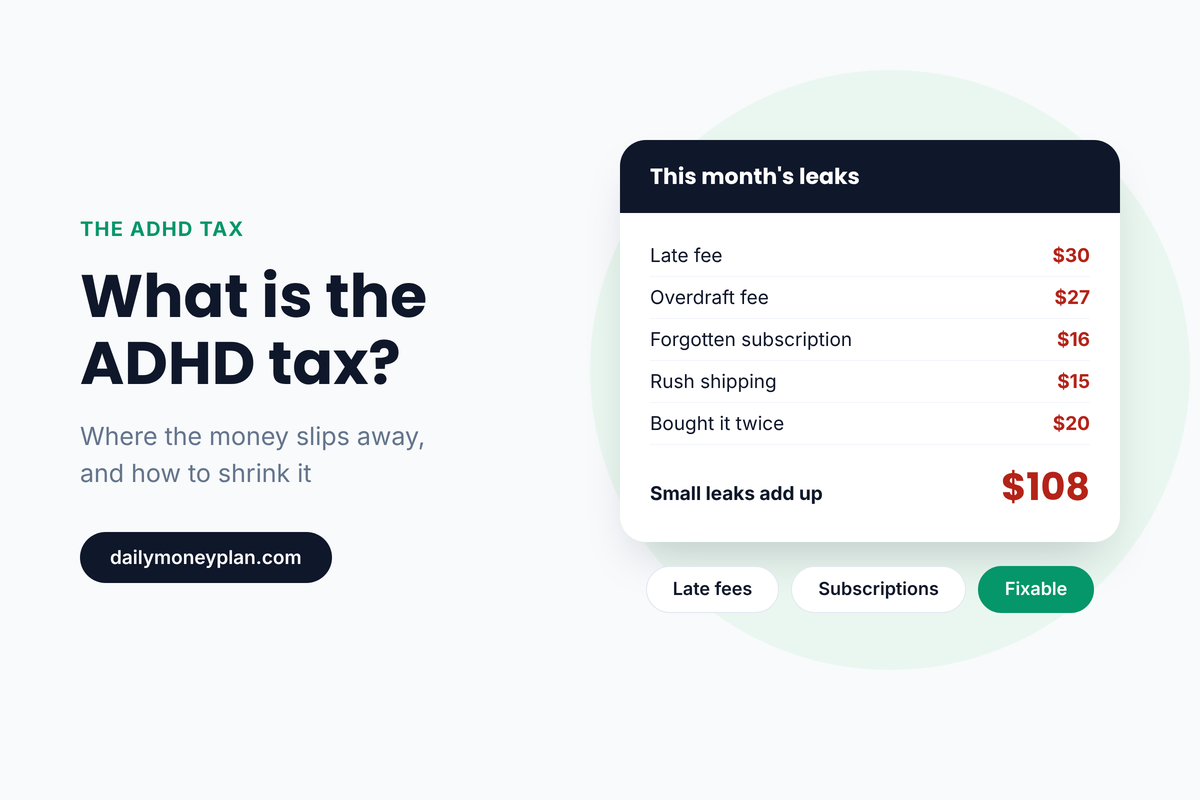
If that sounds familiar, you’ve met the ADHD tax. It’s the extra money people with ADHD often pay because of forgotten due dates, rushed decisions, and things that slip out of sight. Late fees, subscriptions you forgot about, rush shipping, buying something twice because the first one vanished.
None of this means you’re bad with money. It means your money system is leaning on memory and timing, and those are the exact things ADHD can make harder. That’s fixable.
In this guide, you’ll see where the ADHD tax usually hides, why it happens, how to find your own number in one sitting, and one simple fix for each leak.
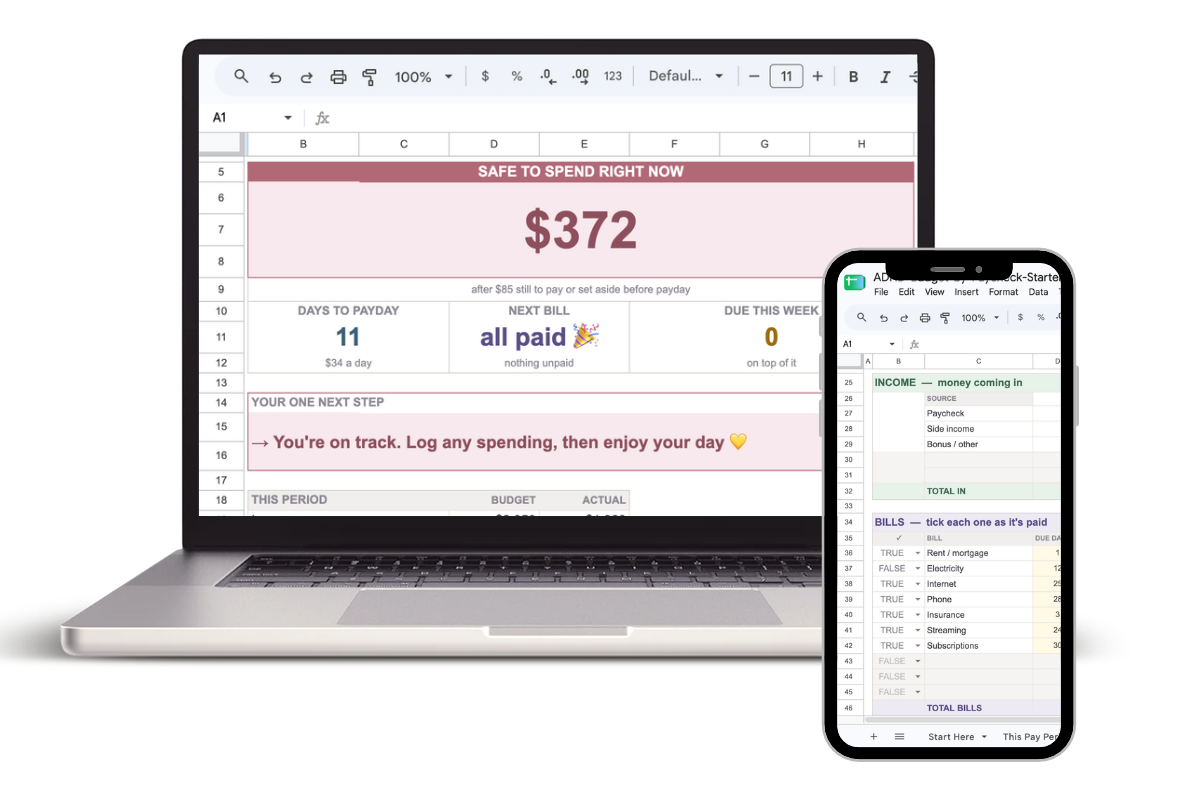
Want to see where your ADHD tax is going?
- One safe-to-spend number
- A countdown to payday
- Bills marked paid, due soon, or overdue
- A 24-hour impulse pause
Free for Google Sheets and Excel. Simple setup, no shame.
What Is the ADHD Tax?
The ADHD tax is an informal name for the extra costs that come from ADHD symptoms meeting everyday life. As Understood puts it, it’s not an actual tax people have to pay, but it can still cost money.
It isn’t a medical term, and it isn’t one big expense. It’s lots of small ones: a fee here, a wasted purchase there. Each one feels too small to fix, so it happens again next month.
It has a time and stress cost too. Calling to get a fee reversed, re-buying something, the dread of opening your bank app. That part matters, because shame is what keeps many people from looking at the leaks at all.
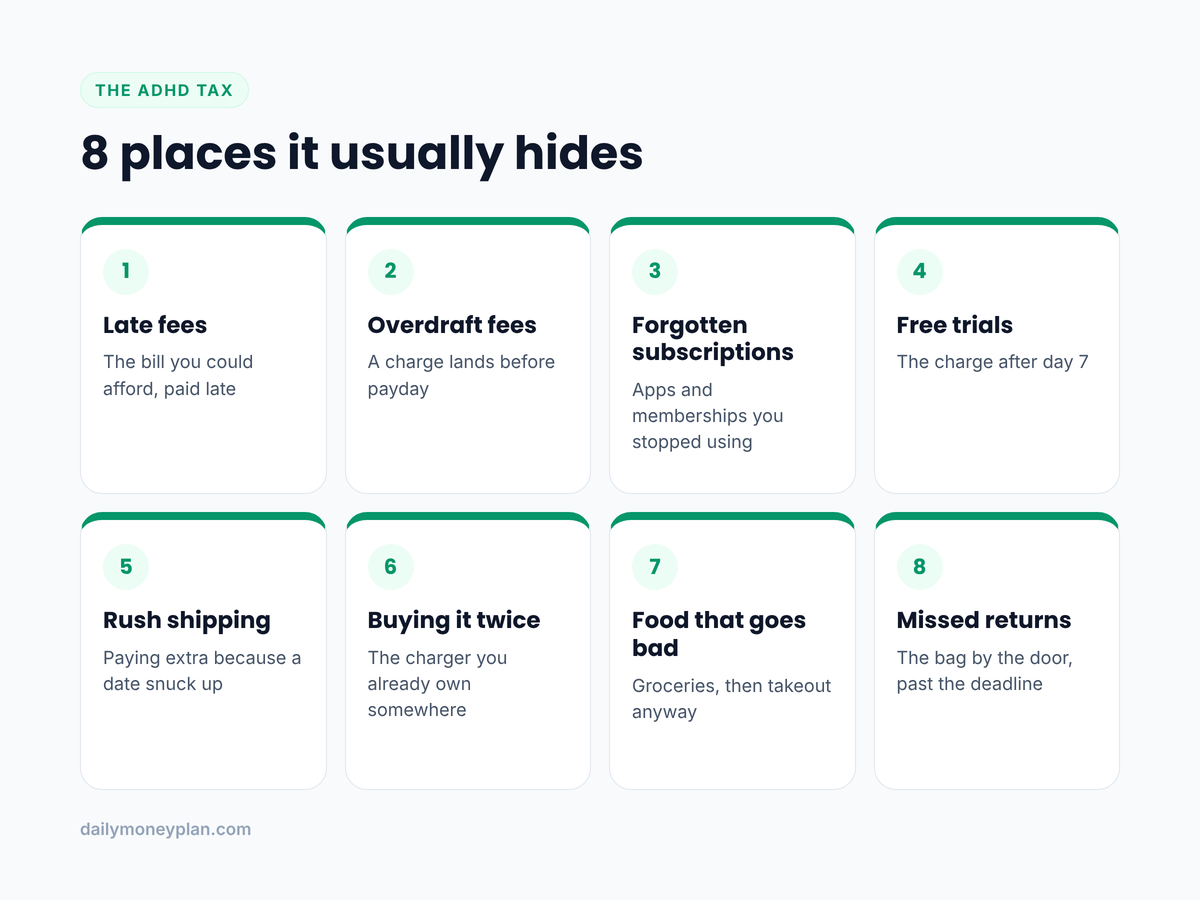
Where the ADHD Tax Hides: 8 Common Leaks
Most ADHD tax shows up in the same few places. See which ones sound like you.
- Late fees. You had the money, you just missed the date. The CFPB found the average late fee at major card issuers reached $32 in 2022, and WalletHub put the 2025 average at $30.50, according to the AP.
- Overdraft fees. A charge goes through before payday and the bank adds a fee. Bankrate’s 2025 study put the average overdraft fee at $26.77.
- Forgotten subscriptions. Apps, streaming, memberships you stopped using. This one isn’t only an ADHD thing: in a 2022 C+R Research survey, people misjudged their subscription costs by $133 a month on average, and 42% kept paying for something they no longer used.
- Free trials that turn into charges. You meant to cancel before day 7.
- Rush shipping. Paying extra because a birthday or deadline snuck up.
- Buying it twice. The charger, the tape, the black shirt you already own but can’t find.
- Food that goes bad. A full week of groceries, then takeout because cooking felt like too much.
- Missed returns. The item sits in the bag until the return window closes.
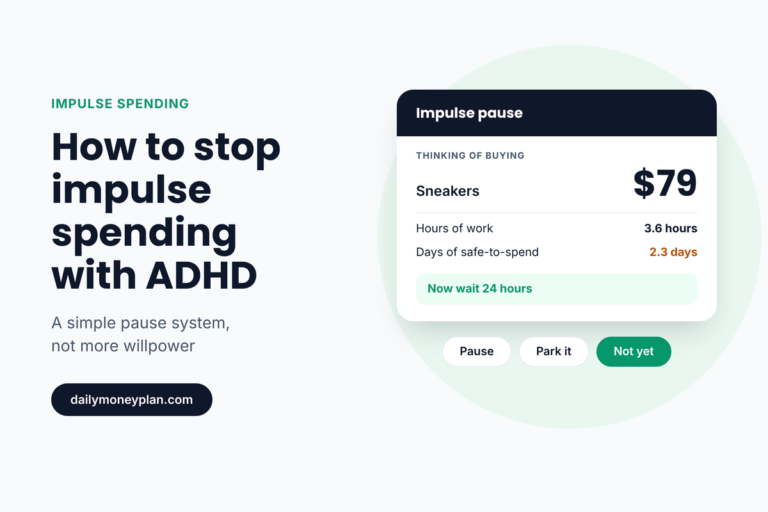
Impulse buys belong here too. They’re big enough to get their own guide: how to stop impulse spending with ADHD.
Why It Happens (and Why It Isn’t Carelessness)
ADHD affects executive functions: the brain skills behind planning, remembering, and following through. Money happens to depend on all of them. A few patterns explain most of the ADHD tax:
- Time blindness. “Due Friday” feels far away until it’s Saturday. Deadlines sneak up because future dates don’t feel real yet.
- Out of sight, out of mind. A bill that isn’t in front of you can disappear from your mind completely. It’s not that you don’t care. Your working memory is holding a hundred other things.
- Acting fast. Rush shipping, a quick “add to cart,” a trial you sign up for in ten seconds. Speed costs money when there’s no pause built in.
- Avoidance. After a few fees, opening the bank app feels awful, so you stop checking. Then more leaks go unnoticed. That loop is the most expensive one.
It’s also common. A large Swedish study found that adults with ADHD were more than four times as likely to have bank overdrafts as other adults. You’re not the only one, and there’s a reason it happens. The fix isn’t trying harder. It’s setting up your money so fewer things depend on memory and timing.
Find Your Number: A Quick ADHD Tax Check
You can’t shrink what you can’t see. So before fixing anything, find out roughly what the ADHD tax costs you. This takes one sitting.
- Open last month’s bank and card statements. One month is enough to start.
- Look for the 8 leaks above. Fees, subscriptions, rush charges, re-buys, trials. Also think back to food you threw out and returns you missed.
- Write each one down with the amount. No judging. You’re just collecting information.
- Add it up. That’s your ADHD tax for the month.
- Circle the leaks you could fix once. Those are where you start.
Example: Maya’s Month
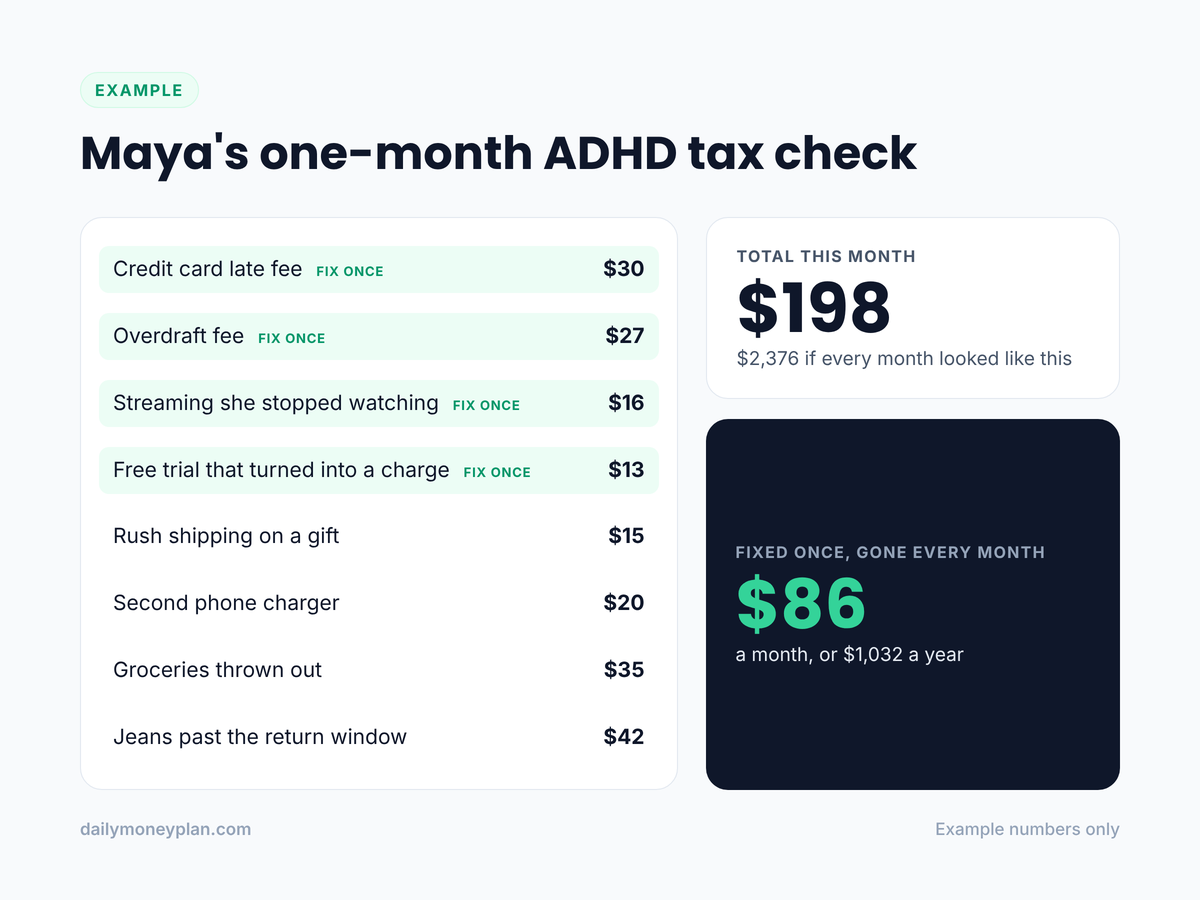
Here’s what one month could look like. This is an example, not anyone’s real budget.
Maya checks last month’s statements and her memory, and finds:
- Credit card late fee: $30
- Overdraft fee: $27
- A streaming service she stopped watching: $16
- A free trial that turned into a charge: $13
- Rush shipping on a birthday gift: $15
- A second phone charger, because the first one is lost: $20
- Groceries thrown out: $35
- Jeans she missed the return window on: $42
That’s $198 in one month. If a month like that repeated all year, it would add up to $2,376.
Now the useful part. The first four leaks (the late fee, the overdraft, the streaming service, and the free trial) can each be fixed once, with a setting or a cancellation. Together they’re $86 a month, or $1,032 a year, and they don’t need any willpower after the first fix. The other $112 comes from everyday habits, which take more time to change.
That’s why the plan below starts with the set-once fixes.
Track your ADHD tax in one simple place
Get the free ADHD Budget Starter for Google Sheets and Excel. It does the math for you, one paycheck at a time.
How to Shrink the ADHD Tax: One Fix for Each Leak
Don’t try to fix everything this week. Pick one leak, ideally your biggest set-once leak, and fix it today. Then add another next week.
Start with the set-once fixes
Late fees: set up autopay for the minimum. Turn on autopay for at least the minimum payment on each card and loan. You can still pay more by hand. Pick a payment date a few days after payday, so the money is there first. If money is tight and autopay could overdraw your account, use a reminder three days before the due date instead. And if a late fee does hit, call and ask for it to be waived. The AP notes that companies often reverse a fee, especially for a first late payment.
Overdraft fees: check your overdraft setting and add an alert. Under federal rules, your bank can’t charge overdraft fees on ATM and one-time debit card purchases unless you’ve opted in. Check if you did. If you opt out, those card purchases are usually declined instead of costing you a fee. Then turn on a low-balance alert in your banking app, so you hear about trouble before it costs you.
Forgotten subscriptions: do the 10-minute audit below and cancel what you don’t use.
Free trials: cancel on day one. When you sign up for a trial, set a phone reminder for two days before it ends. Or cancel right away: many services let you keep using the trial until it ends anyway. Check the terms first.
The 10-minute subscription audit
Set a timer for 10 minutes. That’s it.
- Search your email for “receipt,” “renewal,” and “subscription.”
- Check the subscriptions list on your phone (in your App Store or Google Play account settings).
- Scan one month of bank and card statements for repeat charges.
- For each one, ask: “Did I use this in the last month?”
- Cancel the no’s. Write the yes’s in one list with their renewal dates.
Repeat it every few months, or any time a charge surprises you.
Then the everyday leaks
These take a little more practice, but each has a simple guardrail.
- Rush shipping: keep a “running low” list on your phone, and reorder when something is half full, not empty. Put birthdays in your calendar with a reminder a week before.
- Buying it twice: give the things you lose most a “home spot.” Before buying, check your home spots, or snap a quick photo of your pantry before you shop.
- Food that goes bad: shop for three or four days instead of a full week. Keep one “eat first” spot in the fridge. Plan one super easy backup meal for low-energy nights.
- Missed returns: keep a returns bag by the door. When you buy something you might return, put the return deadline in your calendar the same day.
- Bills you forget: keep every bill in one list you’ll actually see. Here’s more on why you keep forgetting to pay bills and how to catch them.
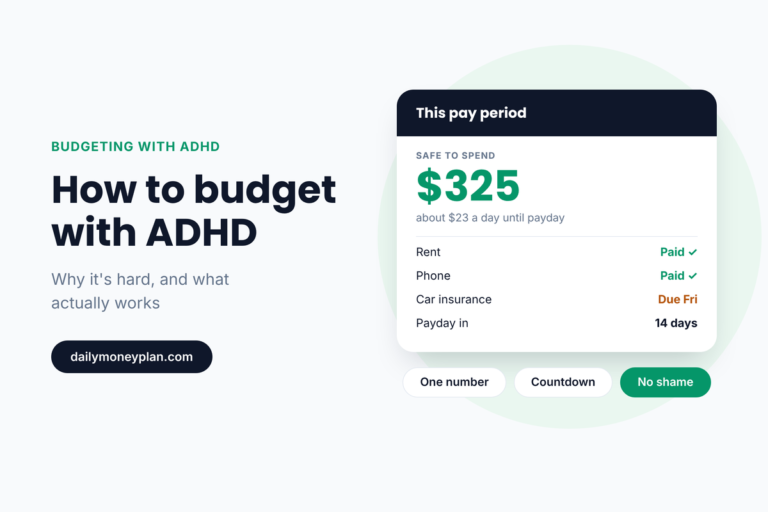
- Impulse buys: wait 24 hours before anything that isn’t planned. It’s easier when you know what’s actually safe to spend. Here’s how to budget with ADHD around your paydays.
Your Monthly ADHD Tax Checklist
Once a month, or once a payday, check these spots:
- Any late fees or overdraft fees? Call about each one.
- Any new subscriptions or trials? Still using them?
- Any rush shipping? What ran out, and can it go on the “running low” list?
- Anything bought twice? Does it need a home spot?
- Any food thrown out? Shop for fewer days next time.
- Any returns waiting? Check the deadlines.
- Write this month’s total next to last month’s.
A short weekly money check-in makes this even easier, because you catch leaks while they’re still small.
When You Slip (Because You Will)
You will pay some ADHD tax again. Everyone does. The goal isn’t zero. The goal is a smaller number than before.
When a fee hits, skip the “I’m so stupid” part. It doesn’t save money, and it makes you avoid your bank app, which costs more. Instead, ask one question: “What setting or habit would have stopped this?” Then add that one fix.
It also helps to set aside a small cushion for the leaks you can’t prevent yet. Even $10 or $20 a paycheck takes the sting out of the next surprise. Here’s more on how to save money with ADHD, even if saving has never worked for you before.
A Simple Place to Track It
Tracking the ADHD tax works best when it lives next to the rest of your money, not in a separate app you’ll forget about.
The free ADHD Budget by Paycheck Starter has a built-in ADHD tax section with rows for late fees, unused subscriptions, replacing lost items, and rushed or last-minute costs. It totals your “ADHD tax this period” for every paycheck, so you can watch it shrink. It also shows your Safe to Spend Right Now number, marks bills amber when they’re due within 7 days, and has a 24-hour Impulse Pause. It works in Google Sheets and Excel.
If you’d like the whole year in one file, the ADHD Budget by Paycheck System adds a full-year budget with Safe to Spend, a payday countdown, the Impulse Pause, and a Weekly Reset.
FAQ
What is the ADHD tax?
The ADHD tax is the extra money people with ADHD often pay because of things like forgotten due dates, rushed decisions, and lost items. Common examples are late fees, overdraft fees, forgotten subscriptions, rush shipping, and buying things twice. It’s an informal term, not a real tax or a medical term.
Is the ADHD tax real?
The name is informal, but the costs are real. Late fees and overdraft fees are real charges, and research has found that adults with ADHD are more likely to have overdrafts. The good news is that many of these costs can be prevented with simple settings and habits.
How much does the ADHD tax cost?
There’s no reliable single number, and it’s different for everyone. The best way to know yours is to check one month of statements and add up the leaks. In the example above, Maya found $198 in one month.
How do I stop paying the ADHD tax?
Start with the fixes you only make once: autopay for minimum payments, checking your overdraft setting, a low-balance alert, and canceling unused subscriptions. Then add everyday habits, like a returns bag by the door and shopping for fewer days at a time.
Does autopay help with ADHD?
Often, yes. Autopay for at least the minimum payment removes the need to remember a due date. Set the payment date a few days after payday so the money is there first. If your balance is often low, a reminder may be safer than autopay until you have a small cushion.
Shrink It One Leak at a Time
The ADHD tax is real, it’s common, and it isn’t a character flaw. It grows in the gaps where your money depends on memory and timing. Close those gaps one at a time, starting with the fixes you only have to make once, and the number gets smaller.
Start today: open last month’s statements and find your number. If you’re new to all this, here’s how to budget with ADHD in a way that fits how your brain works.
Ready to shrink your ADHD tax?
- One safe-to-spend number
- A countdown to payday
- Bills marked paid, due soon, or overdue
- A 24-hour impulse pause
Free for Google Sheets and Excel. Simple setup, no shame.
This article is for general education only and isn’t personalized financial advice. Everyone’s situation is different, so adjust these ideas to fit yours. Daily Money Plan makes the ADHD Budget by Paycheck Starter and System mentioned above.