How to Stop Impulse Spending With ADHD
It’s 11 p.m. You’re scrolling, something catches your eye, and two taps later it’s ordered. A few days later the package shows up, and you feel… nothing. Maybe a little guilty.
If that loop sounds familiar, you’re not alone, and it isn’t a character flaw. ADHD impulse spending happens when the urge to buy moves faster than the part of you that would stop and think, and modern checkout is built to be even faster.
The fix isn’t more willpower. It’s a setup that puts a pause between wanting and buying. In this guide, you’ll see why ADHD makes impulse buys so hard to resist, a simple 4-step system to buy on purpose, the speed bumps that help most, and what to do when an impulse buy slips through anyway.
Want a pause button for impulse buys?
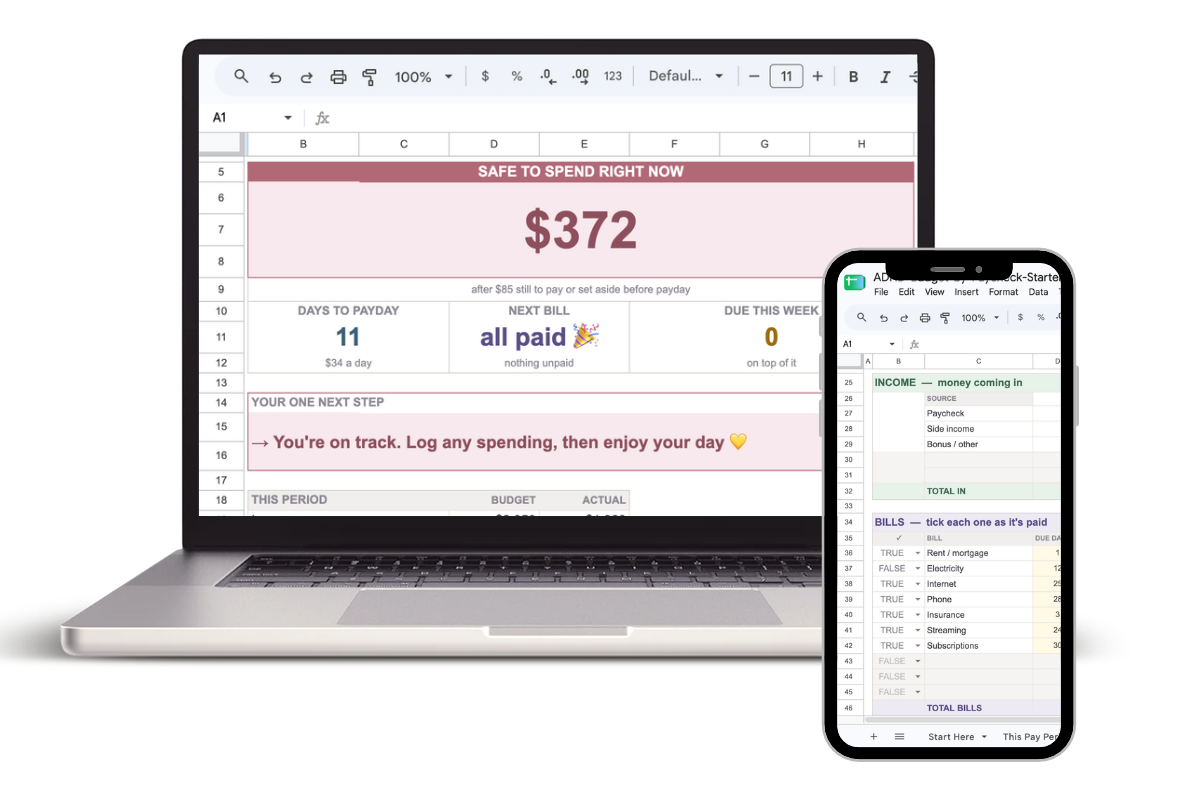
- One safe-to-spend number
- A countdown to payday
- Bills marked paid, due soon, or overdue
- A 24-hour impulse pause
Free for Google Sheets and Excel. Simple setup, no shame.
Why ADHD Impulse Spending Happens (It’s Not Weak Discipline)
If you’ve ever told yourself “I just need more self-control,” here’s what the research actually points to.
Waiting is the hard part. A 2024 study of 225 adults with ADHD found they reported more impulsive buying than adults without ADHD, and the link ran through one thing: the ability to put off a reward. In other words, “now” feels much louder than “later.” The study used self-reports and can’t prove cause and effect, but it fits what many people with ADHD describe. An earlier Dutch study also found that more ADHD symptoms went with more impulse buying.
That’s good news, because it points straight at the fix: build the waiting into your system, so you don’t have to win the “now vs later” fight in the moment.
You often want the feeling, not the thing. Bored, stressed, tired, excited. Buying something new gives a quick lift. Then the package arrives, the lift is gone, and the thing just sits there.
Buying is designed to be fast. One-click checkout, saved cards, “buy now, pay later,” and “deal ends tonight” are all built to remove the pause. Every second they remove is a second your brain doesn’t get to catch up.
Cards feel less real than cash. In a well-known study, people told to pay by credit card offered more than twice as much for the same basketball tickets as people told to pay cash. Tapping a card just doesn’t register the same way.
None of this means you’re bad with money. It means the system around your money needs a few brakes.
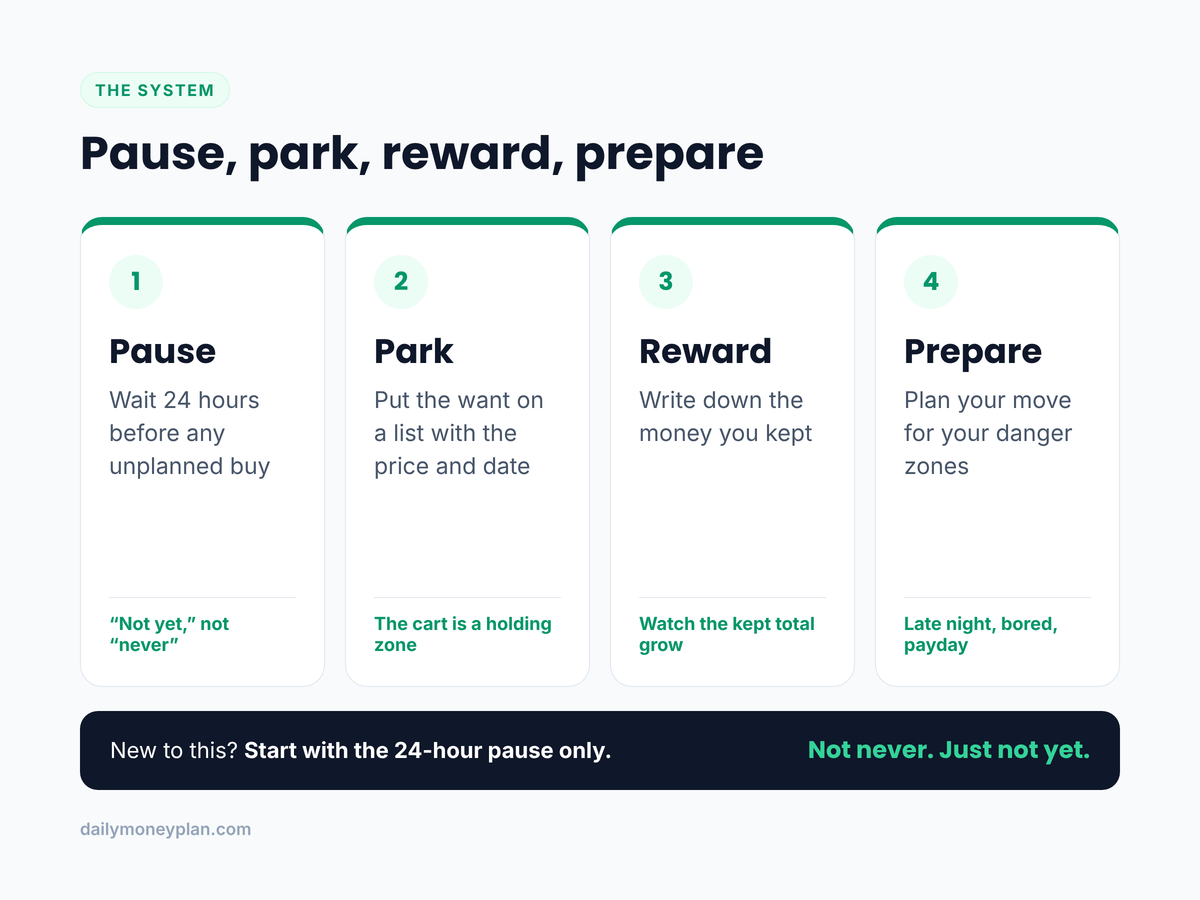
The Pause, Park, Reward, Prepare System
Instead of a long list of rules you won’t remember at 11 p.m., use four steps.
1. Pause: wait 24 hours
When you want something you didn’t plan to buy, don’t decide now. Decide tomorrow. That’s the 24-hour rule, and for bigger purchases, sleep on it for a few days.
While you wait, ask two quick questions:
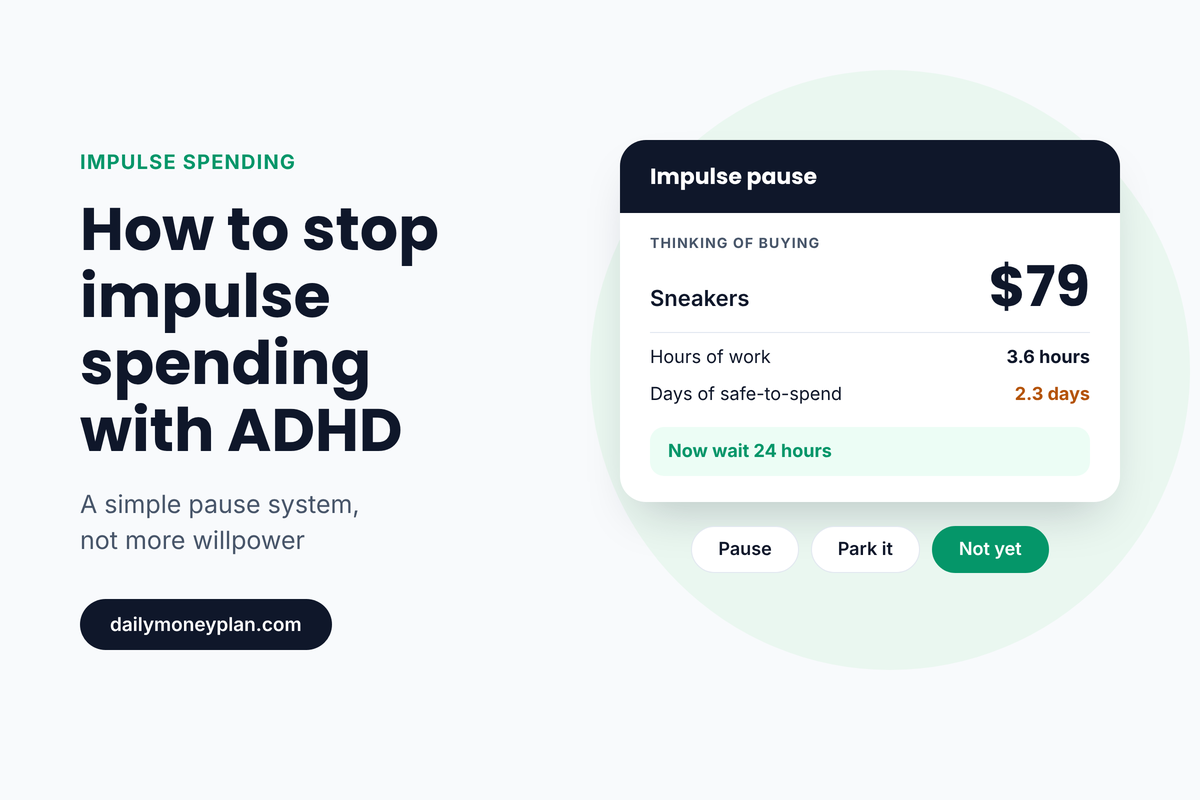
- What would this cost in hours of work? If you take home $22 an hour, a $79 purchase is about 3.6 hours.
- What is this money for? Rent, a trip, a calmer next payday? Picture that instead.
You’re not saying no. You’re saying not yet.
2. Park: give the want somewhere to wait
Write it down on a want-it-later list: what it is, the price, and the date. Or leave it in your online cart and close the tab. The cart becomes a holding zone, not a checkout line.
Parking matters because “I’ll never get it” feels like a loss. “It’s saved, I can decide tomorrow” doesn’t. Once a week, look at the list. You’ll notice how many things you’ve quietly stopped wanting.
3. Reward: count what you kept
Every time you let something go, write down the amount as money you kept. Watching that number grow gives you some of the same good feeling buying would have, without the regret. If you can, move that money into savings so it doesn’t disappear into the next want.
4. Prepare: plan your move before the urge hits
Urges tend to show up at the same times: late at night, when you’re bored, after a hard day, on payday. Name your top two danger zones, then decide your move in advance. For example: “When I’m scrolling in bed, the phone goes across the room and I read instead.”
It’s much easier to follow a plan you made when you were calm than to make one in the moment.
Start with one rule. If this feels like a lot, start with the 24-hour pause only. Add the others once it feels normal.
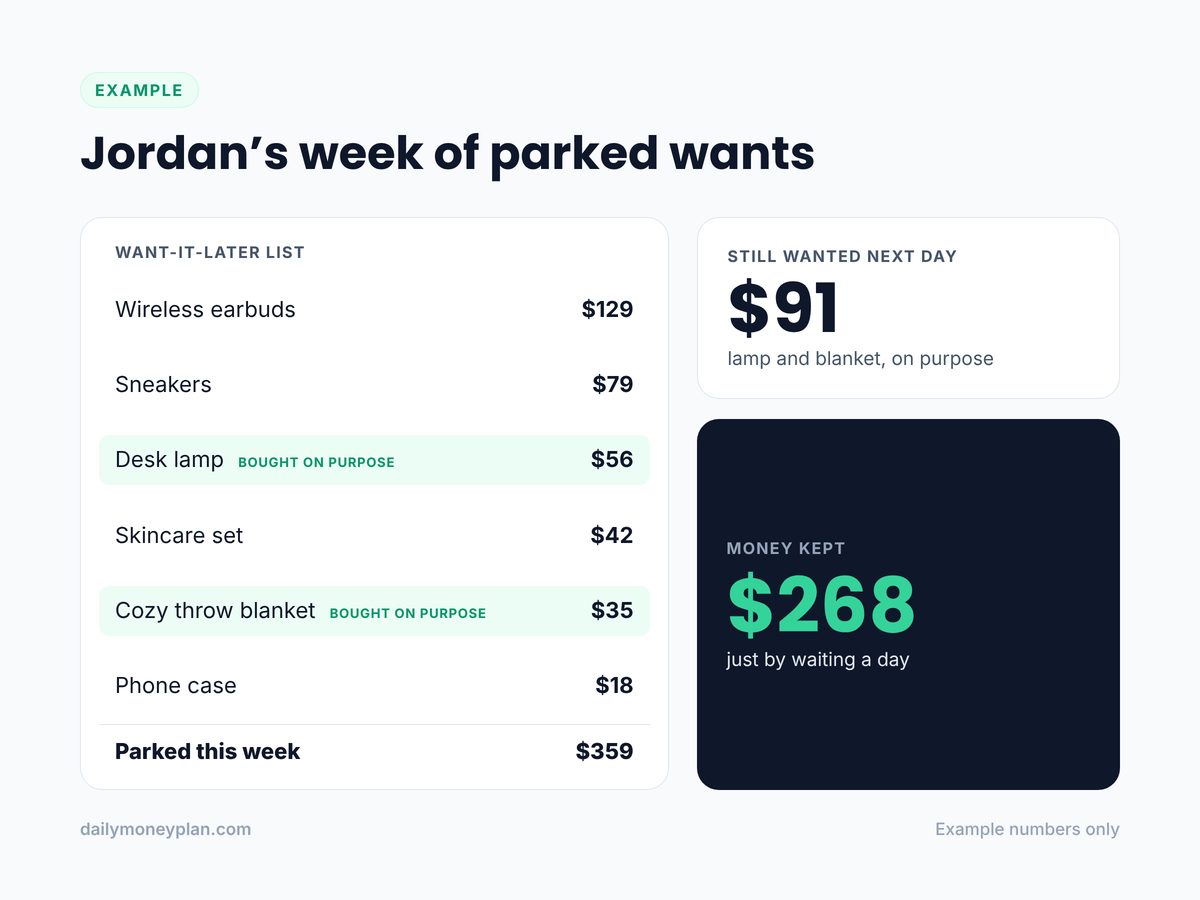
Example: Jordan’s Week of Parked Wants
Here’s how one week could look. This is an example, not anyone’s real budget.
Jordan has $372 safe to spend with 11 days until payday. That’s about $34 a day. Over one week, six things tempt Jordan, and each one goes on the want-it-later list instead of straight to checkout:
- Wireless earbuds: $129
- Sneakers: $79
- Desk lamp: $56
- Skincare set: $42
- Cozy throw blanket: $35
- Phone case: $18
That’s $359 of wants. The sneakers alone would be about 2.3 days of Jordan’s safe-to-spend money.
A day later, Jordan still wants two things: the desk lamp and the blanket. Jordan buys both, on purpose, for $91, and lets the other four go.
Jordan kept $268. No big sacrifice, no “I’m banned from shopping.” Just a pause.
See what you can actually afford before you buy
Get the free ADHD Budget Starter for Google Sheets and Excel. It does the math for you, one paycheck at a time.
Add Speed Bumps Between You and “Buy Now”
Willpower is unreliable. Friction isn’t. Spend 15 minutes once, adding a few small speed bumps:
- Remove saved cards from shopping sites and your browser. Getting up to find your card is a built-in pause.
- Turn off one-click checkout where you can.
- Log out of your top two shopping apps, and move them off your home screen. Opening an app “just to look” is how a lot of impulse buys start.
- Turn off shopping notifications, and unsubscribe from store emails and texts.
- Unfollow the accounts that make you shop, on Instagram and TikTok. You already know which ones they are.
- Skip “buy now, pay later” for wants. It makes a price feel smaller than it is. The CFPB found that BNPL borrowers were, on average, much more likely to be highly indebted.
- Try a cash test. For one week, pay for one category, like takeout or Target runs, with cash only. Notice whether it feels different.
- Keep a pause in your pocket. A note on your phone or a small card in your wallet with three questions: What am I feeling right now? Will I care about this in a week? Can I wait 24 hours?
Late-night shopping gets its own rule: no buying after a set time, say 10 p.m. Put things in the cart if you want, then decide in the morning.
Spot the Stories Your Brain Tells
In the moment, your brain is very good at building a case for buying now. A few common ones, with a calmer line to answer each:
- “I deserve this.” You do deserve good things. You also deserve the calm payday you’re building.
- “The deal ends tonight.” There’s almost always another sale. The urgency belongs to the store, not to you.
- “I’ll definitely use it.” Check your want-it-later list. Would you buy it at full price next week?
- “It’s only $20.” Small buys add up fast. They’re one of the biggest parts of the ADHD tax.
You don’t have to argue with the fast voice. Just let it finish, then read the calmer line.
When the Urge Is Really About a Feeling
A lot of impulse spending is emotional spending: shopping to fix boredom, stress, or a bad day. Blocking the purchase helps, but you also need something else that meets the need.
One popular idea is a “dopamine menu,” introduced by Jessica McCabe of How to ADHD. It’s a short list of things that lift your mood without spending money: a walk, a favorite playlist, texting a friend, a shower, ten minutes of a game. The research behind it is still mixed, so treat it as a practical tool, not a cure. Having the list ready means that when the urge hits, you have options other than “add to cart.”
If you notice you’re shopping to cope with something heavy, that’s worth gentle attention, not blame. Talking it through with someone you trust, or a professional, can help.
What to Do After an Impulse Buy
It will happen sometimes. Here’s what to do next:
- Skip the shame. Beating yourself up makes you avoid your bank app, and that costs more than the purchase.
- Check the return window. If you regret it, return it. That’s not failure. It’s the system working a little late.
- Check your one number. Look at what’s safe to spend until payday, so the rest of the pay period stays calm.
- Ask what triggered it. Bored? Tired? Late at night? Add that moment to your danger zones.
It also helps to plan for some impulse spending. A small, guilt-free “fun money” amount each paycheck makes the occasional treat part of the plan instead of a slip. If saving has always felt impossible, here’s how to save money with ADHD in small, visible steps.
A Simple Place to Pause
The pause works best when the answer to “can I afford this?” is one glance away.
The free ADHD Budget by Paycheck Starter has an Impulse Pause box built in. Type the price and your take-home pay per hour, and it shows the purchase as hours of work and days of your safe-to-spend money, then reminds you to wait 24 hours. There’s also an Impulse buffer line, so a small treat has a planned home. It works in Google Sheets and Excel.
If you want this for the whole year, the ADHD Budget by Paycheck System has a “park it here for a day” Impulse Pause list on the dashboard. You note what you want, the price and the date, and it tells you how that compares with your Safe to Spend. It also includes a payday countdown and a weekly reset. You can see how to budget with ADHD around your paydays for the method behind it.
FAQ
How do I stop impulse spending with ADHD?
Build a pause into your system instead of relying on willpower. Wait 24 hours before buying anything unplanned, park the want on a list, count the money you keep, and plan your move for the times you usually shop. Then add speed bumps, like removing saved cards and logging out of shopping apps.
Why do people with ADHD impulse buy?
Research points to difficulty putting off a reward. “Now” feels louder than “later.” Shopping can also be a quick fix for boredom or stress, and online checkout is designed to be fast. It’s about how ADHD affects waiting, not about caring less or being bad with money.
Does the 24-hour rule work?
It helps for many people, because it builds the waiting into the decision. Many urges fade overnight, and the ones that don’t are usually things you really want. Pair it with a want-it-later list, so waiting doesn’t feel like losing the item.
Is it okay to buy something on impulse sometimes?
Yes. The goal is buying on purpose, not never buying anything fun. Set aside a small guilt-free amount each paycheck, like an impulse buffer, so the occasional treat fits your budget.
Does paying with cash help with ADHD impulse spending?
It can. Research suggests people tend to spend more with cards than with cash. Try a one-week cash test for a single category, like takeout, and see whether it changes how spending feels.
Not Never. Just Not Yet.
ADHD impulse spending isn’t a willpower problem. It’s a waiting problem, and you can build the wait into your system. Pause, park, reward, prepare. Add a few speed bumps. When something slips through, return it or let it go, and check your number.
Start tonight: write down the next thing you want to buy, with today’s date, and decide tomorrow. And if you’re building your whole money system from scratch, here’s how to budget with ADHD in a way that fits how your brain works.
Ready to buy on purpose, not on impulse?
- One safe-to-spend number
- A countdown to payday
- Bills marked paid, due soon, or overdue
- A 24-hour impulse pause
Free for Google Sheets and Excel. Simple setup, no shame.
This article is for general education only and isn’t personalized financial advice. Everyone’s situation is different, so adjust these ideas to fit yours.