How to Budget by Paycheck: A Simple System That Actually Sticks
How many budgets have you started on a Monday and quietly given up on by the end of the week? If the answer is more than one, I want you to hear something first: it probably wasn’t you.
Most budgets fail for one boring reason. They’re built around a tidy monthly paycheck that almost nobody actually gets. You get paid on the 1st and the 15th, or every other Friday, and your bills show up whenever they feel like it. A neat monthly budget was never going to survive that.
Budgeting by paycheck fixes the mismatch. Instead of guessing at a whole month at once, you plan each paycheck as it comes in. It’s simpler, it matches how money actually moves through your life, and it’s a lot easier to stick with. Here’s exactly how to do it.

Know exactly what’s safe to spend this payday
Grab the free Budget by Paycheck Starter. Type in your numbers and it shows your “Money Left to Spend” instantly — no complicated setup.
- See your safe-to-spend number the moment you fill it in
- Built for weekly & biweekly paychecks
- Works in Google Sheets and Excel, on any device
Free forever. No spam. Unsubscribe anytime.
What “budget by paycheck” actually means
Budgeting by paycheck means you build your plan around your pay dates instead of the calendar month.
When a paycheck lands, you give every dollar in it a job before you spend any of it. Some goes to the bills due before your next payday. Some goes to savings. Some is set aside for things like groceries and gas. Whatever is left is yours to spend without worry.
That’s the whole idea. You’re not budgeting a month you can’t see yet. You’re budgeting the money that’s actually in your account, for the short stretch until the next check arrives.
Why monthly budgets fail for how you’re really paid
Here’s the thing almost no one points out. Most people in the US don’t get paid once a month.
Biweekly pay (every two weeks) is the single most common pay schedule, used by 43% of private employers, according to the U.S. Bureau of Labor Statistics. Add in weekly pay and you’ve got the majority of workers getting several smaller paychecks a month, not one big one.
So when you try to run a monthly budget, you’re forcing your real life into a shape it doesn’t fit. Rent is due the 1st. Your paycheck lands the 3rd. A card payment auto-drafts on the 2nd. For a few days every month the math just doesn’t line up, even when you earn plenty over the full month. You’re not bad with money. Your bills and your paydays are simply out of sync.
Budgeting by paycheck lines them back up. If that gap keeps leaving you short at the end of every pay period, here’s why you’re always broke before payday and how to fix it.
The system, step by step
Here’s the whole method. It looks like a lot written out, but once it’s set up, each payday takes about ten minutes.
Step 1: Write down your take-home pay, by paycheck
Start with what actually hits your account, not your salary before taxes. If you’re paid biweekly, write down the amount of one normal paycheck. If your pay changes (tips, commission, gig work), use a low, safe number you can count on, and treat anything extra as a bonus later.
Step 2: List your bills with their due dates
Write every regular bill and the day of the month it’s due. Rent or mortgage, utilities, phone, insurance, subscriptions, minimum debt payments, all of it. The due date matters as much as the amount here, so don’t skip it.
Step 3: Assign each bill to the paycheck that comes before it’s due
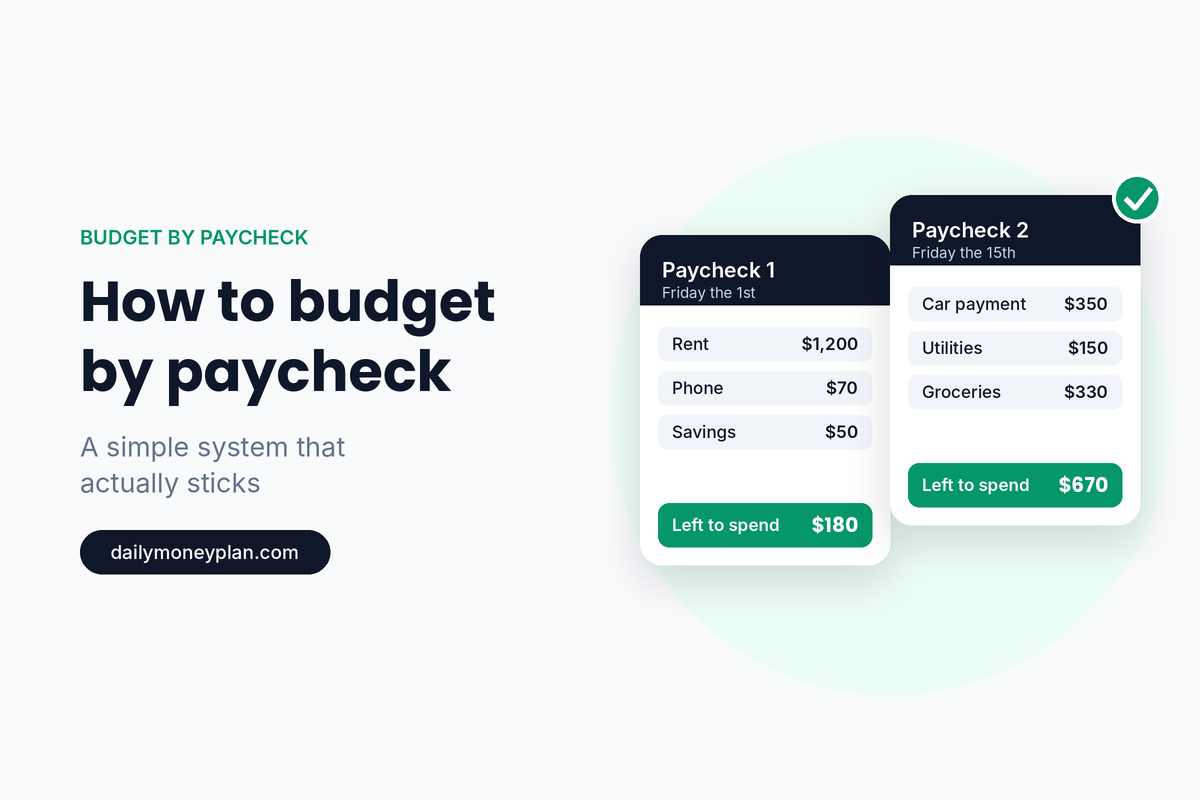
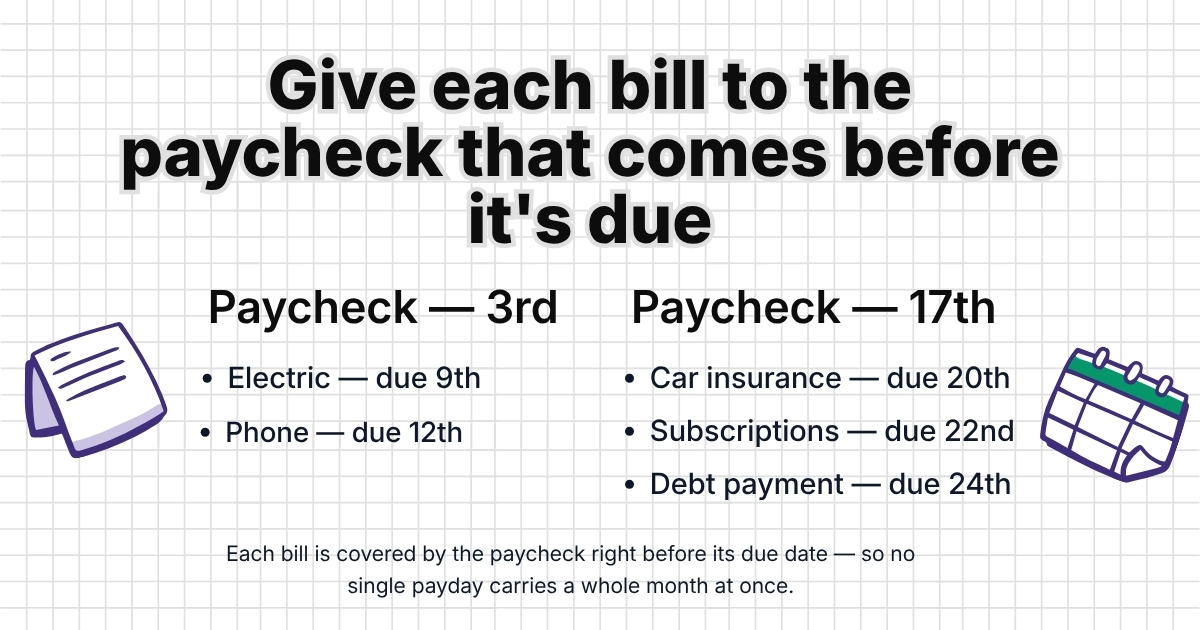
This is the heart of the system. Look at each bill’s due date, then hand it to the paycheck that lands before that date. When that paycheck comes in, set the money aside right away so it’s there when the bill hits.
A bill due on the 10th gets covered by the paycheck you got on the 3rd. A bill due on the 25th gets covered by the paycheck on the 17th. Now no single payday has to carry a whole month of bills at once. Paid every other Friday? Here’s a closer look at how to budget when you get paid every two weeks.
Step 4: Give savings and sinking funds a job too
Before you spend what’s left, set aside a little for savings and for the irregular costs that always seem to ambush you. Car registration, the holidays, an annual subscription, a surprise car repair. Putting a small amount aside each paycheck for these “sinking funds” is what keeps one bad week from blowing up the whole plan.
Even a small amount counts. The habit matters more than the number.
Step 5: Find your “money left to spend”
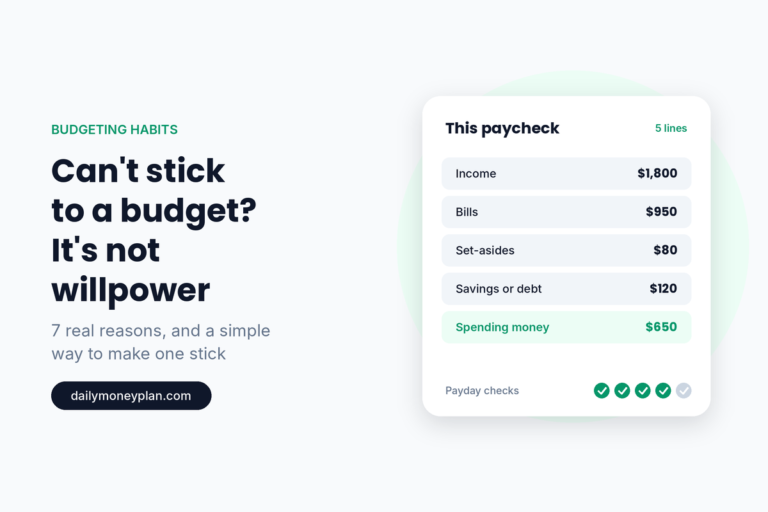
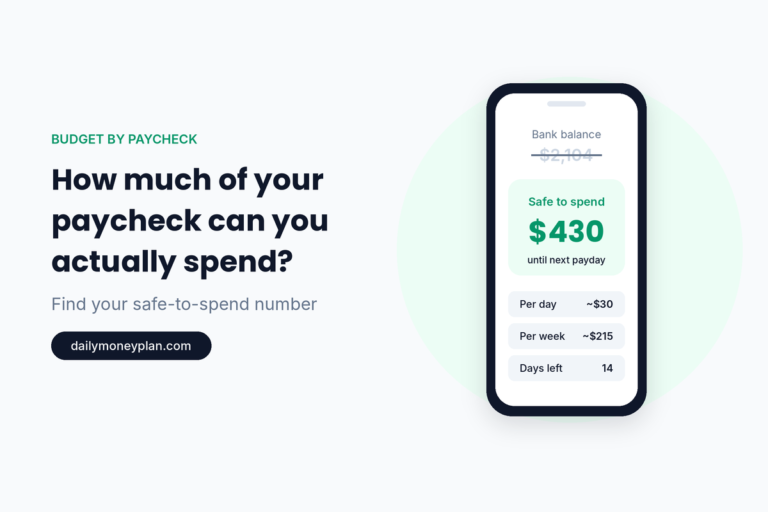
Once this paycheck’s bills, savings, and set-asides are handled, whatever remains is your safe-to-spend money until the next payday. That one number is the quiet magic of this whole system. No guilt, no mental math, no wondering “can I actually afford this?” You already know.
Step 6: Do a quick weekly check
Once a week, take five minutes to glance at what you’ve spent and what’s left. That’s it. You’re not tracking 40 categories or logging every coffee. You’re just making sure the plan still matches reality, and nudging it if it doesn’t.
Want the template that does this math for you?
Grab the free Budget by Paycheck Starter — type in your numbers and it shows your “money left to spend” automatically.
Free forever. No spam. Unsubscribe anytime.
A realistic example
Let’s make this concrete. These are example numbers to show how it works, not a target for anyone.
Say you take home about $1,500 every two weeks. One paycheck lands on the 3rd, the next on the 17th.
Your bills look like this:
- Rent $1,200, due the 1st
- Electric $120, due the 9th
- Phone $60, due the 12th
- Car insurance $110, due the 20th
- Streaming + subscriptions $35, due the 22nd
- Minimum debt payment $90, due the 24th
Here’s how you’d split it:
Paycheck on the 3rd ($1,500) covers the bills due before the 17th: electric ($120) and phone ($60). You’d also set aside part of the rent for next month, plus a little savings. Say $300 toward next month’s rent and $75 to savings. That leaves about $945 for groceries, gas, and spending until the 17th.
Paycheck on the 17th ($1,500) covers car insurance ($110), subscriptions ($35), and the debt payment ($90). You set aside the rest of next month’s rent ($900) and another $75 to savings. That leaves about $290 for the back half of the month.
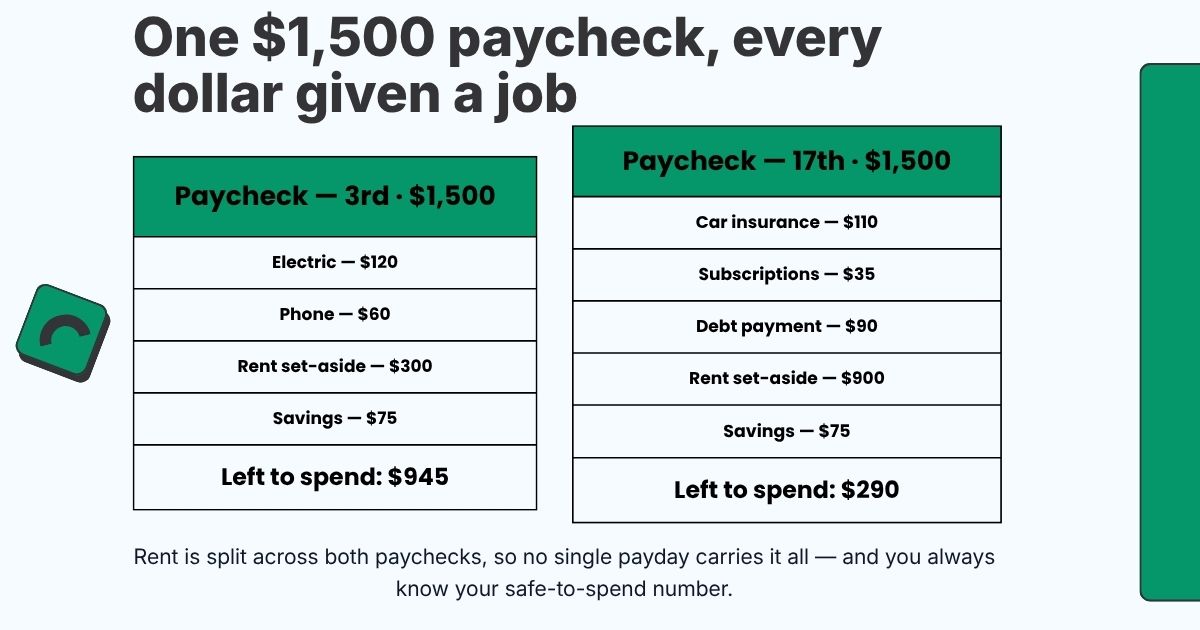
Rent never lands as a single gut-punch, because you built it across two paychecks. Every bill is covered by money you set aside before it was due. And at any moment, you know your safe-to-spend number.
The two “extra paycheck” months most people miss
Here’s a nice perk of biweekly pay. Because there are 52 weeks in a year, getting paid every two weeks means 26 paychecks a year, not 24. That works out to two months where you get a third paycheck instead of the usual two.
Most people spend those extra checks without even noticing. But if you plan for them on purpose, that third paycheck is a gift. It’s a perfect chance to knock out a debt, fully fund a sinking fund, or finally build a little breathing room. Mark those two months on your calendar now. Here’s how to decide what to do with your extra paychecks.
Common mistakes to avoid
A few things trip people up early:
- Budgeting your gross pay. Always plan around take-home pay, the amount that actually lands in your account.
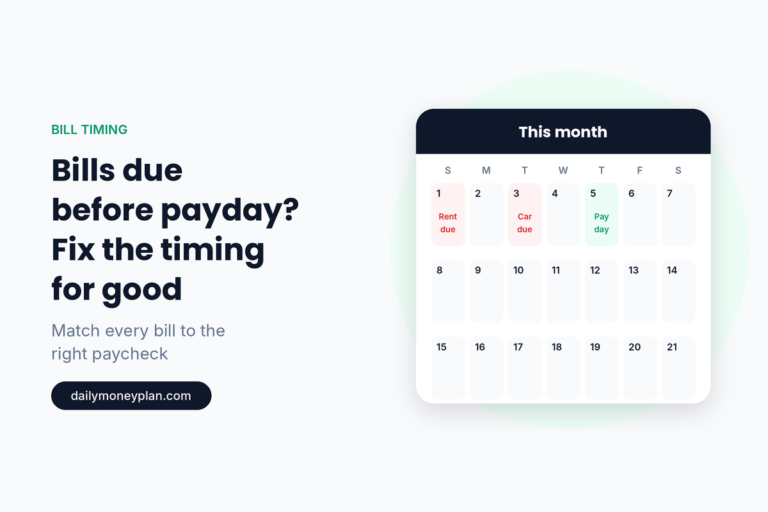
- Ignoring due dates. The due date is what makes this system work. A bill with no date is a bill waiting to surprise you. If one always hits right before you get paid, here’s what to do when bills are due before payday.
- Forgetting irregular costs. The yearly and surprise expenses are what wreck most budgets. Sinking funds are the fix.
- Tracking everything. You don’t need to log every purchase. Give each paycheck a plan, then do a light weekly check. Simple is what keeps it alive.
How to make it actually stick
The real reason budgets die isn’t bad math. It’s friction. If a system takes too much effort, you’ll quit, and that’s a completely human response.
So keep it light. Set it up once, then let each payday be a quick ten-minute routine and each week a five-minute glance. Don’t aim for a perfect budget. Aim for one you’ll still be using in three months. A simple plan you actually follow beats a perfect one you abandon every single time.
If you’ve tried budgeting before and it didn’t take, this is worth another shot, because you’re not fighting your pay schedule anymore. You’re working with it.
Frequently asked questions
How much of my paycheck should go to bills? A common starting point is the 50/30/20 idea: roughly half your take-home for needs like rent and bills, about 30% for wants, and around 20% for savings and extra debt payments. Treat it as a loose guide, not a rule. Your real numbers depend on your rent, your area, and your life.
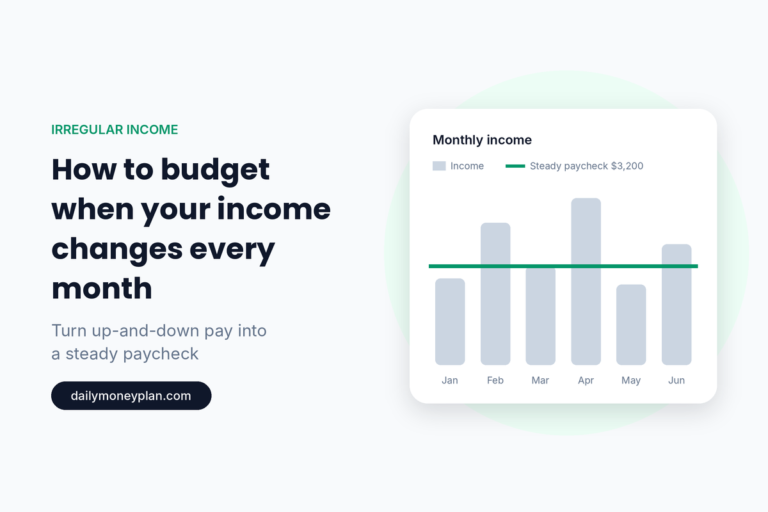
What if my income is different every paycheck? Budget from a low, reliable number, the kind of paycheck you can count on even in a slow month. When a bigger check comes in, treat the extra as a bonus and give it a job (savings, debt, or a sinking fund). If your pay swings a lot, there’s a full walkthrough on how to budget on an irregular income.
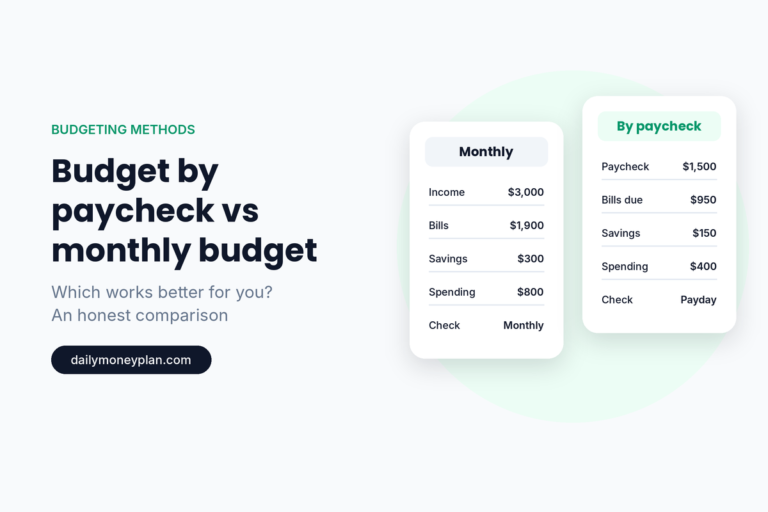
Is budgeting by paycheck better than a monthly budget? If you’re paid weekly or biweekly, usually yes, because it matches how your money actually arrives. If you’re paid once a month, a monthly budget can work fine. It’s about fit, not one being universally “better.” This side-by-side of budget by paycheck vs. a monthly budget can help you decide.
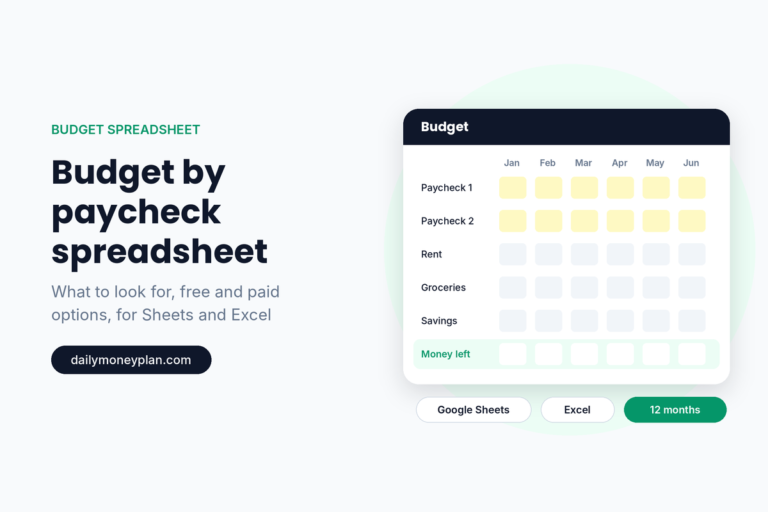
Do I need a special app or spreadsheet? No. You can do this with pen and paper. A simple budget by paycheck spreadsheet just does the math for you and shows your safe-to-spend number automatically, which removes a little more friction.
How long until this feels normal? Give it two or three paydays. The first one takes the most thought because you’re setting everything up. After that, it’s mostly a quick routine.
You’ve got this
Budgeting by paycheck works because it stops fighting your real life. You give each paycheck a job, cover each bill with the check that comes before it, set a little aside for savings and surprises, and always know what’s safe to spend. That’s the whole system.
Start with just your next paycheck. You don’t have to map out the whole year today. Plan the money that’s in front of you, and let the calm of knowing your numbers do the rest.
Know exactly what’s safe to spend this payday
Grab the free Budget by Paycheck Starter. Type in your numbers and it shows your “Money Left to Spend” instantly — no complicated setup.
- See your safe-to-spend number the moment you fill it in
- Built for weekly & biweekly paychecks
- Works in Google Sheets and Excel, on any device
Free forever. No spam. Unsubscribe anytime.
Prefer the whole year handled for you? When you’re ready, the full Budget by Paycheck System rolls every month automatically in one workbook. One-time $27, yours forever.